
City or town
Tax-exempt debt, owns the streets
Needs state authority, new skills
Boise, since 1983 (City of Boise8)

Report | September 2026
A guide for states, cities
and their partners
This report helps a state, a city or a partner make three choices for a thermal energy network (TEN). The choices are who owns it, how it sells service, and how it is paid for. The aim is a project that can get built and financed.
01
Three decisions are linked
02
State law is the gate
03
Split ownership broke the financing
04
Utility pilots stall on cost
05
Cities are getting direct paths
06
One building is not a utility
07
Get the labels right
08
Plan without federal support
How to read the sources: each fact carries a short source name and a number, for example (APPA 20261). The number links to the full source list at the end. Tags mark facts that are UNCONFIRMED or an ESTIMATE. Gaiergy opinion carries a GAIERGY VIEW tag or sits in a green box. All sources were accessed on 2026-09-30. Select any figure to open it at full size.
What this section shows: the three choices every TEN makes, and why they cannot be made one at a time. Applies to any state or city.
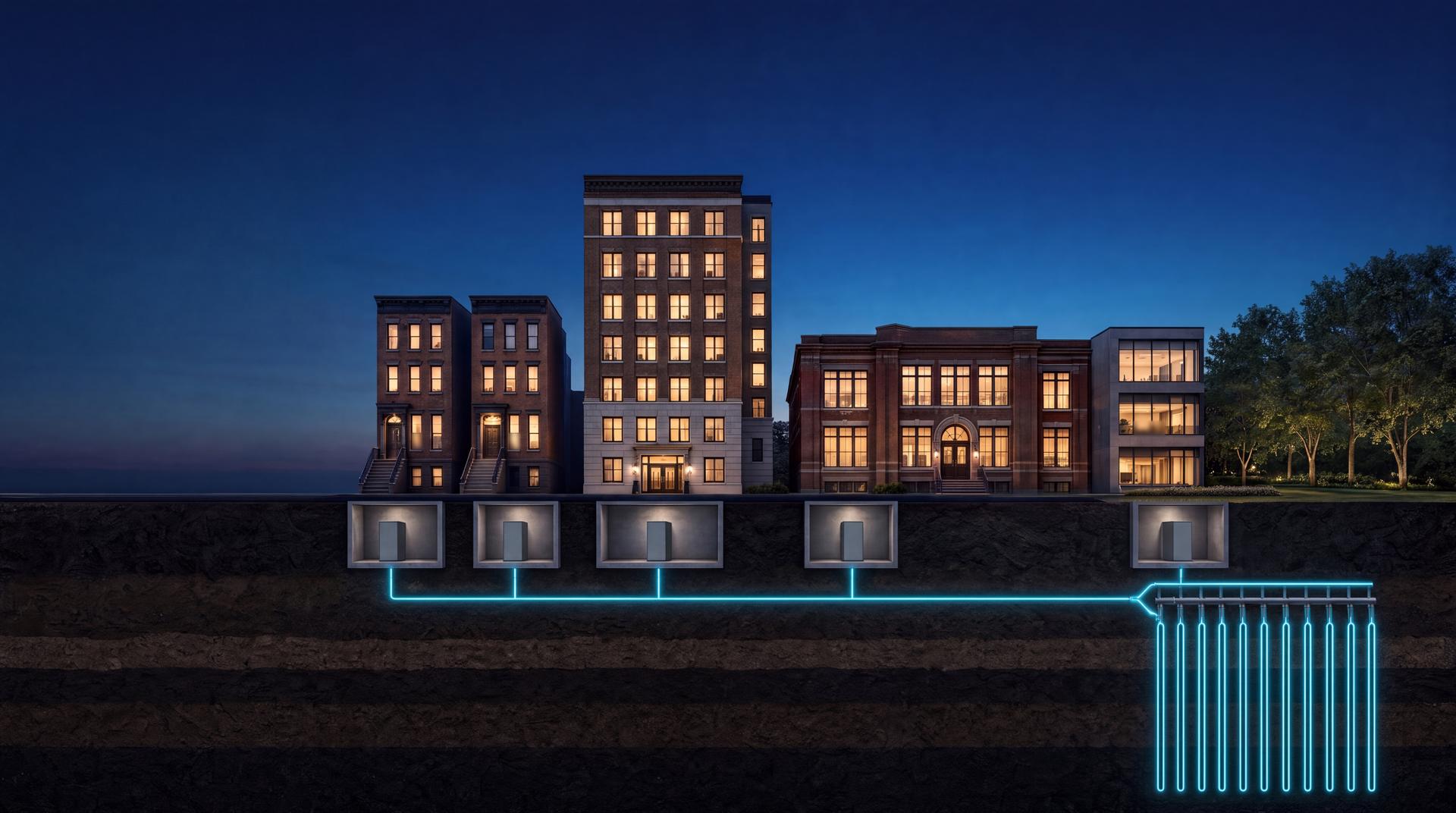
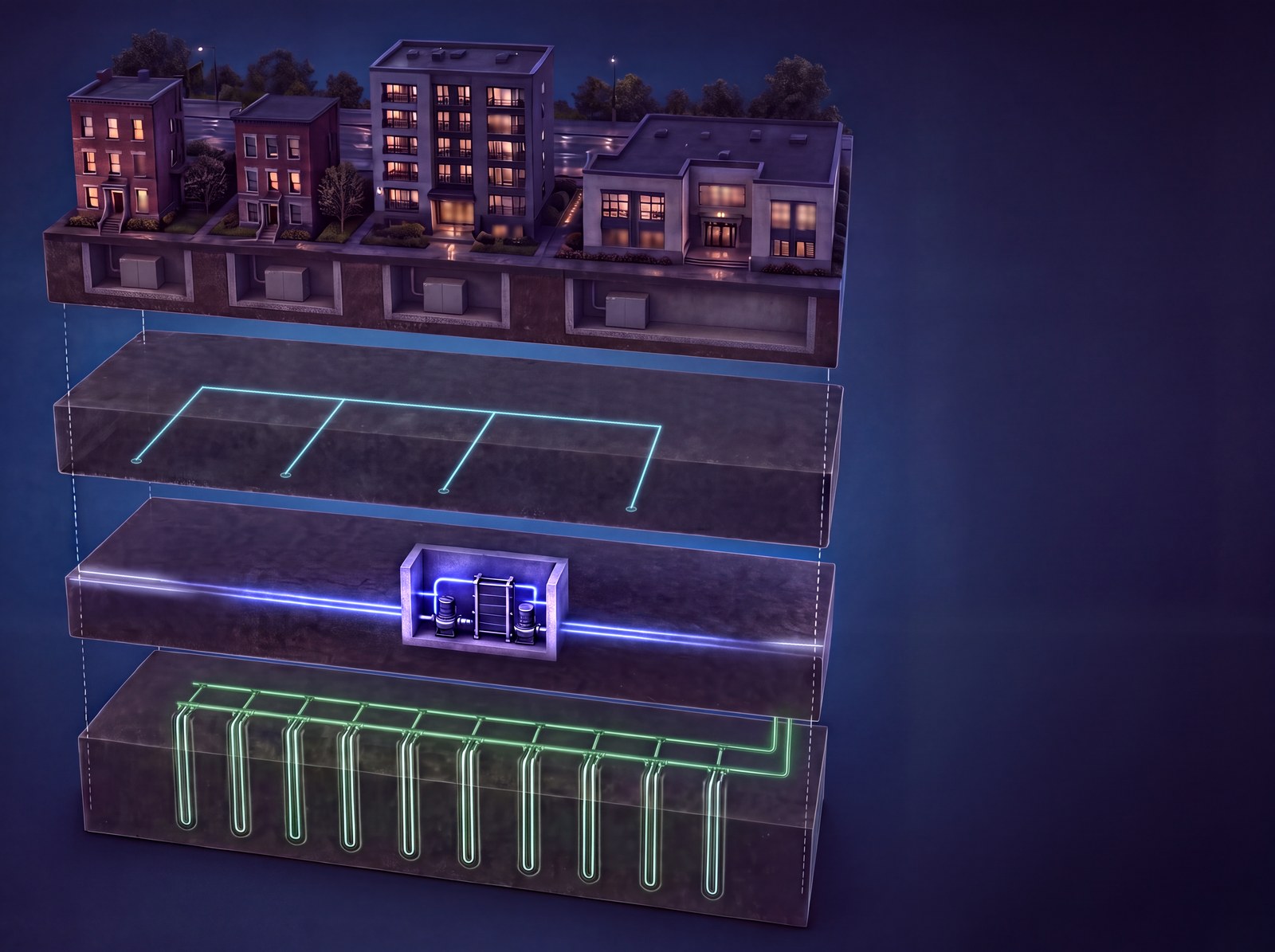
A TEN is a shared loop of water-filled pipe. The loop links wells or another heat source to heat pumps in many buildings. It crosses property lines and runs under public streets. That makes it look like a utility, even when it is small.
Every TEN answers three questions:
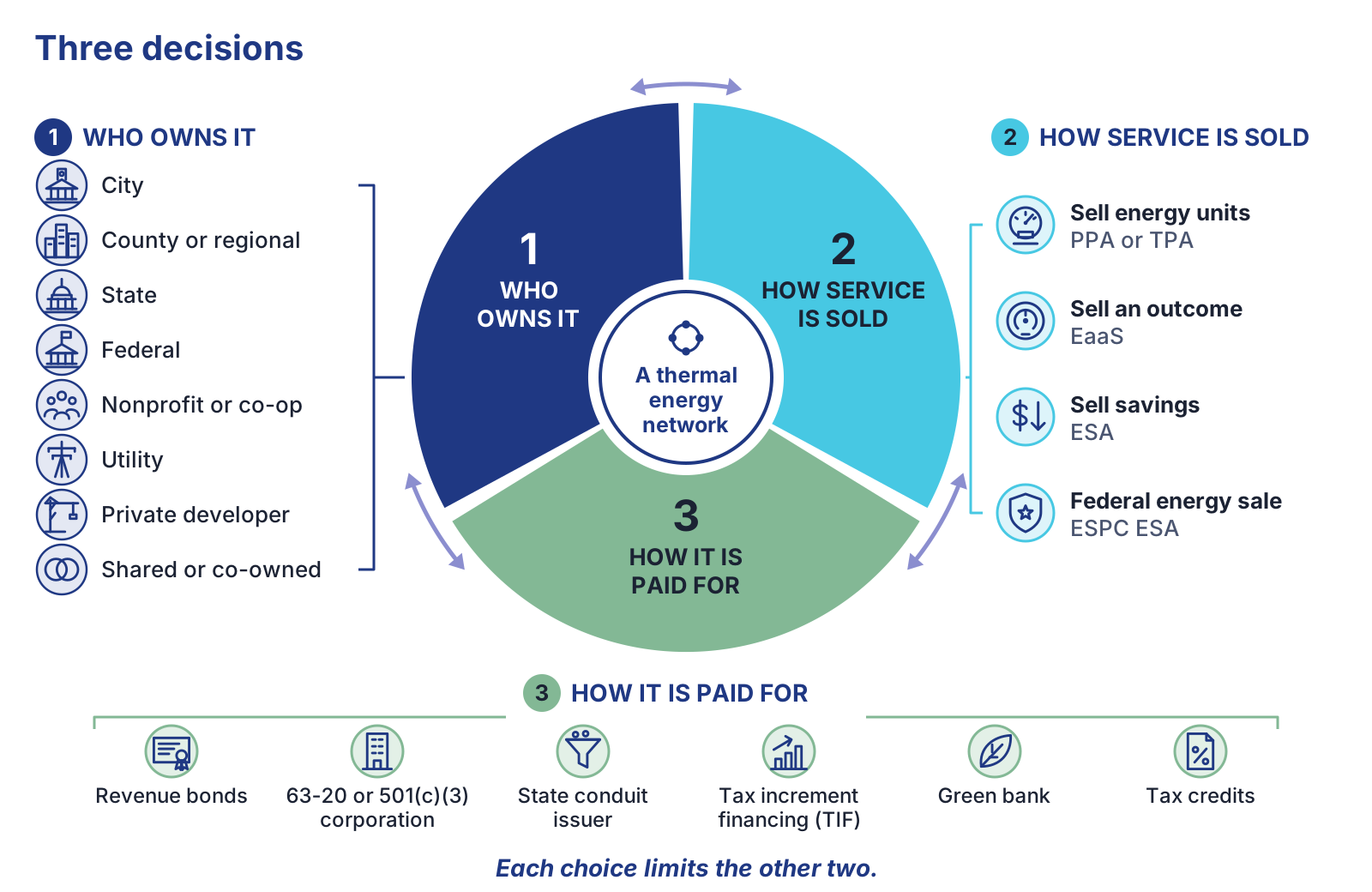
The links are concrete. Some examples:
serving multiple customers across property linesas generally a utility (NY PSC order, Case 22-M-04295). So the owner and the sales contract together decide who regulates the network.
Gaiergy view
Teams often pick an owner first and leave finance to the end. Gaiergy recommends that a team test all three decisions together, early, against the state law that applies. A good owner with no path to finance does not get built.
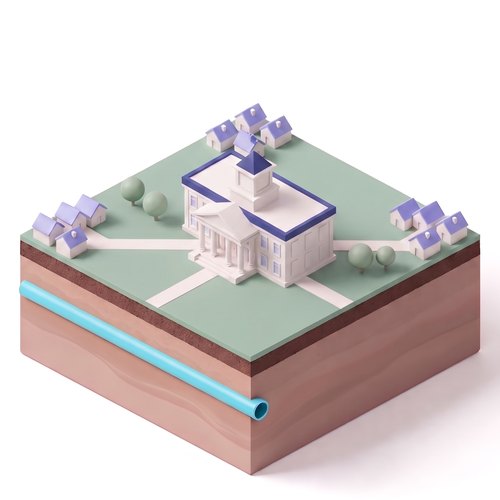
What this section shows: the eight owner types, why each can work, and where each struggles. The strengths and weaknesses are Gaiergy's judgment. The examples are sourced.
Tax-exempt debt, owns the streets
Needs state authority, new skills
Serves across town lines
Few heat precedents, slow governance

Bond power, statewide reach
Far from local customers, political change
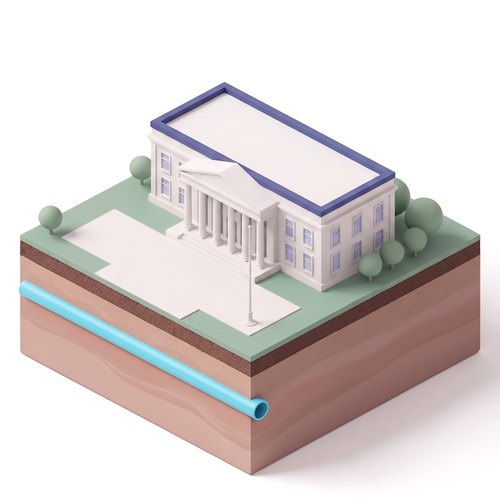
Large anchor load, energy sales contract
Stays inside the fence; DOE pilots: 5 selected, 3 left (Utility Dive 202411; DOE 202612)
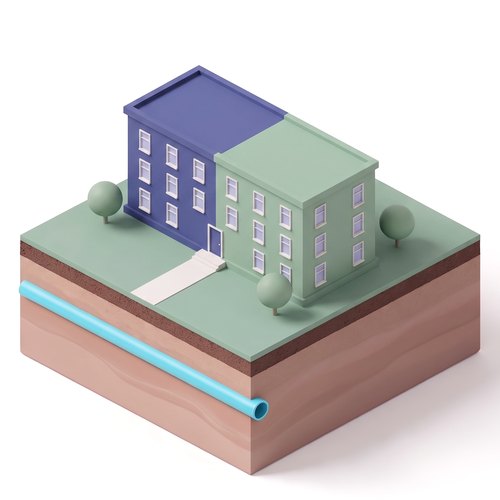
Public land or debt plus private skill
Split title can block financing
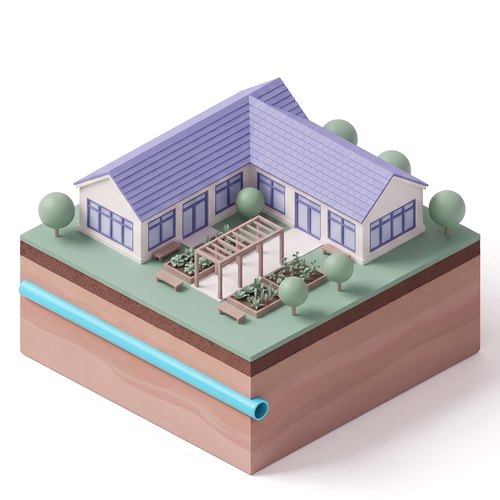
Mission first, no shareholder return
No rate or eminent domain power
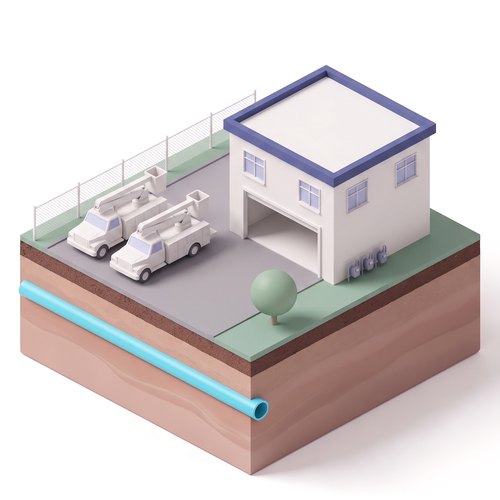
Operating skill, most TEN laws use it
Cost, regulator approval
Speed, bundles with real estate
Costlier capital, may be regulated
Why it can workWhere it struggles. Strengths and struggles: GAIERGY VIEW Examples: sourced.
may own, operate, or manage a TENunder a 2024 law (Washington ESHB 21319).
a corporate municipal instrumentality of the stateunder New York Public Authorities Law (PAL) s.1002 (NY PAL s.100210). Whether NYPA may own TENs is UNCONFIRMED.
water and sewer servicesas like organizations (IRS Publication 55719). GAIERGY VIEW A thermal water network can be organized the same way, like a mutual water company (Section 6).
at least one and as many as fivepilots (NY S9422 text20). Eversource runs a working network in Framingham, Massachusetts: about one mile of main pipe, 90 boreholes, 36 buildings and 135 customer accounts (Eversource15). It launched in 2024 (Canary Media 202521). The struggle is cost: the Maryland PSC did not approve utility pilots in December 2025 and cited cost (Maryland Matters 202622), and National Grid canceled its Lowell pilot in December 2024 because
the cost per customer for this project was unfortunately much too high(WBUR 202523).
an operations fee for continued access to the geothermal system(EcoSmart16). The fee amount is UNCONFIRMED. Vicinity Energy runs district energy systems in 12 US cities (Vicinity Energy24). A private owner that serves many customers across property lines may be regulated as a utility (NY PSC order, Case 22-M-04295).
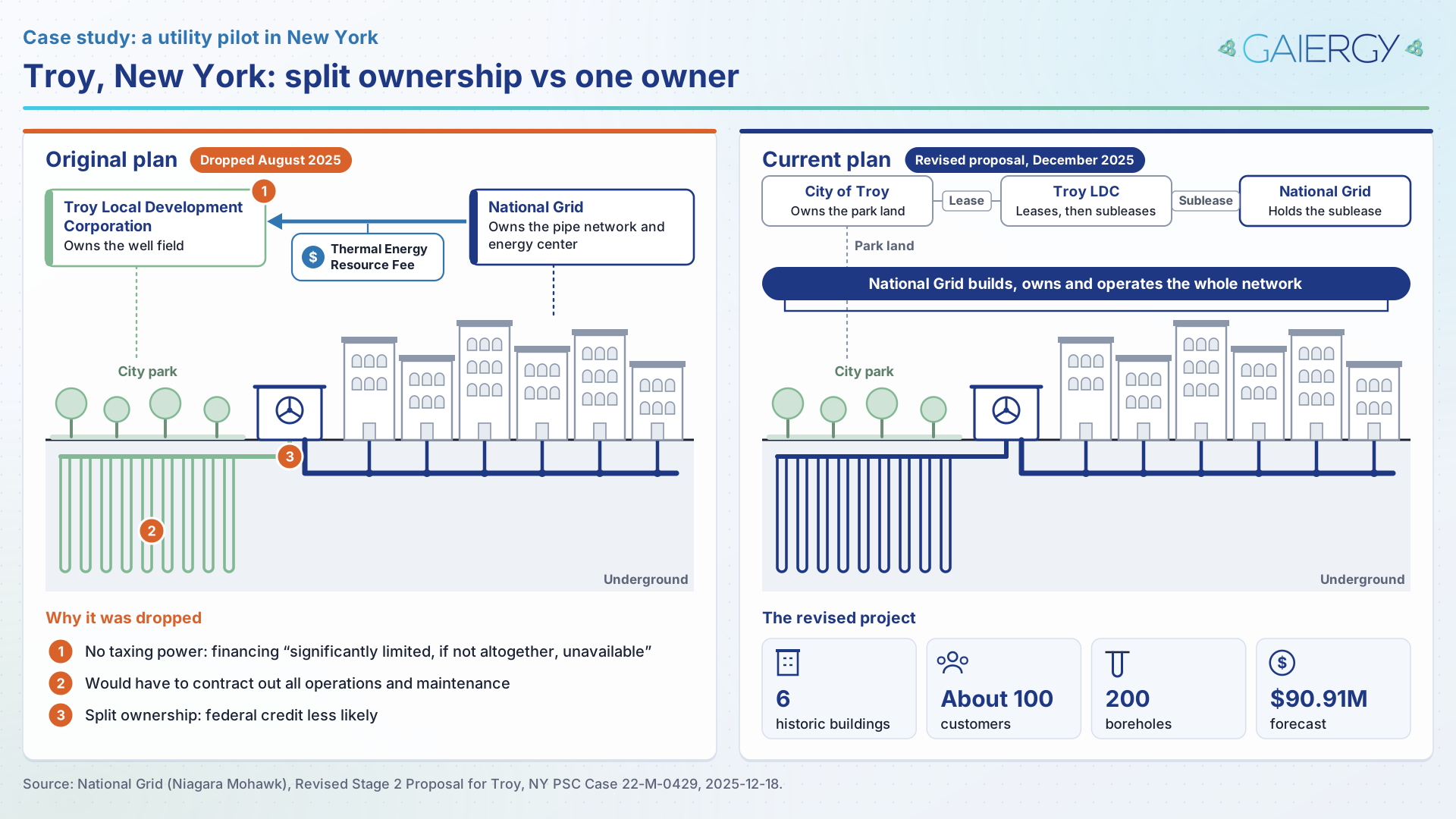
In a shared model, a public body owns one layer (often the wells, Figure 2) and a utility or private firm owns the rest. Troy, New York tested this. The plan put the well field with the Troy Local Development Corporation (LDC), which would charge National Grid a fee. It was dropped in August 2025 (National Grid, Troy Stage 2, 202513). The filing gives these reasons (National Grid, Troy Stage 2, 202513):
significantly limited, if not altogether, unavailable.
contract out all operations and maintenance to a third-party firm.
one important criterionfor the federal credit. Under split ownership, credit eligibility was less likely.
National Grid will now build, own and operate the well field. The LDC leases park land from the City and subleases it. The project serves 6 historic buildings and about 100 customers with 200 boreholes, at a forecast total of $90.91M (National Grid, Troy Stage 2, 202513).
What this section shows: how much power a city has on its own, which states have a TEN law, and what each law allows. Status as of September 2026.
Under Dillon's Rule, a city has only the powers the state gives it in express terms. Under home rule, a city has broad powers unless the state takes them away. A 2003 Brookings survey classed 31 states as Dillon's Rule for all cities, 8 for some local governments, and 10 as not following it; Florida was unclear (Brookings 200325).
The labels are not exact. For example, the survey marks New York "Yes," but notes that the New York Constitution rejects strict construction for powers granted under its Article IX (Brookings 200325).
This matters for a TEN because heat networks are new. In a Dillon's Rule state, a city that wants to own a network will look for a statute that names it. GAIERGY VIEW Most state codes do not.
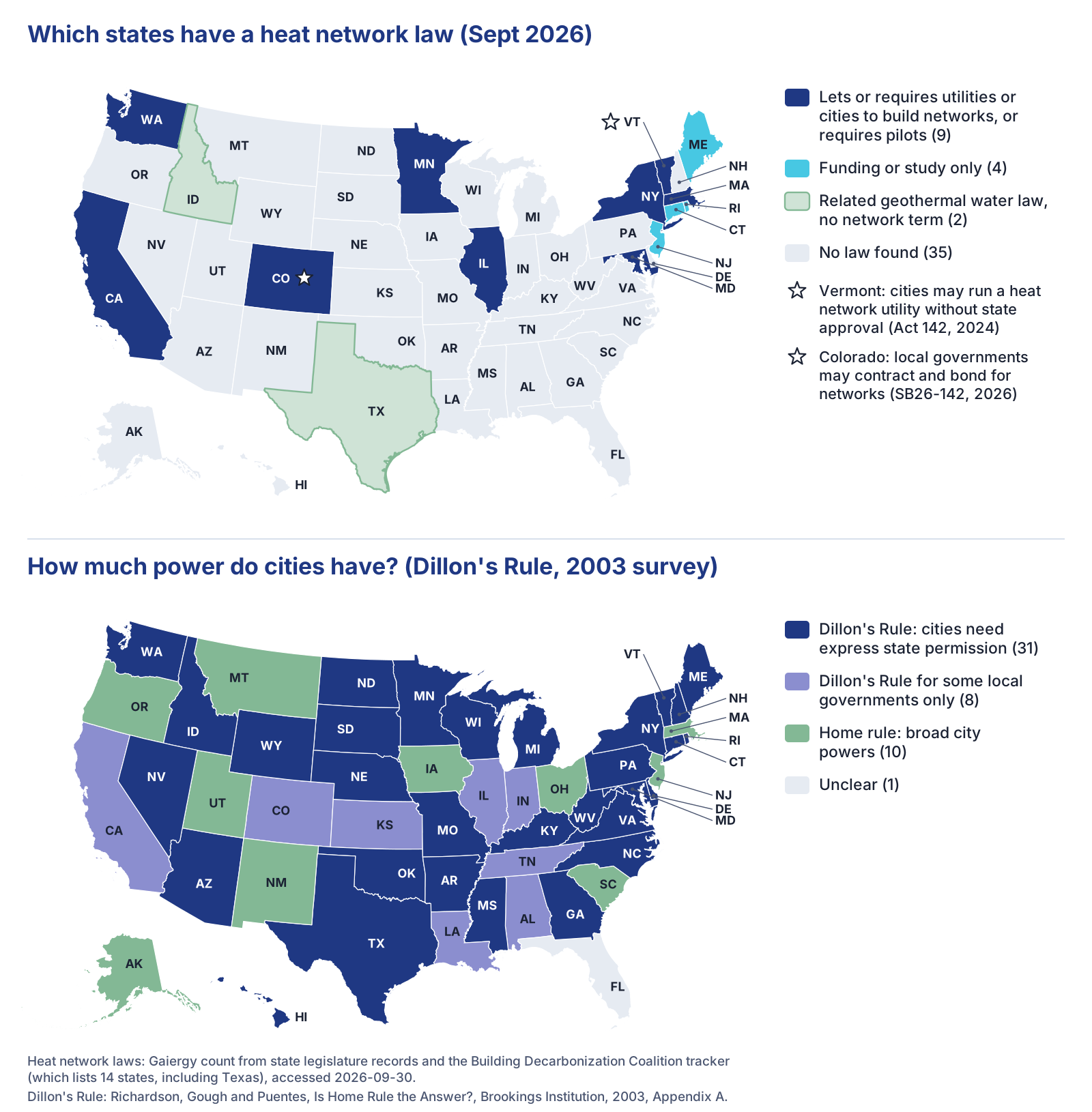
By Gaiergy's count from the Building Decarbonization Coalition tracker, 13 states have enacted laws that deal with TENs in express terms. The tracker lists 14, because it also includes Texas (Building Decarbonization Coalition 202626). GAIERGY VIEW Gaiergy groups them as 9 laws that let or direct utilities or cities to build TENs, and 4 that fund, study or make pilots optional. Texas and Idaho have related geothermal water laws that do not use the TEN term (Building Decarbonization Coalition 202626; Idaho HB 676 (2026)27).

Acts 2021 ch. 8; 2022 ch. 179; 2024 ch. 239 (Mass. Acts 2021 ch. 828; Mass. Acts 2022 ch. 17929; Mass. Acts 2024 ch. 23930)
 Gas companies
City path not found UNCONFIRMED

UTENJA, Laws 2022 ch. 375 (NY UTENJA 202231; NY S9422 text20)

HB22-1381; HB23-1252; HB24-1370; SB26-142 (Colorado HB22-138132; Colorado HB23-125233; Colorado HB24-137034; Colorado SB26-14235)
Utilities Local governments
Minn. Stat. 216B.2427 (Minn. Stat. 216B.242736)
Gas utilities
WARMTH Act, HB 397, 2024 ch. 564 (Maryland ch. 564 (2024)37; Maryland SB 570 fiscal note38)
Electric, gas or water companiesNo city ownership path

Act 142 of 2024 (Vermont Act 14239)
Municipalities
ESHB 2131 (2024); 2SHB 1514, Laws 2025 ch. 263 (Washington ESHB 21319; Washington 2SHB 151440)
Gas and electric companies PUDs
PUDs Thermal energy companies
SB 1221, 2024 ch. 602 (California SB 122141)
Gas corporations
SB 25, P.A. 104-0458 (2026) (Illinois P.A. 104-045842)
Utilities
H 7879 Sub A / S 3080 (2026) (Rhode Island H 7879 Sub A43; Building Decarbonization Coalition 202626)
Utilities, if they proposeEnactment: UNCONFIRMED in a primary source (FastDemocracy, RI HB 787944)

P.A. 25-173 s.32 (Connecticut P.A. 25-17345; Building Decarbonization Coalition 202626)
within available appropriations

P.L.2023 c.328 (New Jersey P.L.2023 c.32846)

LD 1619 (2025) (Building Decarbonization Coalition 202626)
City path: a local government may own or contract directlyUtilityCity or townRegional authorityPrivate companyGrouping: GAIERGY VIEW
The New York PSC adopted initial TEN rules on 2024-07-18. It declines to categorically exempt municipal-owned TENs from regulation at this time,
although New York City asked for an exemption (NY PSC order, Case 22-M-04295). So a city-owned network in New York that serves several customers may still face PSC review. GAIERGY VIEW A Gaiergy search of the docket found no Stage 3 construction order as of 2026-09-30.
Vermont Act 142 lets a municipality construct, operate, set rates for, finance, and use eminent domain for
a TEN utility with no certificate of public good or Public Utility Commission approval (Vermont Act 14239). Colorado SB26-142 lets local governments contract for TEN service and bond-finance TEN infrastructure. Its signed act is dated 2026-06-02 (Colorado SB26-14235).
Idaho city law counts a public water system providing water at any temperature for space heating or cooling
as a water system. It appears in the water system definition (s.50-323, amended 1979) and in the city bond statutes (s.50-1020 and s.50-1029) (Idaho Code 50-32347; Idaho Code 50-102048; Idaho Code 50-102949). Boise's system started with 15 buildings in 1983. Today it heats about 90 buildings and over 6 million square feet with 177 F water (City of Boise8).
A 2026 Idaho law (HB 676) is a statewide water-rights change. It makes low-temperature municipal geothermal heating a "municipal purpose" if the water is reinjected. It does not name Boise (Idaho HB 676 (2026)27).
Lesson. Boise worked because the state named the use in the city's utility and bond law. GAIERGY VIEW Gaiergy recommends that a city in a Dillon's Rule state look for that kind of express grant before it plans to own a network.
What this section shows: what older public and private utilities teach about TEN ownership. Facts are sourced; the lessons are Gaiergy's view.
The United States has 1,998 public power utilities that serve over 55 million people (APPA 20261). NRECA has 890 member utilities that serve about 42 million people (NRECA 202618). Public and member ownership of a utility is normal. GAIERGY VIEW The open question for heat is not "can a public body own a utility" but "does this public body have the authority, the skills and the customers."
After 10 years of effort to form a city electric utility, Boulder, Colorado voters approved ballot measure 2C in November 2020 and returned to an Xcel franchise (Boulder Beat 202050; City of Boulder51). In Maine, Question 3 on 2023-11-07 proposed a new consumer-owned Pine Tree Power Company (Maine Office of the Public Advocate52). It got about 30.3% yes and 69.7% no (122,961 to 283,401) (Maine Secretary of State53).
GAIERGY VIEW Both efforts tried to take over a system that already existed. A TEN is usually new. Public ownership is easier to set up at the start than to buy later.
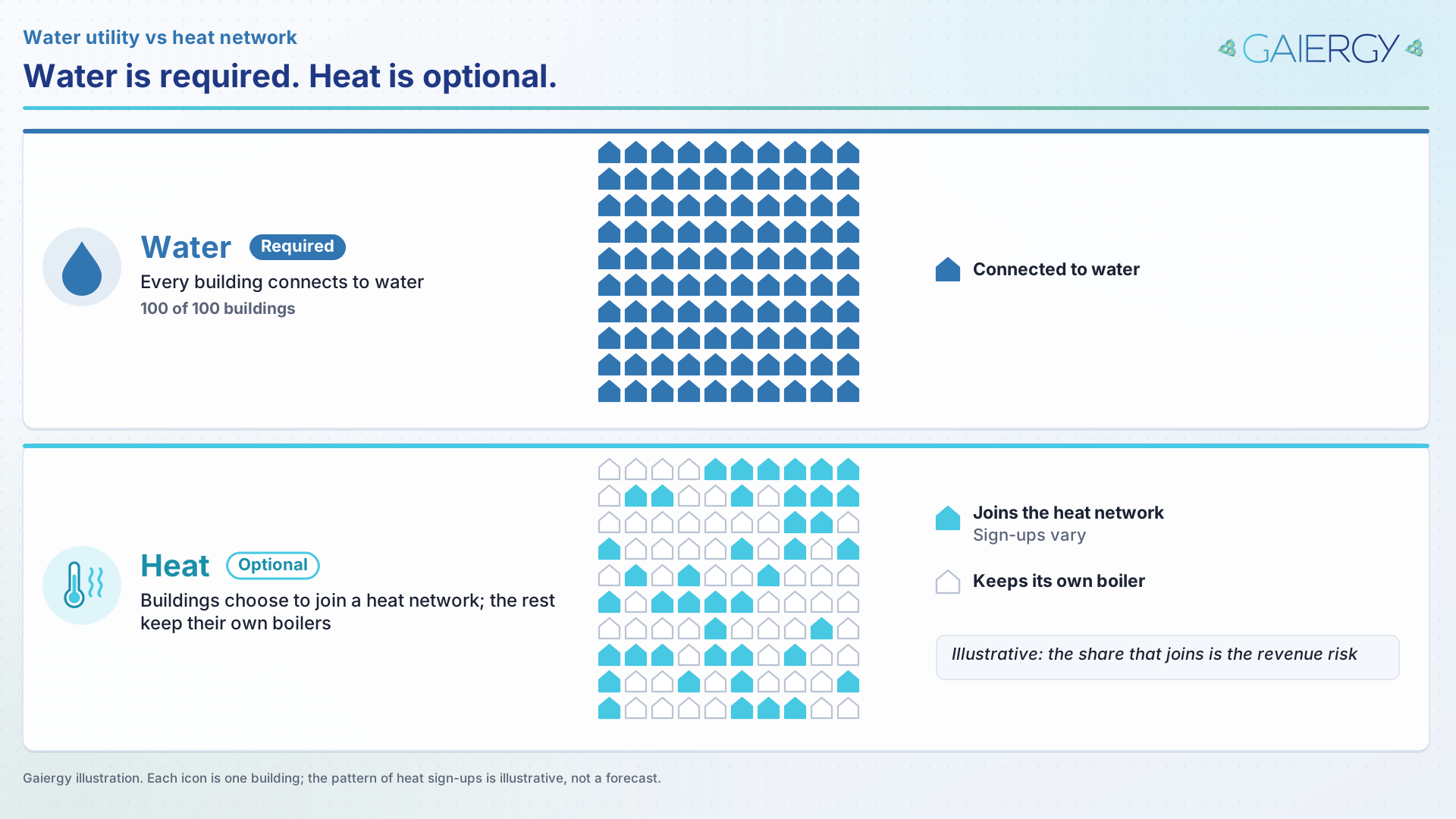
GAIERGY VIEW A city water system has a secure revenue base. Every building needs water, and codes make buildings connect. Heat is different. A building owner can keep a boiler, a furnace or a rooftop unit. So a TEN wins its customers one at a time. That risk shows up in bond ratings, reserves and interest rates.
GAIERGY VIEW Under an old downtown street there are water, sewer, gas, electric, telecom and sometimes steam lines. A new pipe threads a path through them. On a new site, the network goes in with the other utilities, in one trench, before the road is paved. Cost and risk are lower.

formerly known as Enwave Energy US,was acquired by QIC and Ullico in 2021 (IDEA 202156).
GAIERGY VIEW Most large US district energy systems in this list are private. District energy shows that public and private owners can both run shared heat for a long time. An existing district energy owner is also a natural partner, or competitor, for a new TEN in the same downtown.
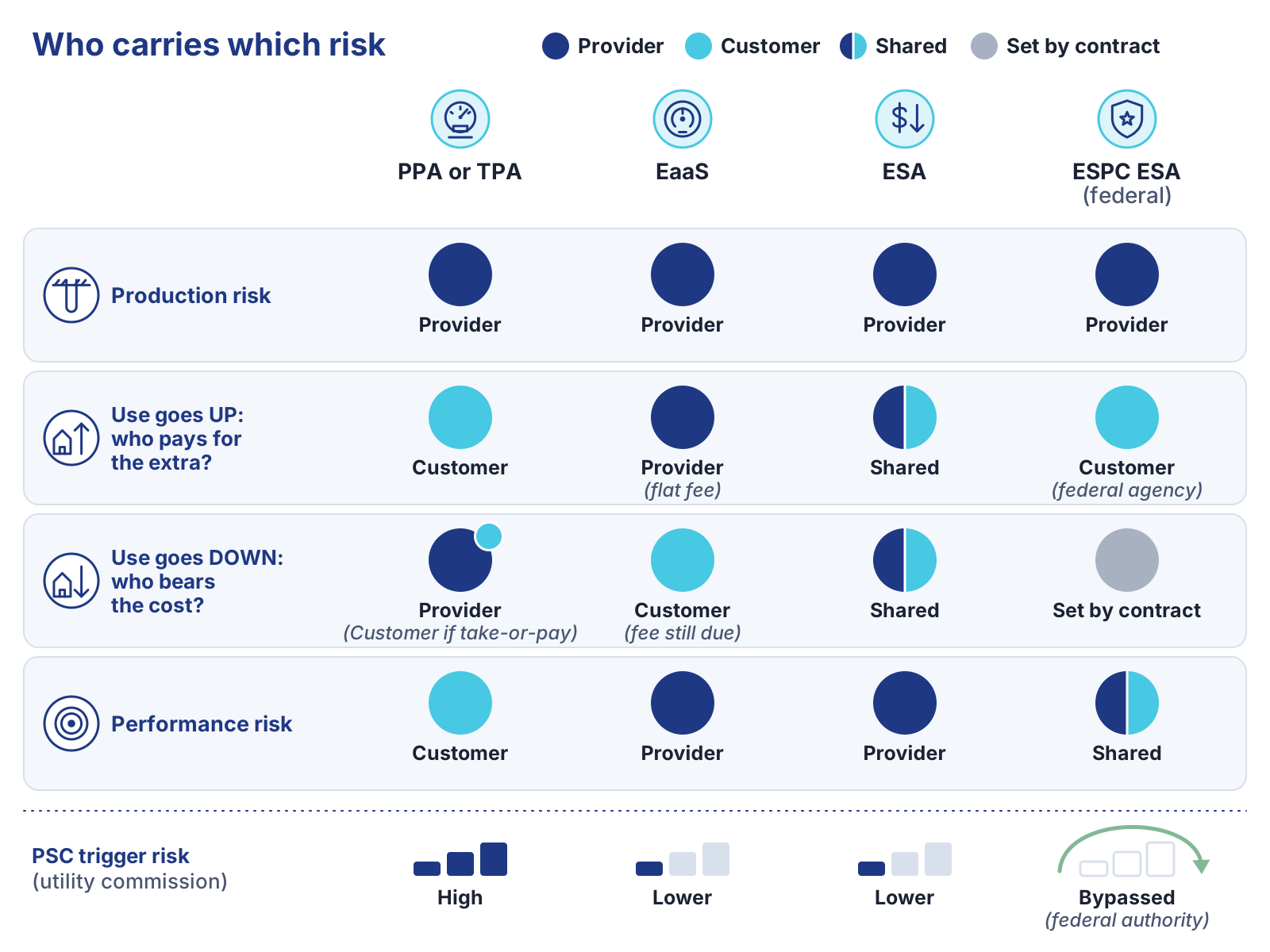
What this section shows: four contract types for selling heat, who carries each risk, how each can affect a customer's balance sheet, and which is more likely to bring in a utility regulator.
The first three definitions below are Gaiergy working definitions of common market terms. The federal definition is from FEMP.
Each such contract may, notwithstanding any other provision of law, be for a period not to exceed 25 years.(42 USC 828757) FEMP describes the energy sales agreement form for on-site electricity: the energy service company (ESCO) owns the system and the agency buys the electricity it produces (DOE FEMP17). GAIERGY VIEW The same structure could be used for heat.
The key difference is what happens when heat use changes. GAIERGY VIEW
Private companies follow the lease rule ASC 842. Under it, a contract holds a lease if the customer controls the use of an identified asset. Control means the customer gets substantially all the economic benefits and also has the right to direct how the asset is used. Buying all the output is not enough on its own. A PPA can become a lease when the buyer holds dispatch rights (Deloitte Roadmap: Leasing58).
Cities, public hospitals and public universities follow GASB Statement 87 instead. It defines a lease as a contract that conveys control of the right to use another entity's nonfinancial asset
(GASB 87 summary59).
GAIERGY VIEW In plain terms: a customer that only buys heat usually keeps the contract off its balance sheet. A customer that also decides how and when the equipment runs may book a lease.
The New York PSC says an entity that owns and operates a TEN serving multiple customers across property lines would generally be considered a utility
(NY PSC order, Case 22-M-04295). The test looks at what the network does, not what the contract is called.
Gaiergy view
A per-unit sale of heat to many customers looks most like a utility. A flat-fee service contract may look less like one. But a regulator can look past the name to the economic substance. Gaiergy recommends that a developer ask the state regulator early, in writing, how it will treat the chosen structure.
GAIERGY VIEW One network can use several contracts at once, one at each handoff between the layers in Figure 2 (Section 1). For example: the well field owner sells heat to the pipe network owner under a TPA. The network owner then serves buildings under a tariff, a flat fee or a per-unit price. The contract at each handoff sets who carries the risk there.
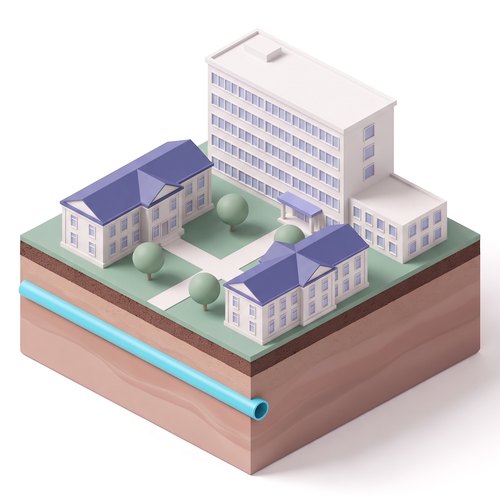
Steady load, strong credit: revenue certainty for lenders
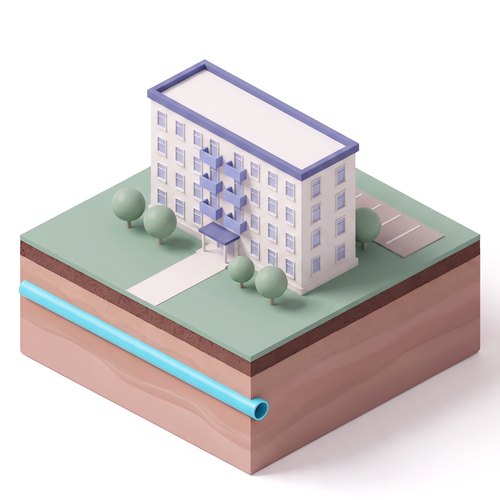
Predictable bill, no technical role
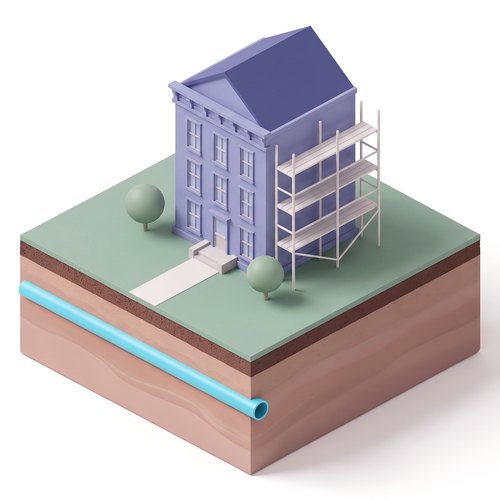
Pays on measured savings: low adoption risk
Federal contract authority; up to 25 years under 42 U.S.C. § 8287 (42 USC 828757)
Utility sets rates through the regulator (NY UTENJA 202231)
Fit and reason: GAIERGY VIEW except where a source is shown.
What this section shows: the main ways to finance a TEN, the choice between a general obligation (GO) bond and a revenue bond, what a climate (green) bond label adds, what each financing tool is in law, how a 63-20 corporation differs from a 501(c)(3) corporation, how a tax-exempt P3 fits the pieces together, and how federal tax credits work after the 2025 tax law. Rates are July 2026 estimates.
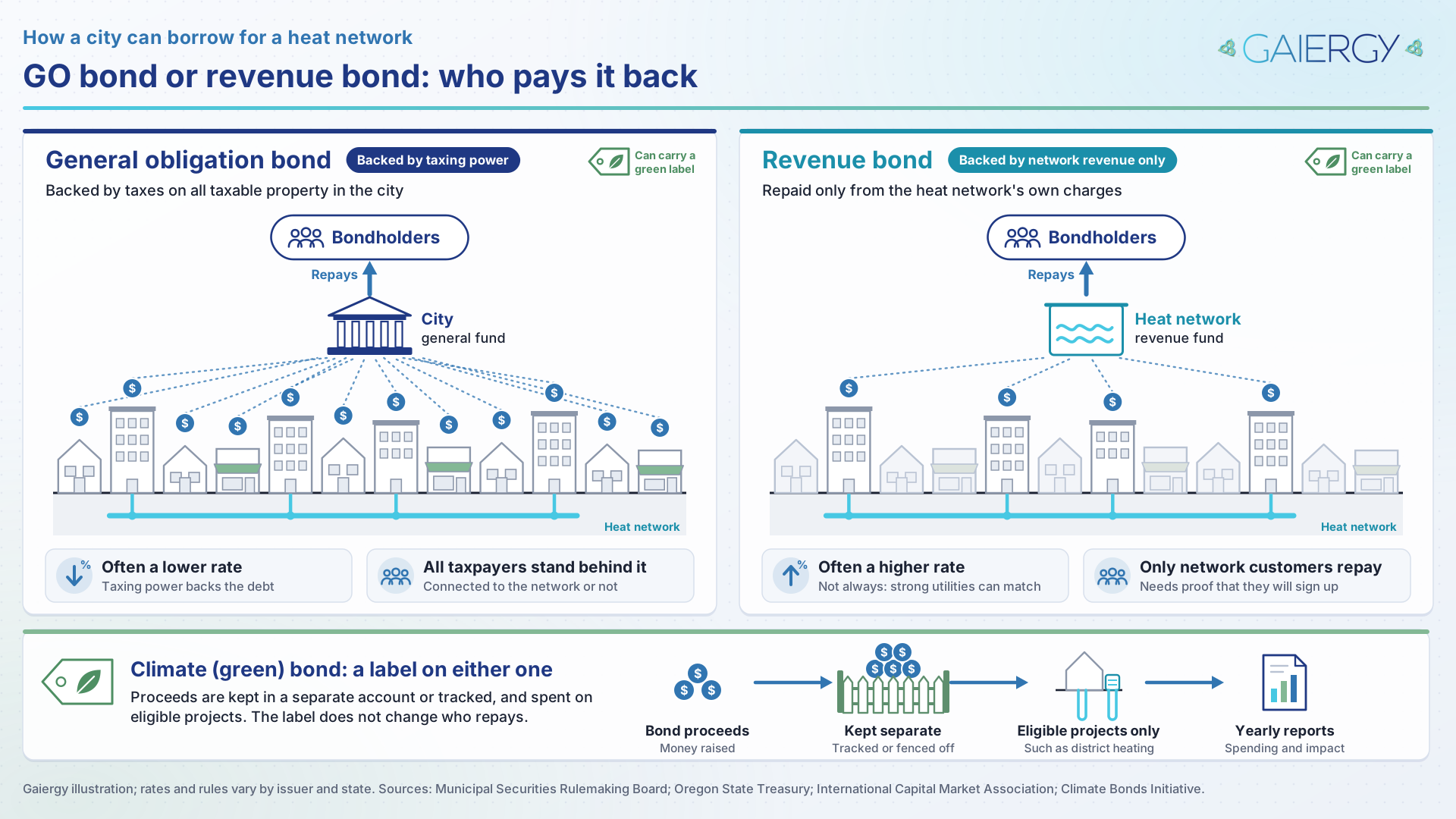
A city that borrows for a TEN has two main choices: a general obligation (GO) bond or a revenue bond (SEC Investor.gov60). A GO bond is backed by the issuer's full faith, credit and taxing power
. A revenue bond is payable from a specific source of revenue
, and the issuer does not pledge its taxing power (MSRB, Sources of Repayment61). In plain terms: every taxpayer in the city stands behind a GO bond. Only the network's customers repay a revenue bond (Figure 9).
Typical rate (Oregon Treasury, Types of Debt62) GAIERGY VIEW
Vote and debt limit (MSRB, Sources of Repayment61; Oregon Treasury, Types of Debt62; M.G.L. c.44 s.1065)
Fit for a TEN GAIERGY VIEW
A GO bond spreads the risk across every taxpayer in the city, including owners whose buildings never connect (MSRB, Sources of Repayment61; SEC Investor.gov60). A city can still repay a GO bond from network charges first, with taxes as the backstop, as Oregon's Self-supporting GO bonds
do (Oregon Treasury, Types of Debt62). A revenue bond puts repayment on the people who use the network, a user pays
approach (Oregon Treasury, Types of Debt62). If the pledged revenue becomes inadequate, a default in payment of principal or interest may occur
(MSRB, Sources of Repayment61). Revenue bonds often carry extra terms, such as higher coverage requirements and a debt service reserve fund (Oregon Treasury, Types of Debt62). So buyers want proof that customers will connect and pay (Section 4).
GAIERGY VIEW A GO bond often borrows at a lower rate. Oregon's guide says a revenue bond's limited security may mean a higher rate, but not always
. Essential utilities such as water and sewer can borrow at comparable cost (Oregon Treasury, Types of Debt62).
A GO bond may need voter approval, and in Oregon local GO bonds always do (MSRB, Sources of Repayment61; Oregon Treasury, Types of Debt62). It can also count toward a legal debt limit. In Massachusetts, for example, a city or town may not authorize debt above 5 percent of its equalized valuation, except as the law provides. With approval of the municipal finance oversight board, the limit is 10 percent (M.G.L. c.44 s.1065).
Some bonds use both pledges. A double-barreled
bond is secured by a revenue source and by the full faith and credit of an issuer with taxing power (MSRB, Sources of Repayment61). GAIERGY VIEW A city could also split one project. GO bonds could pay for a public well field that serves the whole district, and revenue bonds for the pipes and connections that only customers use. Gaiergy has not found a TEN that has used this split, so it is an option to test with bond counsel. A GO bond fits best when the city sees the network as shared public infrastructure; a revenue bond fits best when signed customers are already in hand.
A climate or green bond is a label, not a separate type of security. Under the International Capital Market Association (ICMA) Green Bond Principles, a green bond's proceeds or an equivalent amount will be exclusively applied
to eligible green projects. These principles are voluntary guidelines (ICMA Green Bond Principles 202163). The list of eligible categories includes energy efficiency, such as in new and refurbished buildings, energy storage, district heating
(ICMA Green Bond Principles 202163). ICMA lists a green bond with full recourse-to-the-issuer
and a Green Revenue Bond
whose credit exposure is to the pledged cash flows
(ICMA Green Bond Principles 202163). So a green GO bond is still a GO bond, and a green revenue bond is still a revenue bond.
How the proceeds are kept separate. The Green Bond Principles have four core components: use of proceeds, project evaluation and selection, management of proceeds, and reporting (ICMA Green Bond Principles 202163). Net proceeds should be credited to a sub-account, moved to a sub-portfolio or otherwise tracked by the issuer
. The issuer should report each year, until all proceeds are spent, on the projects funded, the amounts allocated and their expected impact (ICMA Green Bond Principles 202163).
The Climate Bonds Standard makes this a certification rule: proceeds must be credited to a sub-account, moved to a sub-portfolio, or otherwise identified
. At least 95 percent of net proceeds go to projects that meet its sector criteria. The issuer either earmarks the money or ring-fences it in designated bank accounts that can only fund the specified nominated projects and assets
. Money not yet spent sits in cash or other permitted temporary holdings (Climate Bonds Standard v4.264).
Two public examples. The Massachusetts State Treasurer wrote that in 2013 the state became the first municipal issuer of green bonds in the nation
. Its green bonds are General Obligations of the Commonwealth
and are not priced at a premium over its other GO bonds. All green bond proceeds are held in a segregated account and accounted for separately
. For its third green issue, a taxable sale that closed July 7, 2016, the state reported 7 investors that purchased specifically due to the Green label
(MA Treasury green bond report 201666).
DC Water, a water and sewer utility, sold its first green bonds in 2014. It said the cost would be supported by future ratepayers who will also benefit
(DC Water, 2014-07-1067). GAIERGY VIEW For a TEN, a green label can widen the pool of bond buyers. It adds tracking and reporting work. It does not change who repays.
A city can issue revenue bonds that are repaid from the network's own charges. Idaho's bond statutes cover a water system for space heating, which is the basis for Boise (Idaho Code 50-102048; Idaho Code 50-102949). The benefit is interest cost. In July 2026, 30-year high-grade municipal bonds yielded about 4.27% and Moody's Aaa corporate bonds about 5.76%, so tax-exempt debt cost about 150 basis points less ESTIMATE (Midwest Trust 202668; FRED Aaa69). The risk: bond buyers want proof that customers will connect and pay (Section 4).
Private activity bond test. Under 26 USC 141, a bond is a private activity bond if it meets both the private business use test and the private security or payment test (26 USC 14170). GAIERGY VIEW A network that serves private buildings can meet those tests. The usual route is then an exempt facility bond for local district heating or cooling facilities
under 26 USC 142(a)(9). The statute defines such a system as a pipeline or network providing hot water, chilled water or steam to 2 or more users (26 USC 14271). Whether an ambient-temperature loop fits that definition is UNCONFIRMED, and a question for bond counsel.
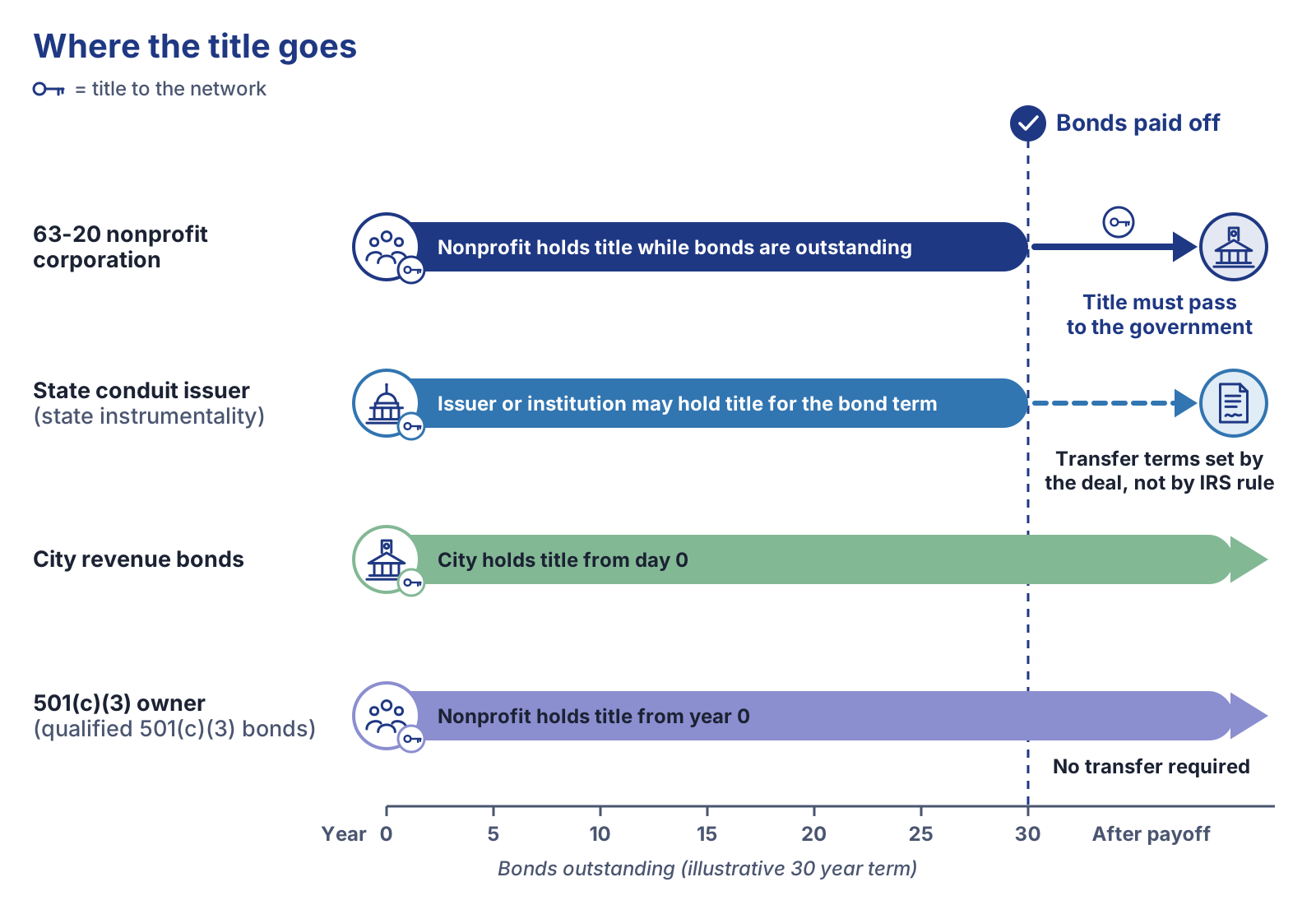
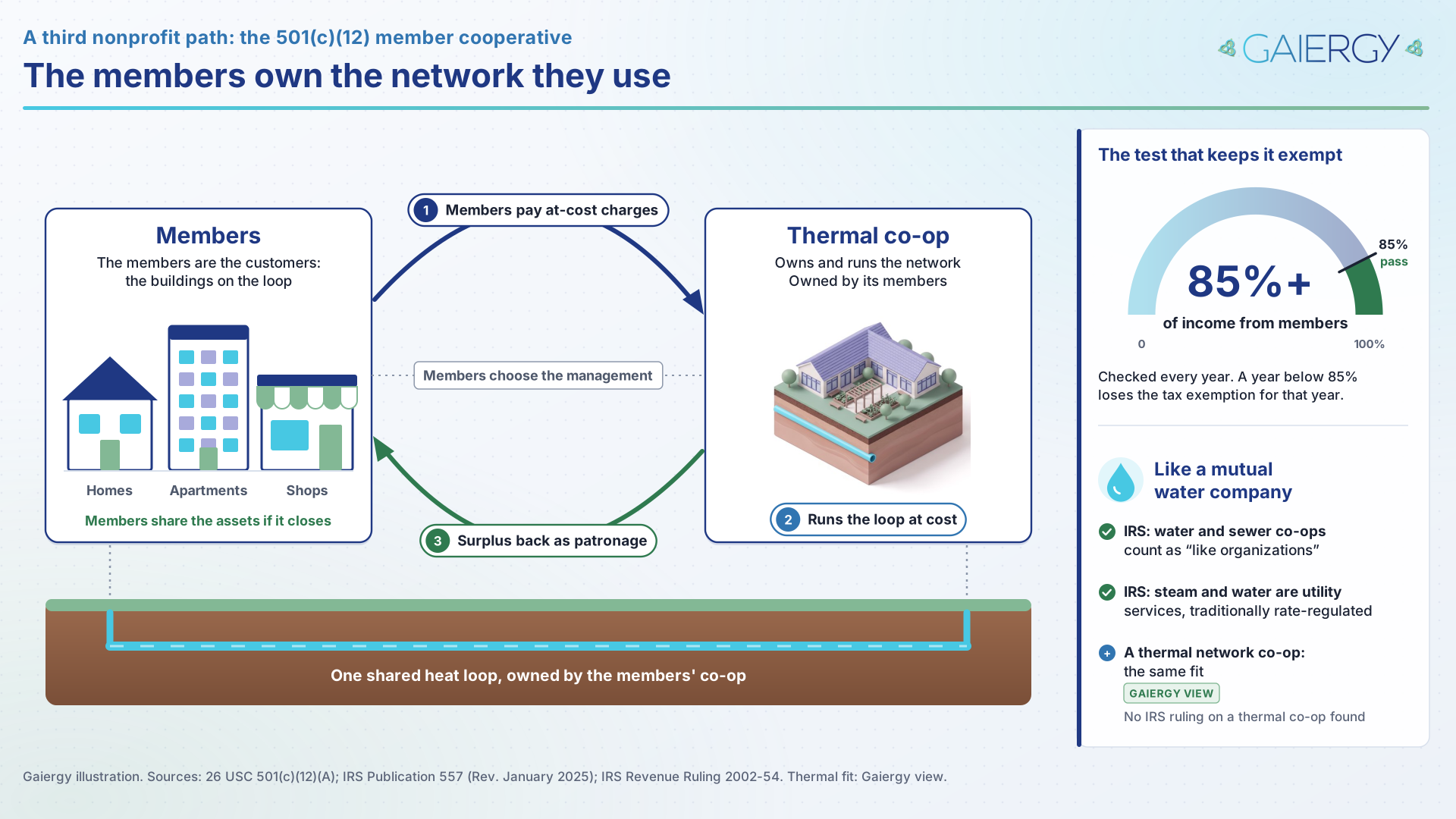
Two kinds of nonprofit corporation can sit at the center of a tax-exempt deal. The names sound alike, but the tax code treats them very differently. The key difference for a TEN: under 63-20, the government ends up owning the network. Under 501(c)(3), the nonprofit can keep owning it (Rev. Rul. 63-20; Rev. Proc. 82-266; 26 USC 1457).
What a 63-20 corporation is. It is a corporation organized under a state's general nonprofit corporation law that issues bonds on behalf of
a government (Rev. Rul. 63-20; Rev. Proc. 82-266). If it meets the five conditions of Revenue Ruling 63-20, its bonds are treated as the government's own bonds. The government approves the corporation and each bond issue, holds a beneficial interest while the debt is outstanding, and gets full legal title when the debt is retired (Rev. Rul. 63-20; Rev. Proc. 82-266).
What a 501(c)(3) corporation is. It is a charity: a corporation organized and operated exclusively for religious, charitable, scientific, testing for public safety, literary, or educational purposes
(among other listed purposes), whose net earnings do not benefit any private person. It is exempt from federal income tax (26 USC 50172). It cannot issue tax-exempt bonds in its own name, because the exclusion covers an obligation of a State or political subdivision thereof
(26 USC 10373). Instead, a government issuer sells "qualified 501(c)(3) bonds" for the charity's project. GAIERGY VIEW In practice this is often a conduit issuer that lends the proceeds to the charity. The financed property is to be owned by a 501(c)(3) organization or a governmental unit
(26 USC 1457), so the charity keeps the asset.
What the IRS requires of a 63-20 corporation. Revenue Ruling 63-20 holds that the bonds of a nonprofit corporation will be considered issued on behalf of a governmental unit if
five conditions are met (Rev. Rul. 63-20; Rev. Proc. 82-266):
the corporation engages in activities that are essentially public in nature;
the corporation is not organized for profit, except to the extent of retiring indebtedness;
the corporate income does not inure to any private person;
the governmental unit has a beneficial interest in the corporation while the indebtedness is outstanding, and it obtains full legal title to the property of the corporation with respect to which the indebtedness was incurred upon retirement of the indebtedness; and
the corporation and the specific obligations to be issued by the corporation have been approved by the governmental unit on whose behalf the obligations are issued.
Revenue Procedure 82-26, section 3, sets the operating rules the IRS applies before it will rule that the five conditions are met (Rev. Rul. 63-20; Rev. Proc. 82-266):
permitted under the general nonprofit corporation law of the state. The financed property is
located within the geographical boundaries of or has a substantial connection withthe government.
not organized for profit.
the corporate income will not inure to any private person, and in fact, the corporate income does not inure to any private person.
exclusive beneficial possession and useof property worth 95 percent or more of its fair rental value; (b) the corporation has that use, and the government
appoints or approves the appointment of at least 80 percent of the members of the governing boardand can remove members for cause; or (c) the government
has the right at any time to obtain unencumbered fee title and exclusive possessionof the property by paying off (defeasing) the bonds. Unless the government uses the property under (a), it also gets
an exclusive option to purchase the propertyfor the debt owed if the corporation defaults.
no more than one governmental unit, and
unencumbered fee title to the property will vest solely in that governmental unit when the obligations are discharged.All proceeds go to
tangible real or tangible personal property, not working capital. At payoff the government gets title and possession
without demand or further action on its part, and
all leases, management contracts, and other similar encumbrances must terminate. Before the bonds are issued, the government adopts a resolution that
it will accept title. Later refunding or improvement bonds end by the original final maturity date. Insurance money rebuilds the property or goes to the government. At final maturity the property keeps at least
20 percent of the original costin value and a remaining useful life of
the longer of one year or 20 percentof its original life. (The refunding-date rule and the value and life rule do not apply where the government uses the property under s.3.04(a).)
within one year prior to the issuance of the obligations, the governmental unit adopts a resolution approving the purposes and activities of the corporation and the specific obligations to be issued by the corporation.One resolution can cover a series of bonds for one project issued over up to five years.
Section 4 adds rules for refunding bonds (Rev. Rul. 63-20; Rev. Proc. 82-266). Revenue Procedure 82-26 describes when the IRS will ordinarily issue an advance ruling
, and it says its operating rules are not to be used as tests for determining the taxability of bond interest
(Rev. Rul. 63-20; Rev. Proc. 82-266). Revenue Procedure 2026-1 still points ruling requests for "on behalf of" issuers to Revenue Procedure 82-26 (IRS Rev. Proc. 2026-174). GAIERGY VIEW A deal that misses any of the five conditions cannot rely on Revenue Ruling 63-20 to treat its bonds as the government's. It would need another legal basis, which is a question for bond counsel.
How a 63-20 corporation can be used for a TEN.
more than 10 percent of the proceedsgo to private business use and the payment or security test is also met (26 USC 14170). GAIERGY VIEW So an operator contract has limits, and its terms are a question for bond counsel.
Side by side.
Scroll sideways to see the full table.
| Question | 63-20 corporation | 501(c)(3) corporation | 501(c)(12) cooperative (next subsection) |
|---|---|---|---|
| Legal source of status | Revenue Ruling 63-20 and Revenue Procedure 82-26. Organized under the state's general nonprofit corporation law (s.3.02) (Rev. Rul. 63-20; Rev. Proc. 82-266) | 26 USC 501(c)(3). Exempt from federal income tax under s.501(a) (26 USC 50172) | 26 USC 501(c)(12)(A): mutual ditch or irrigation companies, mutual or cooperative telephone companies, or like organizations. Exempt from federal income tax under s.501(a) (26 USC 50172). The IRS counts water and sewer co-ops as like organizations (IRS Publication 55719) |
| Who issues the bonds | The corporation itself, on behalf of one government (Rev. Rul. 63-20; Rev. Proc. 82-266) | A state or local government issuer. The charity cannot issue tax-exempt bonds in its own name (26 USC 10373) | Not the co-op. The exclusion covers an obligation of a State or political subdivision thereof(26 USC 10373). GAIERGY VIEW A government issuer can sell exempt facility bonds for the co-op's network, or the co-op borrows from a lender |
| What kind of bonds | Treated as obligations of a state or a political subdivision(s.1) (Rev. Rul. 63-20; Rev. Proc. 82-266) | Qualified 501(c)(3) bonds: private activity bonds that meet s.145 (26 USC 1457) | Not qualified 501(c)(3) bonds (26 USC 1457). Exempt facility bonds for local district heating or cooling facilities(s.142(a)(9)); s.142(b)(1) requires government ownership only for paragraphs (1), (2), (3) and (12) (26 USC 14271). Or co-op loans, from lenders that serve rural utilities: CoBank serves rural power, water and digital infrastructure providers(CoBank75); the National Rural Utilities Cooperative Finance Corporation (CFC) was Created and owned by America’s electric cooperative network(CFC76). A loan to a thermal co-op: UNCONFIRMED |
| Owner while the bonds are out | The corporation, with a government beneficial interest (s.3.04) (Rev. Rul. 63-20; Rev. Proc. 82-266) | A 501(c)(3) organization or a governmental unit (s.145(a)(1)) (26 USC 1457) | The co-op, which its members own. Members choose the managementand get service at cost (IRS Publication 55719) |
| Owner after the bonds are paid | The government. Title will vest solely in that governmental unit(s.3.05) (Rev. Rul. 63-20; Rev. Proc. 82-266) | The nonprofit can keep it. Section 145 has no rule that passes title to a government (26 USC 1457) | The co-op keeps it. Section 501(c)(12) has no rule that passes title to a government (26 USC 50172). Members have the right to share in any assets upon dissolution(IRS Publication 55719) |
| Government control and approval | Approves the corporation and each issue within one year before issue (s.3.06). Also uses the property, or appoints at least 80% of the board, or can take title at any time by paying off the bonds (s.3.04) (Rev. Rul. 63-20; Rev. Proc. 82-266) | The issue is approved under s.147(f) (next row) (26 USC 14777). Section 145 sets no board or title rule for the government (26 USC 1457) | No federal tax rule gives a government control of the co-op. Members have the right to choose the management(IRS Publication 55719). An exempt facility bond issue is approved under s.147(f) (26 USC 14777). State utility regulation of a thermal co-op: UNCONFIRMED |
| Public hearing (26 USC 147(f)) | Section 147(f) is written for private activity bonds (26 USC 14777). A 63-20 deal relies on the government resolution (s.3.06) (Rev. Rul. 63-20; Rev. Proc. 82-266) | Yes. Approval by the applicable elected representativeafter a public hearing following reasonable public notice, or by voter referendum (26 USC 14777) | Only if exempt facility bonds are used. Then the s.147(f) hearing and approval apply. A co-op loan is not a private activity bond, so s.147(f) does not apply (26 USC 14777) |
| State volume cap (26 USC 146) | Section 146 caps private activity bonds (26 USC 14678). Not needed if the bonds pass the s.141 tests (26 USC 14170) | Not needed. For the cap, private activity bonddoes not include any qualified 501(c)(3) bond(s.146(g)(2)) (26 USC 14678) | Needed for district heating exempt facility bonds. Sections 146(g) and 146(h) do not leave out s.142(a)(9) bonds (26 USC 14678; 26 USC 14271). A co-op loan is not a private activity bond, so the cap does not apply (26 USC 14678) |
| Private business use limit | 10 percent of proceeds, plus the 10 percent payment or security test (s.141(b)) (26 USC 14170) | 5 percent of net proceeds: s.141(b) applies by substitutingand5 percentfor10 percent (s.145(a)(2)(B)) (26 USC 1457)net proceedsforproceeds | The s.145 5 percent rule does not apply (26 USC 1457). Exempt facility bonds: 95 percent or more of net proceeds go to the facility (s.142(a)) (26 USC 14271). For the co-op's own exemption, the limit is the 85 percent member income test, applied each year (26 USC 50172; IRS Publication 55719) |
| Does the entity need 501(c)(3) status? | No. Revenue Procedure 82-26 requires a state nonprofit corporation, and s.3.04 refers to one that is not an organization described in section 501(c)(3)(Rev. Rul. 63-20; Rev. Proc. 82-266) | Yes, unless the owner is a governmental unit (s.145(a)(1)) (26 USC 1457) | No. It needs 501(c)(12) status, and keeps it only in years when 85 percent or more of its income comes from members (26 USC 50172; IRS Publication 55719) |
| Federal credit by direct pay (26 USC 6417) | The government owner after payoff is eligible (any State or political subdivision thereof). The corporation itself: UNCONFIRMED (26 USC 641779) | Eligible as any organization exempt from the tax imposed by subtitle A(26 USC 641779; 26 USC 50172) | Eligible as any organization exempt from the tax imposed by subtitle A(26 USC 641779; 26 USC 50172). For a tax-exempt electric co-op, the IRS says direct pay does not affect the 85-percent income test(IRS elective pay FAQ80). For a thermal co-op: UNCONFIRMED |
| Fits which long-term plan | GAIERGY VIEW The city or other government ends up owning the network | GAIERGY VIEW A nonprofit keeps owning the network | GAIERGY VIEW The buildings on the network own it together and pay at cost, like a mutual water company |
GAIERGY VIEW In plain terms: 63-20 fits when the plan is for the government to own the network at bond payoff. A 501(c)(3) owner with qualified 501(c)(3) bonds fits when a nonprofit is to keep it. A 501(c)(12) member co-op fits when the buildings on the network are to own it together.
Federal tax law also exempts mutual ditch or irrigation companies, mutual or cooperative telephone companies, or like organizations
(26 USC 50172). The exemption holds only if 85 percent or more of the income consists of amounts collected from members for the sole purpose of meeting losses and expenses
(26 USC 50172). The IRS counts co-ops that provide water and sewer services
or natural gas services
as like organizations (IRS Publication 55719). Revenue Ruling 2002-54 treats electricity, gas, steam or water
as public utility type services, traditionally with rates set or approved by a state or similar body, and with extensive infrastructure (IRS Rev. Rul. 2002-5481). GAIERGY VIEW A thermal network that moves heat in water pipes to its members can be organized the same way as a mutual water company. Gaiergy did not find an IRS ruling on a thermal network co-op, so how the IRS would treat one is UNCONFIRMED.
The members are the customers. They choose the management
, get service at cost, and get any surplus back as patronage (IRS Publication 55719). Section 501(c)(12) has no rule that passes title to a government, so the co-op keeps the network (26 USC 50172). One caution: the exclusion for government grants covers only telephone and electric co-ops (26 USC 50172; IRS Publication 55719). GAIERGY VIEW So a large grant can count as non-member income and put a thermal co-op below 85 percent in that year.
A conduit issuer lends its name to a bond. The borrower repays it from project revenue. These entities get their powers from a state statute, not from the 63-20 ruling. Examples:

Maryland Economic Development Corporation
State instrumentalityAn instrumentality of the State; created 1984; nonrecourse bonds; debt not debt of the State
(Maryland DLS 202682)
Maryland Clean Energy Center
State instrumentalityAuthorized 2008 as an instrumentality of the State
(Chapter 137, Acts of 2008) (Maryland Manual, MCEC83)
Power Authority of the State of New York
Corporate municipal instrumentalityPAL s.1002 (NY PAL s.100210)

Dormitory Authority of the State of New York
Public benefit corporationEstablished 1944 (DASNY FY2025-2684)
Helps 501(c)(3) organizations and other exempt facilities
access low-cost debt through tax-exempt bond financing
(Build NYC85)
InstrumentalityPublic benefit corporation
Many cities work through a nonprofit development corporation. The Baltimore Development Corporation (BDC) is a 501(c)(3) with a tax exemption issued in January 1992 (ProPublica, BDC88). The New York City Economic Development Corporation (NYCEDC) describes itself as a mission-driven, nonprofit organization
(NYCEDC 202689). GAIERGY VIEW These groups can plan, assemble sites and run procurements. Being a nonprofit does not make them a 63-20 corporation. A 501(c)(3) can still borrow tax-exempt money through a conduit issuer, if it owns the financed assets and meets 26 USC 145 (26 USC 1457).
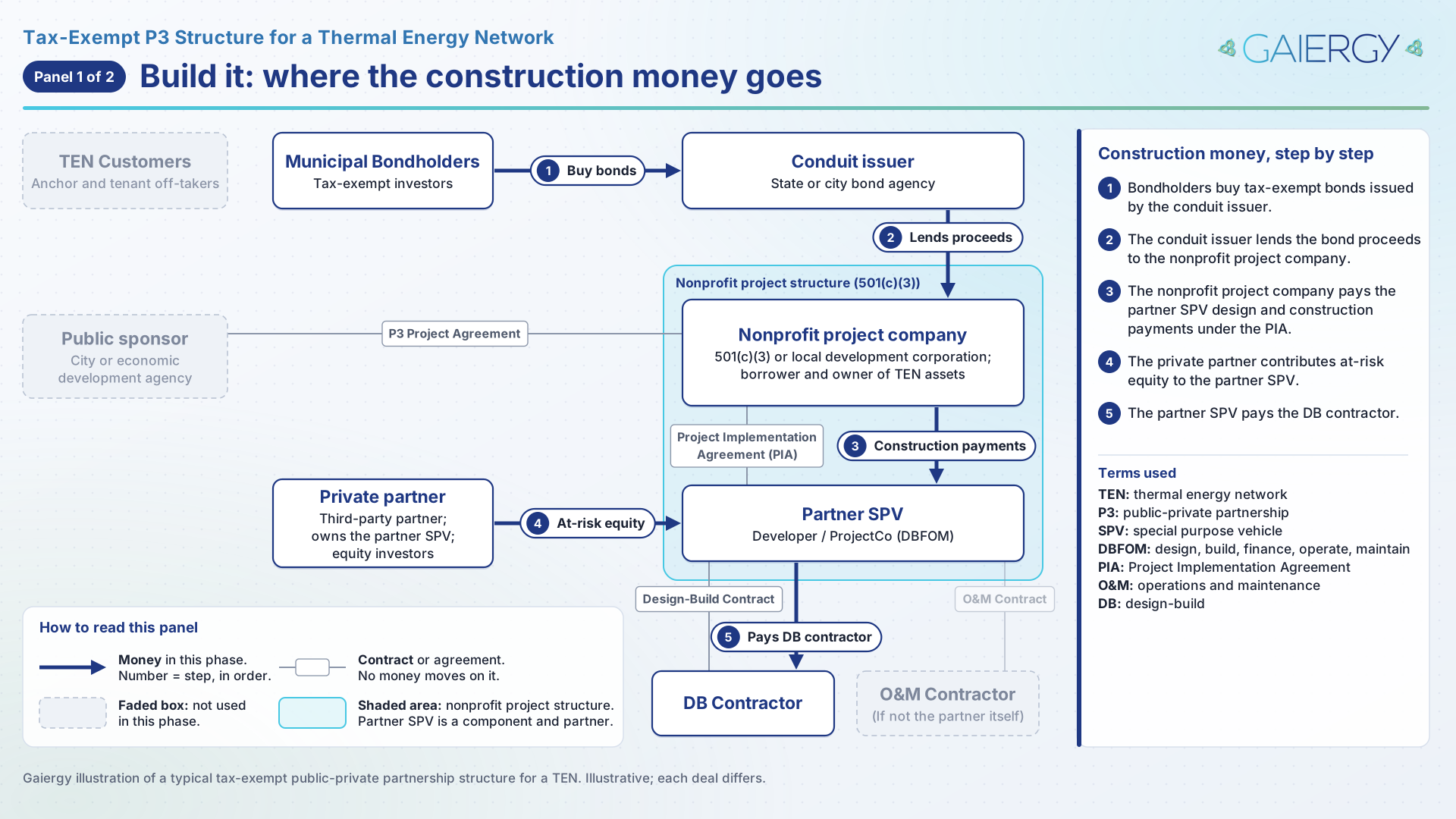
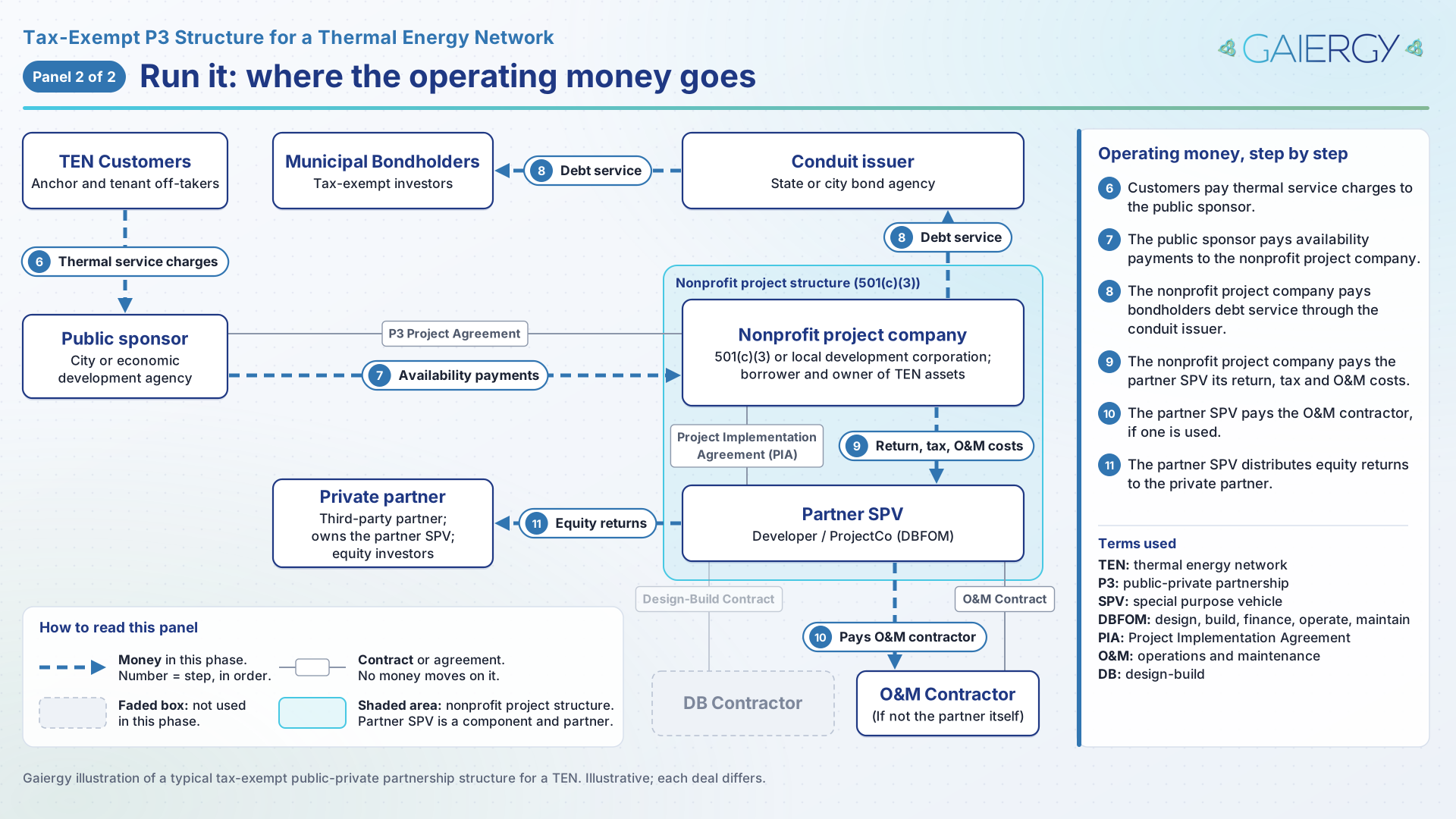
GAIERGY VIEW A tax-exempt public-private partnership (P3) can combine these pieces. A public sponsor, such as a city or its economic development agency, signs a P3 Project Agreement with a nonprofit project company. The nonprofit company borrows through a conduit issuer and owns the network. A private partner, a third-party company, forms a partner special purpose vehicle (SPV) and owns it. The partner SPV designs, builds, finances, operates and maintains the network under a Project Implementation Agreement (Figures 12 and 13).
Who owns what. The 501(c)(3) nonprofit project company owns the network and keeps its nonprofit status. The private partner's SPV designs, builds, finances, operates and maintains the network as a component of, and a partner in, the nonprofit structure. Partners in the structure do not have to be nonprofits: a private partner can be a contractor within the 501(c)(3) structure or a partner in it.
GAIERGY VIEW During construction, bond money flows from bondholders through the conduit issuer to the nonprofit company, which pays the partner SPV to build. The private partner adds at-risk equity. Once the network runs, customers pay thermal service charges to the public sponsor, and the sponsor makes availability payments to the nonprofit company. The nonprofit company pays debt service to bondholders and pays the partner SPV its return, tax and operating costs. The partner SPV is a component of, and a partner in, the nonprofit project structure.
Why the nonprofit owner matters for the bonds. Because the nonprofit company owns the network, the deal can use qualified 501(c)(3) bonds. These require that all property which is to be provided by the net proceeds of the issue is to be owned by a 501(c)(3) organization or a governmental unit
(26 USC 1457). They sit outside the state volume cap: for the cap, the term private activity bond does not include any qualified 501(c)(3) bond
(26 USC 14678). An exempt facility bond for local district heating or cooling facilities
under 26 USC 142(a)(9) has no such exception. Sections 146(g) and 146(h) list the exempt facility bonds left out of the cap, in whole or in part, and paragraph (9) is not among them (26 USC 14678; 26 USC 14271). A private activity bond is a qualified bond only if its issue meets the applicable requirements of section 146
(26 USC 14170). So a district heating bond draws on the state's volume cap.
GAIERGY VIEW For a TEN, that is the main appeal of a nonprofit owner: its bonds do not compete for volume cap with housing and other private activity bonds. Whether a given deal qualifies is a question for bond counsel.
TIF repays debt from the growth in property tax inside a set district. WORKING DEFINITION GAIERGY VIEW It can fit a TEN that serves a new development district, where new buildings create the tax growth. It is harder to use for a retrofit of an existing district with flat tax values.
NY Green Bank is a division of NYSERDA,
the New York State Energy Research and Development Authority (NY Green Bank90). In Maryland, MCEC and the City of Baltimore report a $121M pipeline of geothermal projects (ICLEI USA and MCEC 202691). GAIERGY VIEW Green banks can fill gaps that bond buyers and commercial lenders avoid, such as early-stage or first-of-a-kind risk.
without regard to whether such property is readily usable by a person other than the lessee or service recipient(Pub. L. 119-2192). The reading that this helps third-party loop ownership is an inference with no IRS guidance yet UNCONFIRMED.
a maximum net output of less than 1 megawatt (as measured in alternating current).For other facilities, the codified text sets 100% if construction began before 2024 and 90% if it began in 2024. It states no percentage for later years. Treasury exceptions apply if US content raises construction cost by more than 25% or is not available (26 USC 453). GAIERGY VIEW A direct-pay project of 1 MW or more that starts in 2026 and does not meet domestic content risks losing some or all of the credit; the exact result is UNCONFIRMED. The text also does not say how the 1 MW (AC) test applies to a heat pump system, which produces heat, not electricity UNCONFIRMED.
Get the label right. A nonprofit is not a 63-20 corporation by default. A state conduit issuer is not a 63-20 corporation. A 501(c)(3) does not issue tax-exempt bonds in its own name, but it can borrow them through a conduit issuer if it owns the financed assets and meets 26 USC 145 (26 USC 1457). Each has a different legal source of power, a different end state for title, and different approvals: under 63-20 the government ends up owning the network, and under 501(c)(3) the nonprofit can keep owning it (Rev. Rul. 63-20; Rev. Proc. 82-266; 26 USC 1457). GAIERGY VIEW Gaiergy recommends that a project name each entity by what it is in law, and pick the one whose end state matches the long-term ownership plan.
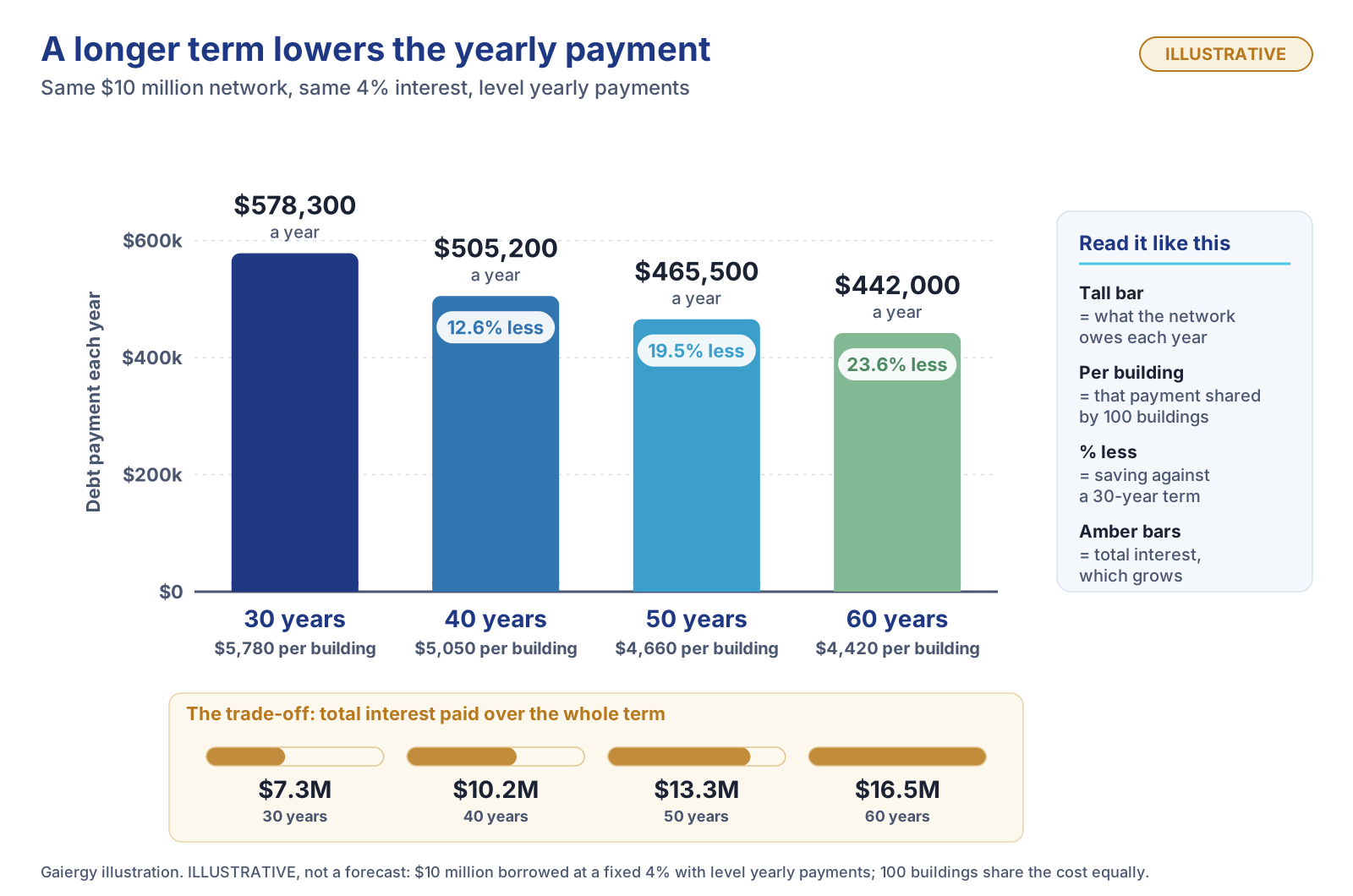
What this section shows: how a longer repayment term lowers the yearly cost of a TEN, where public bodies already repay or recover long-lived assets over more than 30 years, how a new bond can extend an old one, and the limits on doing so. The dollar example is ILLUSTRATIVE, not a forecast.
GAIERGY VIEW A TEN is a large, up-front build, and much of the cost is pipe and wells in the ground. If that cost is repaid over 25 or 30 years, the yearly charge to each building can be too high for many owners to join. A longer term spreads the same cost over more years, so each year's share is smaller.
Public finance already works this way. The Government Finance Officers Association (GFOA) describes debt as a way to spread the cost of significant long-term assets over their useful life
(GFOA, Debt Management Policy94). When DC Water sold a 100-year bond for its sewer tunnels, it said the bond lets it spread the costs of the project over the minimum expected life of the tunnels and be supported by future ratepayers who will also benefit
(DC Water, 2014-07-1067).
ILLUSTRATIVE Take $10 million of network cost, borrowed at a fixed 4% and repaid in level yearly payments, shared equally by 100 buildings. The 4% rate is a round example, not a forecast. Level debt service means the combined annual amount of principal and interest payments remains relatively constant over the life of the issue of bonds
(MSRB Glossary 201395).
ILLUSTRATIVE Moving from 30 to 60 years cuts the yearly payment by 23.6%. Per building, the debt part of the charge falls from about $482 a month to about $368. The trade-off is total interest, which rises from $7.3 million over 30 years to $16.5 million over 60 years.
Federal programs, state funds, a city water utility, a public university, a regulated gas utility and Denmark's municipal lender all repay or recover long-lived assets over more than 30 years. Each one rests on a specific structure: a statute, a federal program rule, a guarantee, a pledge of utility or university revenue, or a utility rate base. The cards run from the shortest term to the longest.
District heating 30 years; water companies 40
Full municipal guarantee; all municipalities jointly liable
Water systems in disadvantaged communities
Federal law lets a state extend 30 to 40 years
Rural water and waste systems
Up to 40 years by law; rule also caps at useful life
Power system, $1.0 billion bond due 2065
TVA Act lets bonds run up to 50 years
Plastic gas mains, Spire Missouri
Rate base: 70-year ordered life; 60 proposed in 2021
Transportation assets lasting over 50 years
2021 law: up to 75 years, or 75% of asset life if less

$350 million for deep sewer tunnels
Taxable bond matched to a 100-year tunnel life
$500 million for capital projects, due 2111
Taxable bond, repaid from university receipts
What it paid for What made the long term possible. Every card is sourced; the term chip is the term each source states for that asset.
Some federal and state programs stop short of 40 years. The Water Infrastructure Finance and Innovation Act (WIFIA) program lends to water projects with a final maturity up to 35 years after the date of substantial completion
, and no later than the useful life (33 USC 3908107). Clean Water State Revolving Fund loans run up to the lesser of 30 years and the projected useful life
of the project (33 USC 1383108).
Every bond has a final maturity. To keep paying over a longer life, an issuer can sell a new bond and use the money to pay off the old one. This is a refunding: A procedure whereby an issuer refinances outstanding bonds by issuing new bonds
(MSRB Glossary 201395).
to pay principal, interest, or redemption price on another issue(26 CFR 1.150-1109).
restructure the stream of debt service payments(GFOA, Refunding Municipal Bonds110). GAIERGY VIEW A further refunding is possible only while the asset has life left and the law allows it.
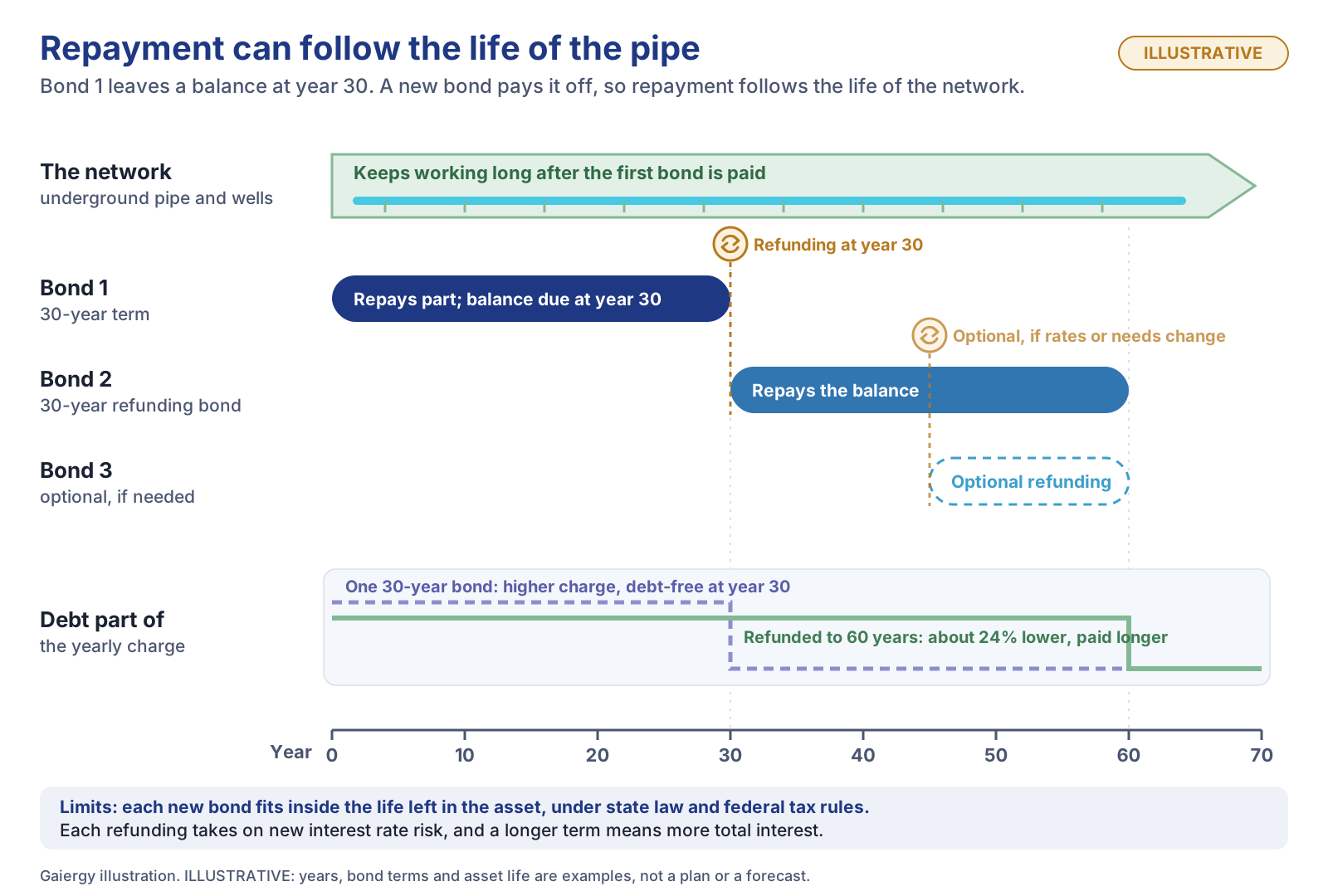
Current refunding, not advance. A current refunding is issued not more than 90 days before
its proceeds finish paying off the old bonds; any other refunding is an advance refunding (26 CFR 1.150-1109). Interest on a bond issued to advance refund another bond
is not tax-exempt (26 USC 149(d)111). That rule applies to advance refunding bonds issued after December 31, 2017 (Pub. L. 115-97, s.13532112). A taxable advance refunding is still possible, but GFOA notes the higher interest cost relative to tax-exempt bonds should be considered
(GFOA, Refunding Municipal Bonds110). GAIERGY VIEW A TEN plan that counts on tax-exempt refundings would issue each new bond no more than 90 days before it pays off the old one.
Level or back-loaded. Level debt service keeps the yearly payment about the same (MSRB Glossary 201395). GAIERGY VIEW A back-loaded schedule pays less in the early years, while buildings are still connecting, and more later. It lowers early charges, but it adds interest and risk if connections lag.
A federal loan first, bonds later. GAIERGY VIEW A project could borrow from a long-term federal loan program during construction, then refinance with bonds once customers are connected and paying. Whether a given program allows prepayment or refinancing on these terms is UNCONFIRMED and depends on each loan agreement.
State useful-life caps
Some states, such as New York, tie local debt to the life of the asset. New York bars debt for a period longer than the period of probable usefulness
(NY Local Finance Law 11.00113). Its table gives water systems forty years
(fifty in New York City), but Hot water heating plants or distribution systems
get thirty years
(NY Local Finance Law 11.00113). A refunding bond can run no later than the longest period the law allows when the old or the new bonds are issued, computed from the date of issuance of the bonds to be refunded
(NY Local Finance Law 90.00114). Denmark caps municipal-guaranteed loans for energy supply networks at 30 years, but allows 40 for water companies (Denmark BEK 1484/202497).
Federal tax tests
For a private activity bond, the average maturity cannot exceed 120 percent of the average reasonably expected economic life of the facilities being financed
(26 USC 14777). That test reaches qualified 501(c)(3) bonds and exempt facility bonds (26 USC 14777). Federal arbitrage rules also treat it as abuse when an issuer gains an interest-rate advantage while allowing bonds to remain outstanding longer than is otherwise reasonably necessary
(26 CFR 1.148-10115).
Interest rate risk at each refunding
A refunding is priced at the rates of its day. For an advance refunding, GFOA suggests a breakeven analysis of how much interest rates can rise
before waiting for a tax-exempt current refunding becomes the better choice (GFOA, Refunding Municipal Bonds110). GAIERGY VIEW A plan that needs a refunding in year 30 carries that rate risk for 30 years. A refunding also needs a call date, and some very long bonds have none: TVA's 2065 bonds are not subject to redemption prior to maturity
(TVA 8-K 2015101).
More total interest
ILLUSTRATIVE In the example above, total interest rises from $7.3 million at 30 years to $16.5 million at 60 years. GAIERGY VIEW Very long bonds may also price higher, or be taxable: the DC Water century bond was a taxable bond (DC Water, 2014-07-1067).
Gaiergy view: what it means for a TEN
What this section shows: four common site types and the ownership model that fits each. This section is GAIERGY VIEW except where a source is shown.
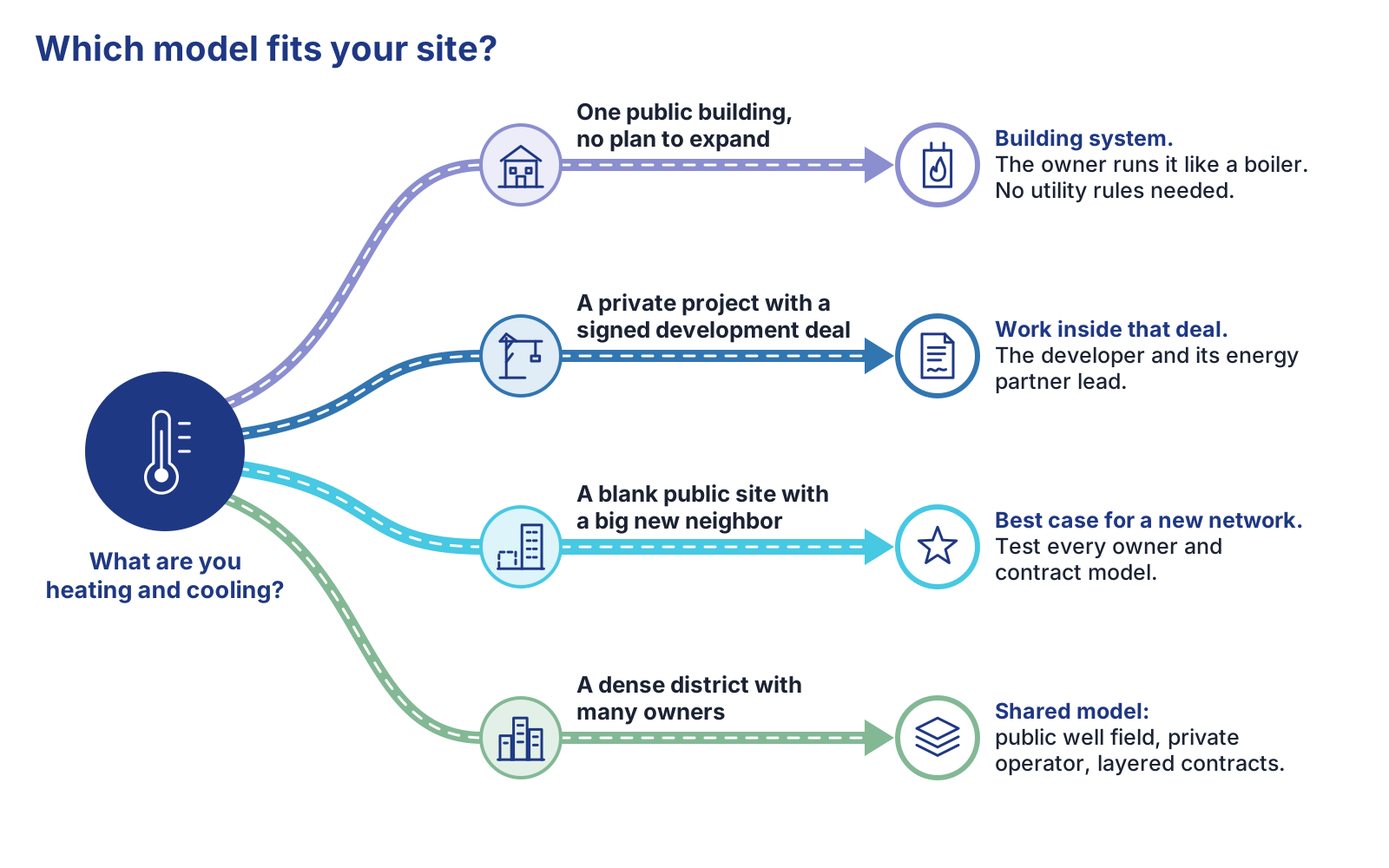
Wells and heat pumps for one public building are a building system, not a utility (Figure 8, Section 5). There are no outside customers, no tariff and no billing. The owner runs it like a boiler or a chiller. A city that owns both the ground loop and the heat pumps can claim the s.48 credit by direct pay, if the project is under 1 MW or meets domestic content (Section 6) (26 USC 641779; Treasury T.D. 100152; 26 USC 453).
If the plan later grows to serve neighbors, the project becomes a network. That is a different governance problem. Gaiergy recommends that a city keep the two cases separate in its plans.
When a city has already signed a development deal, the developer and its energy partner lead. The city's role is to work inside that deal: permits, street access, and any incentives the deal allows. Whisper Valley in Austin shows a developer-led model at scale: the provider owns and runs four district systems for over 800 homes (EcoSmart16). A new public governance layer on top of a signed deal would need the developer's consent.
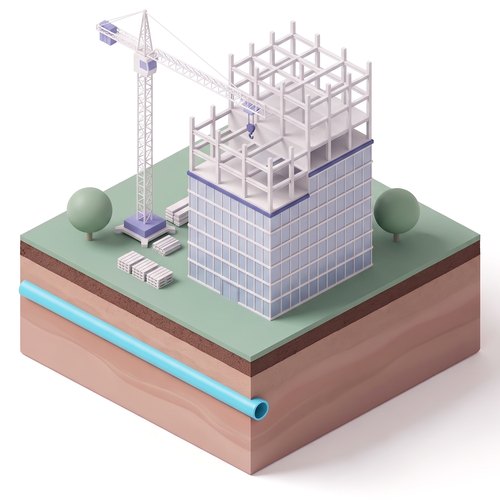
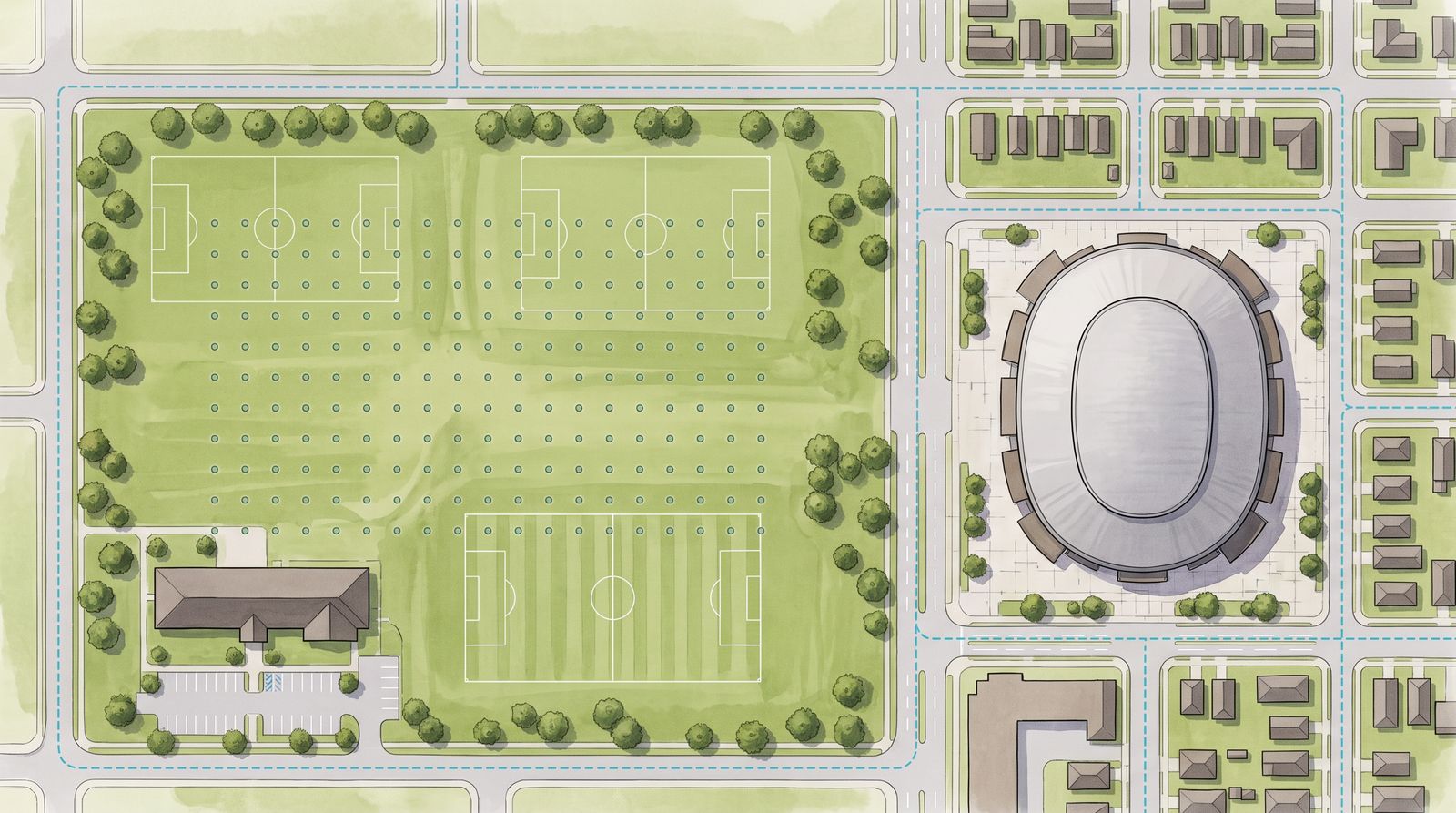
This is the best chance to test every model. The land is public. The site has no design and no development team. A large, predictable anchor building nearby gives the network a core customer. Every owner type, contract and financing tool in this report is still open. The loop can go in the ground before the streets are built (Section 4).
A dense downtown has many owners, old streets and often an existing district energy system. A shared model with layered contracts fits best. One option is a public well field and a private operator. Another is the final Troy structure: a public body leases the land, and one owner holds the whole network (National Grid, Troy Stage 2, 202513). That owner holds the ground loop and heat pumps that the credit rules look for (Treasury T.D. 100152). Gaiergy recommends that the team check the credit ownership rules and bond financing before it splits title between parties. If the project uses a 63-20 corporation, the government ends up owning the network at bond payoff. If a nonprofit is to keep it, a 501(c)(3) owner with qualified 501(c)(3) bonds fits better (Section 6).
What this section shows: how the three decisions look in Baltimore, New York City and Boston, from public sources as of 2026-09-30. Each snapshot ends with a short Gaiergy view.
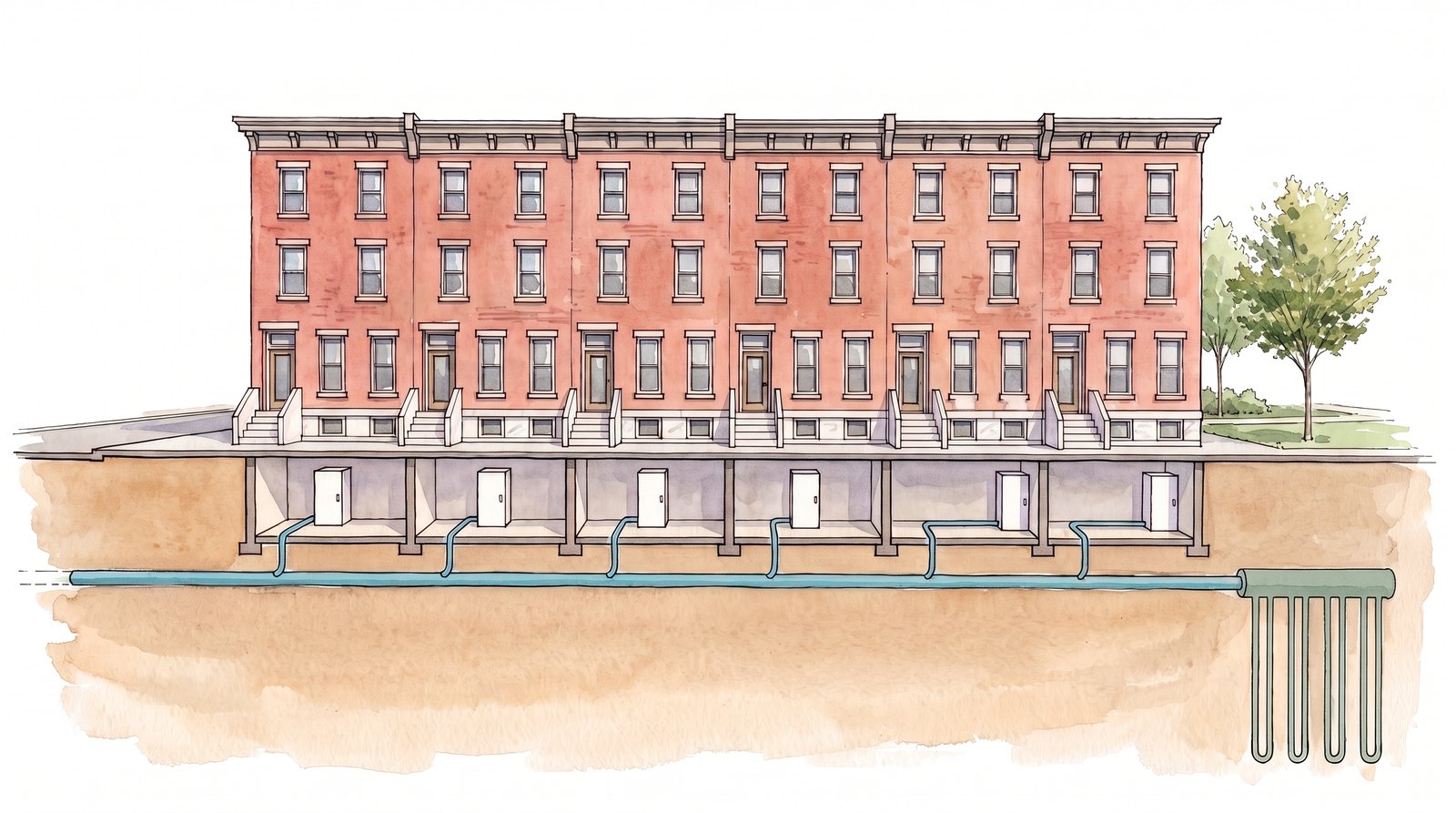
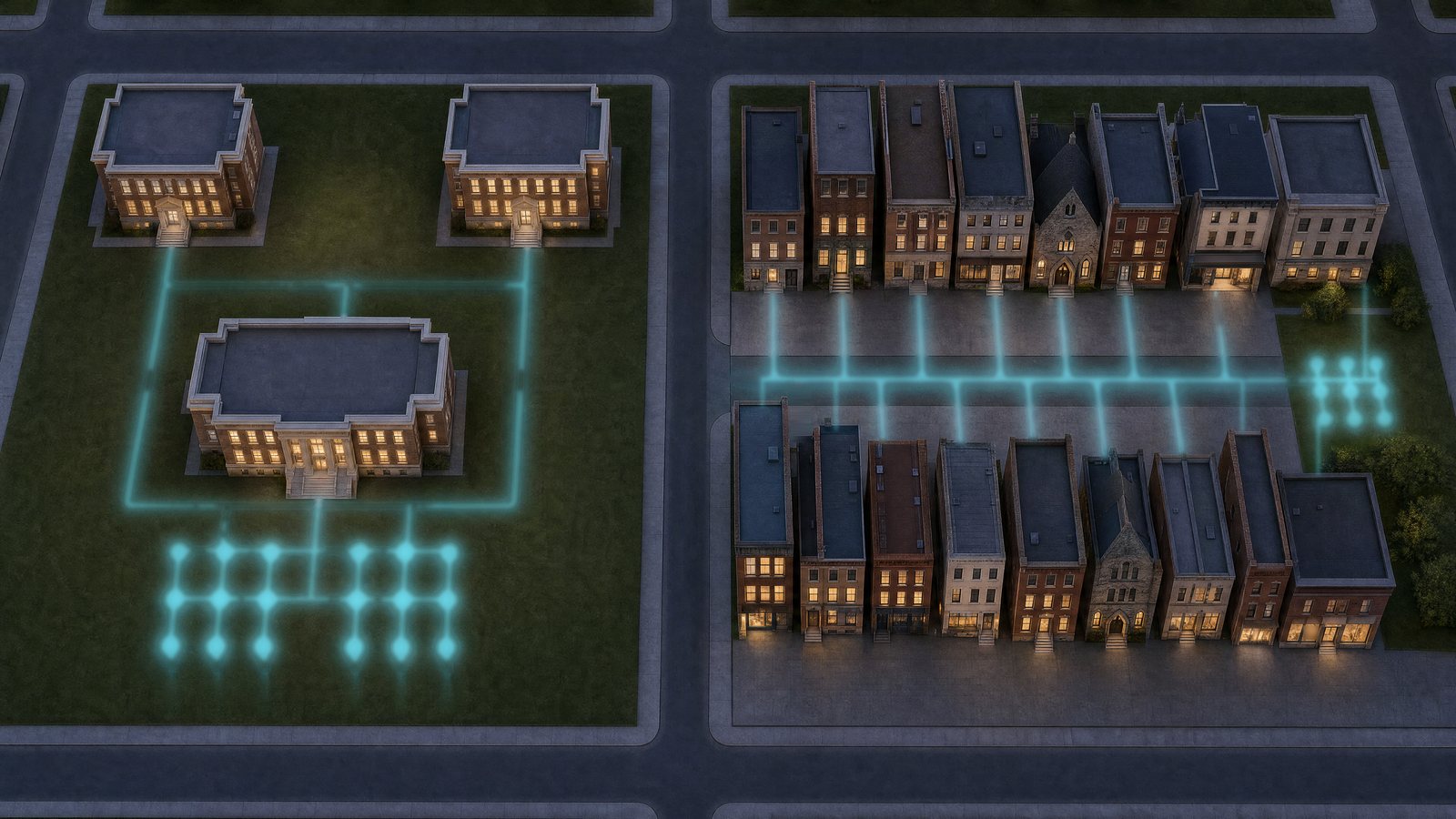
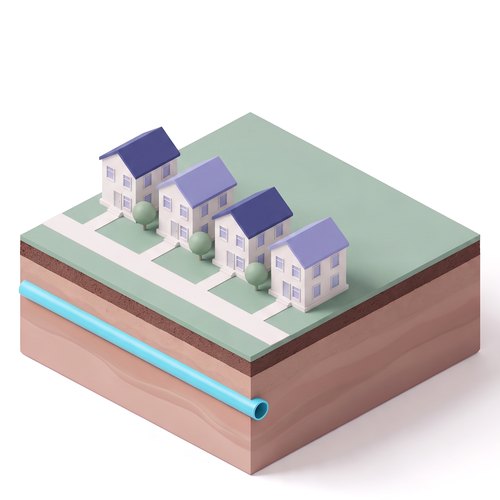
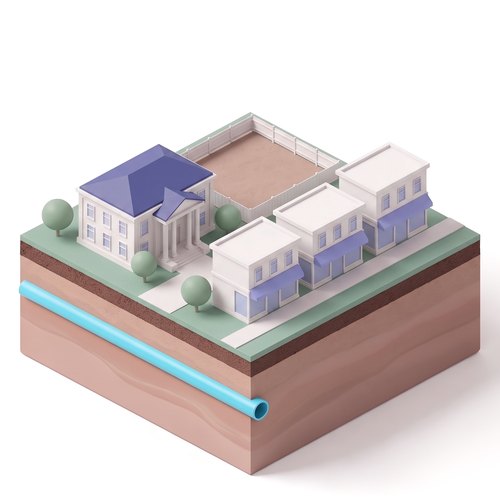
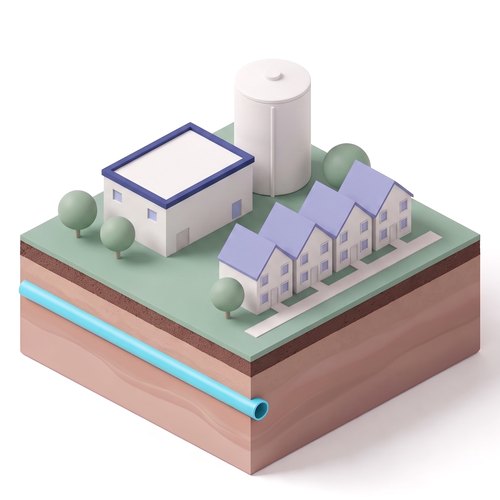
Figure 18.Rowhouses, each with a basement heat pump, sharing one pipe below ground and a small well field at the end of the block. Gaiergy illustration.
not only exorbitant, but also speculative; plans to hire a consultant (Maryland Matters 202622) (PSC order UNCONFIRMED)
remain stalled(Earthjustice 2026116)
key decisions on ownership, technology, and revenue are in progress(ICLEI USA and MCEC 202691)
still undergoing feasibility assessments(ICLEI USA and MCEC 202691)
What could be done (Gaiergy view)
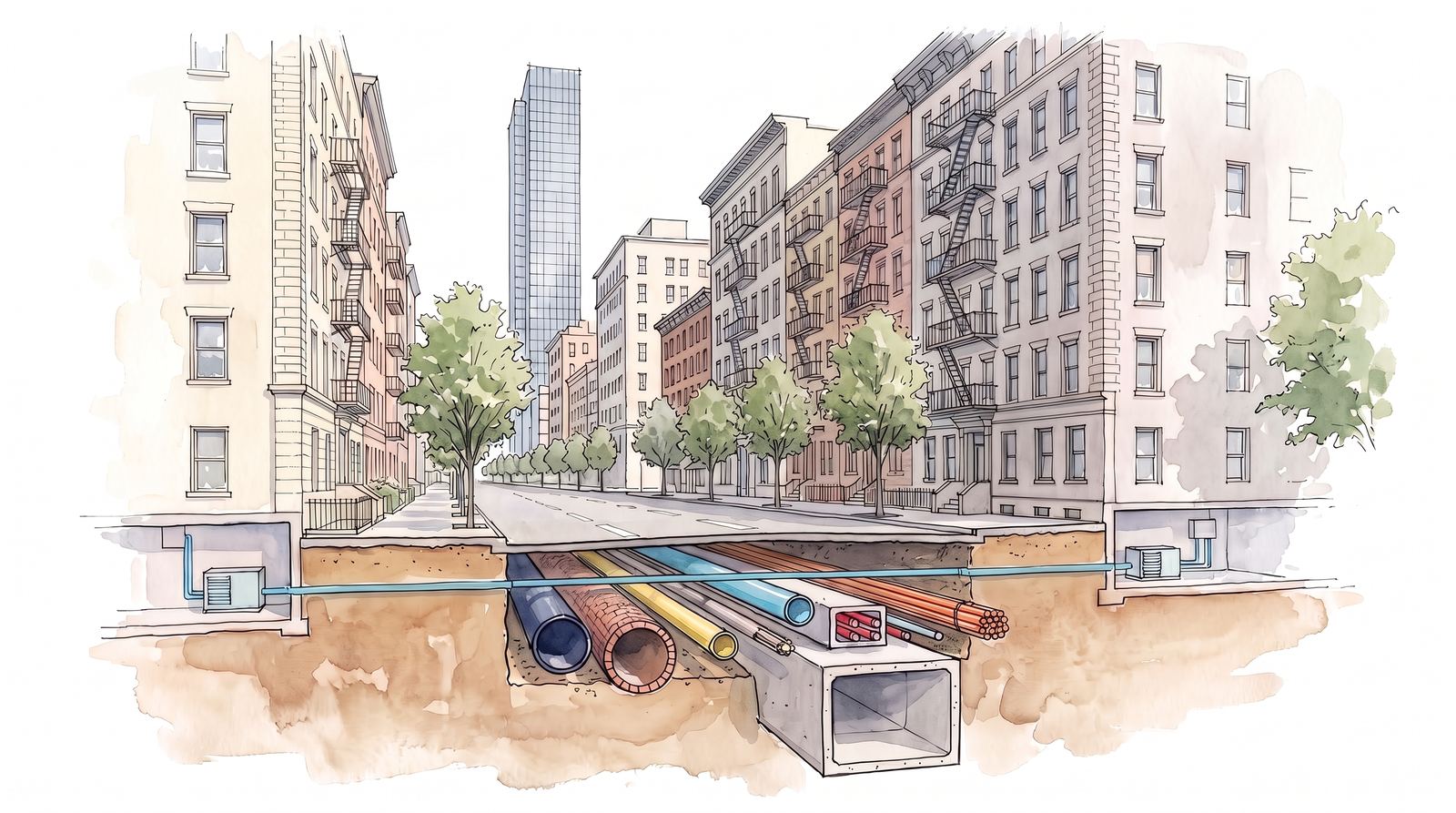
Figure 19.A dense street section: the network main fits among water, sewer, gas, power, telecom and the subway. Gaiergy illustration.
a mission-driven, nonprofit organization(NYCEDC 202689)
501(c)(3) organizations and other exempt facilitiesaccess
low-cost debt through tax-exempt bond financing(Build NYC85)
What could be done (Gaiergy view)
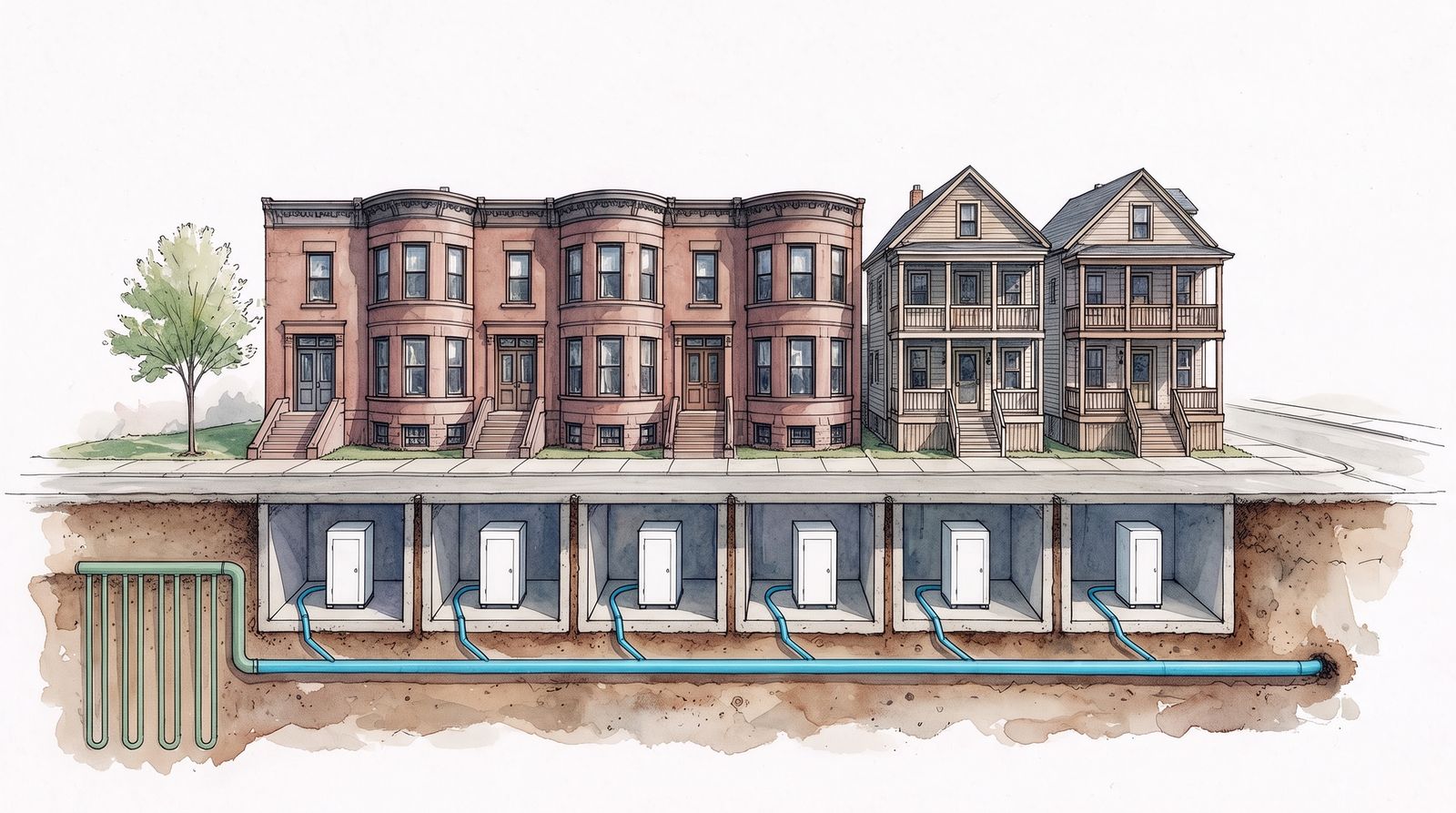
Figure 20.Brownstones and triple-deckers served by one main below ground and a small well field. The main can extend street by street. Gaiergy illustration.
A gas company may make, sell or distribute utility-scale non-emitting thermal energy, including networked geothermal(Mass. Acts 2021 ch. 828; Mass. Acts 2022 ch. 17929; Mass. Acts 2024 ch. 23930)
What could be done (Gaiergy view)
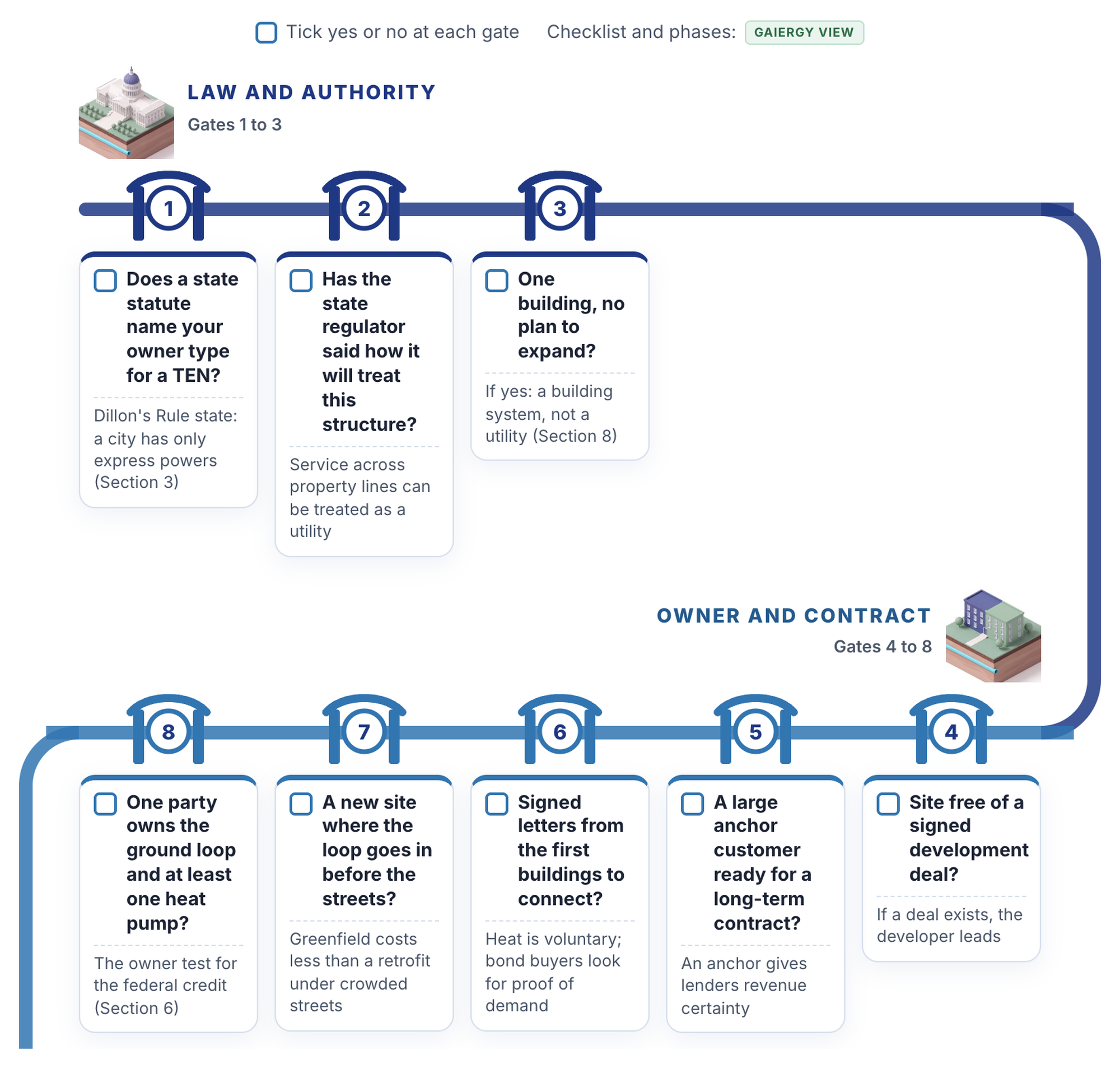
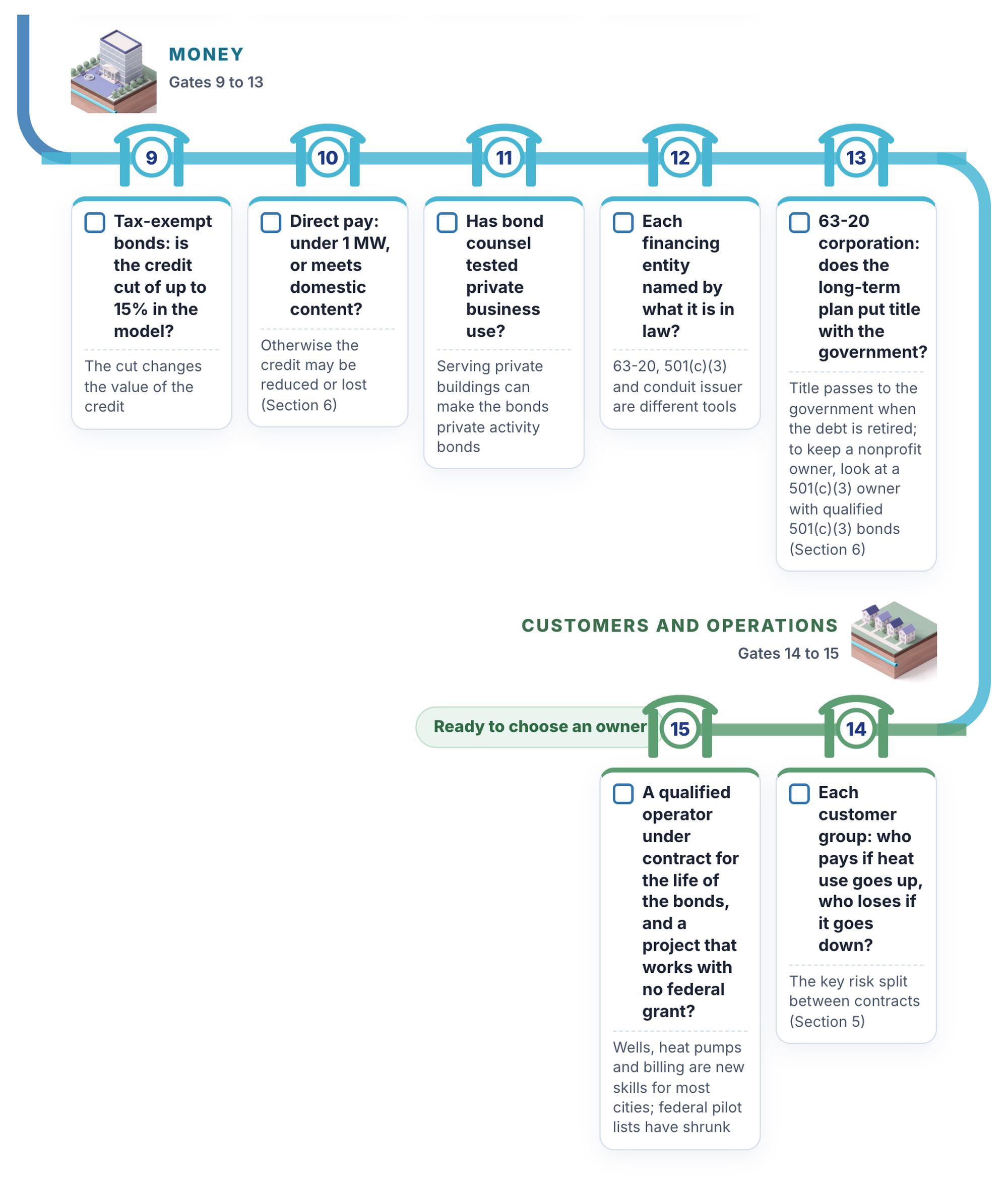
What this section shows: 15 yes or no questions to answer before choosing an owner. A "no" is not a stop. It shows where work is needed. The checklist is GAIERGY VIEW.
Tick yes or no at each gateChecklist and phases: GAIERGY VIEW

Does a state statute name your owner type for a TEN?
Dillon's Rule state: a city has only express powers (Section 3)
Has the state regulator said how it will treat this structure?
Service across property lines can be treated as a utility
One building, no plan to expand?
If yes: a building system, not a utility (Section 8)
Site free of a signed development deal?
If a deal exists, the developer leads
A large anchor customer ready for a long-term contract?
An anchor gives lenders revenue certainty
Signed letters from the first buildings to connect?
Heat is voluntary; bond buyers look for proof of demand
A new site where the loop goes in before the streets?
Greenfield costs less than a retrofit under crowded streets
One party owns the ground loop and at least one heat pump?
The owner test for the federal credit (Section 6)

Tax-exempt bonds: is the credit cut of up to 15% in the model?
The cut changes the value of the credit
Direct pay: under 1 MW, or meets domestic content?
Otherwise the credit may be reduced or lost (Section 6)
Has bond counsel tested private business use?
Serving private buildings can make the bonds private activity bonds
Each financing entity named by what it is in law?
63-20, 501(c)(3) and conduit issuer are different tools
63-20 corporation: does the long-term plan put title with the government?
Title passes to the government when the debt is retired; to keep a nonprofit owner, look at a 501(c)(3) owner with qualified 501(c)(3) bonds (Section 6)
Each customer group: who pays if heat use goes up, who loses if it goes down?
The key risk split between contracts (Section 5)
A qualified operator under contract for the life of the bonds, and a project that works with no federal grant?
Wells, heat pumps and billing are new skills for most cities; federal pilot lists have shrunk
What this section shows: every source cited above, in order of first use. All accessed 2026-09-30.