
2 of 11 move forward
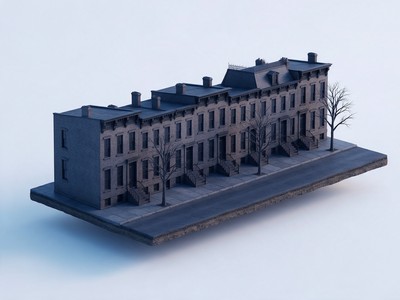
 City HallLake Erie96-inch sewer: heat source, below the street
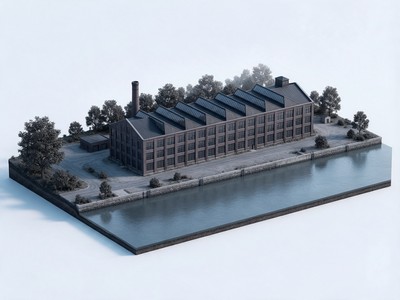
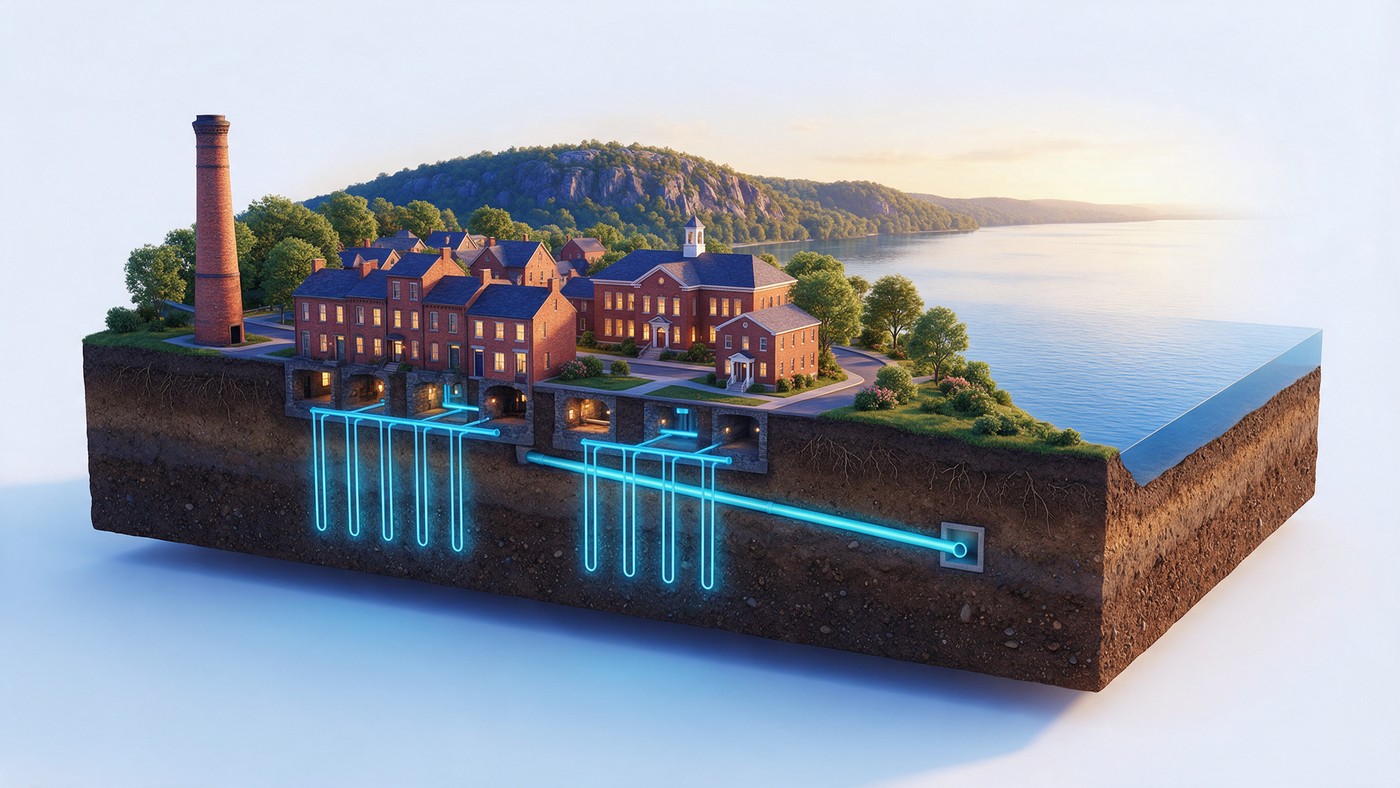 brick kiln stackHigh TorHudson River2 borefields + wastewater main, below grade
9 not advanced (pp. 95-144, 201-202)




Part 1
Executive summary
Key takeaways
2 of 11 move forward
Haverstraw West Loop (O&R)
The PSC made the right call
Raised the enrollment bar to 50%
The study left value out
No credit for avoided grid upgrades
No carbon damage value
Behind the cost: site and route
Unsigned land
Buildings slated for demolition
The incentive points the wrong way
The PSC flagged it in 2016
Next window: 180 days
Waste heat and the rules for TENs
1. What the PSC decided
- PSC advanced 2 of 11: Buffalo (NFG) and Haverstraw West Loop (O&R) (pp. 201-202)
- Other 9 stopped; Rockefeller Center and Syracuse only "at this time" (pp. 114, 130)
- $93M in state funds lowers ratepayer cost for the 2 winners (pp. 3-4, 153-154)
- Budgets for all 11 rose from $413M (2023) to $1,139M (Appendix A)
The 2 approved pilots: deferral caps against state funds
- Buffalo may defer up to $61.4M, less state funds (p. 154)
- Haverstraw West Loop may defer up to $50.1M, less state funds (p. 157)
- These are deferral caps, not final costs
- $93M in state funds goes to the 2 pilots, not split between them (pp. 3-4, 153-154)
- $111.5M is the sum of the 2 caps; $18.5M is $111.5M less $93M
- Both are Gaiergy calculations, not figures the order states
- What customers finally pay depends on actual costs (pp. 155-156, 159-160)
2. Credit where it is due
The PSC did its job as a gatekeeper. It:
- stopped 9 pilots that would have needed large ongoing subsidies (pp. 95-144);
- said utility financing "does not operate as an interest-free loan" (p. 74);
- raised O&R's enrollment minimum from 15% to 50% of load (pp. 183-184);
- found 15% "insufficient to protect ratepayers' interests" (pp. 183-184);
- capped each approved pilot's surcharge at 1.0% of utility revenue a year (pp. 155-156, 159-160);
- set recovery on actual costs, not projections (pp. 155-156, 159-160);
- opened the door to gas boilers for the coldest days as a transition step (p. 78).
3. What the cost study should have counted
Gaiergy analysis and opinion
The PSC compared each network with individual air-source and ground-source heat pumps over 25 years (pp. 45, 52). Several things were left out of that comparison:
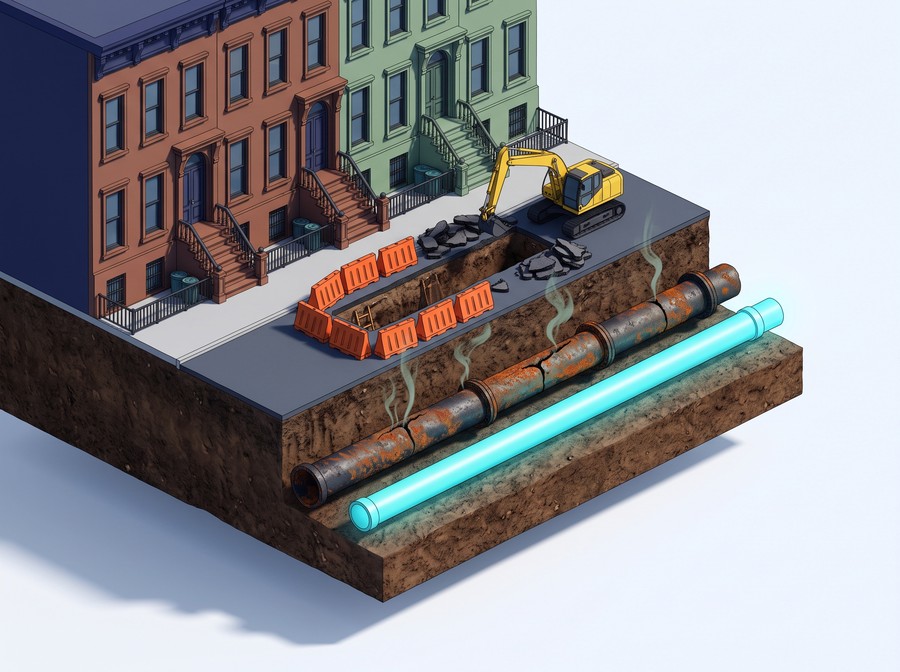 cast-iron gas main, 1890$0 credit
Avoided gas pipe replacement
Not counted- None tried to "quantify this value" (p. 83)
- PSC: "most likely not zero" (p. 83)
- Mount Vernon: 1890 main, no value (p. 107)
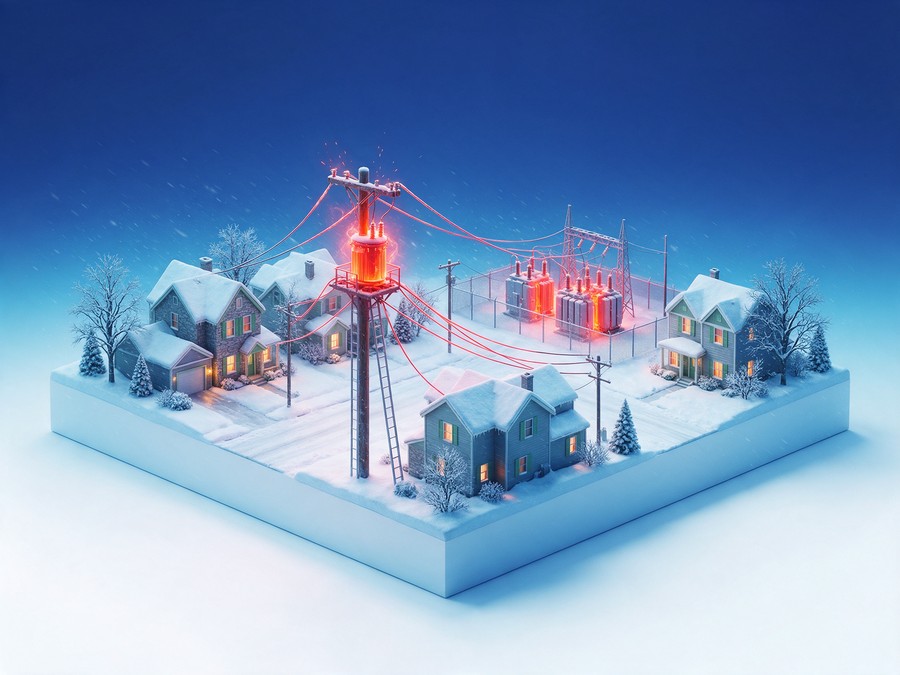 transformer and line upgrades$0 credit
Avoided electric grid upgrades
Not counted- Winter peak cut 17% to 66% vs ASHP (p. 79)
- No dollar value for avoided upgrades (p. 83)
 CO2$3,383 to $15,804 a ton$0 damage value
The value of carbon
Not counted- $3,383 to $15,804 per ton avoided (p. 65)
- No "social cost" or "value of carbon"
Utility return, depreciation and financing
Left out of the LCCA- Left out of the LCCA: return, depreciation, financing (p. 46 n.57)
- PSC: costs therefore "somewhat understated" (p. 74)
Other owners
Not compared- No pilot compared with a municipal, cooperative or private owner
- NYSERDA and the PSC point past investor-owned utilities (pp. 42, 194)
Hybrid designs and storage
Not tested- No gas peak boiler, and no pilot can actively shift its peak (pp. 77, 82)
- Cited study: gas peaking cuts borefield size and costs "by 50 percent" (p. 78)
Property tax
Not addressed- Largest single operating cost: 27% on average, 72% at Poughkeepsie (p. 73)
- The order does not discuss exemptions or payments in lieu of taxes
Open books
Workpapers not filed unredacted- Central Hudson, KEDNY and NMPC (Syracuse) did not file unredacted cost workpapers (p. 48)
4. Behind the cost: site, route and who signs up
Gaiergy analysis and opinion
The PSC stopped these pilots on cost. In our reading, much of that cost traces back to where the pilots were put and who was ready to join:
Poughkeepsie
Anchor customer gone- Anchor customer dropped out (pp. 13-14, 96)
- Asbestos, lead, PCB work "may be required" (pp. 13-14, 96)
- Residents would relocate temporarily (pp. 13-14, 96)
Chelsea
Buildings slated for demolition- 3 buildings slated for demolition (pp. 19, 100, 103-104)
- $12.0M left "stranded" (pp. 19, 100, 103-104)
- No deal with the waste-heat owner (pp. 19, 100, 103-104)
Mount Vernon
Land not signed- Land for the 4 borefields not secured (p. 109)
- PSC: "not in and of itself determinative" (p. 109)
Brooklyn
No room for bores- "insufficient space" for the required boreholes (p. 124)
Syracuse
Buildings not built- 13 of 14 buildings not built yet (pp. 127, 129)
Troy
City stepped back- City stepped back from owning the borefield (p. 133)
- Costs rose (p. 133)
Ithaca
Aquifer risk- Aquifer: uncertain water "quantity or quality" (p. 137)
Haverstraw East
One developer- Hinges on one developer's schedule (pp. 140-141)
Enrollment was the weak link
- O&R proposed starting at 15% of forecast load (pp. 183-184)
- PSC: 15% is "insufficient to protect ratepayers' interests"; it required 50% (pp. 183-184)
- NYSERDA: Mount Vernon and West Loop analyses "assume full enrollment" (p. 41)
- That is "despite much lower contractual minimum thresholds" (p. 41)
- PSC: one step was "overlooked by the Act's ambitious timeline" (p. 44)
- That step: the "time needed to educate potential pilot project participants" (p. 44)
Enrollment: assumed vs required
- Bars: share of forecast load signed before construction (pp. 183-184)
- First bar: enrollment assumed in two cost analyses (NYSERDA, p. 41)
Gaiergy practice
- We knock on doors and list who wants to join before we draw a route
- The route follows the people who sign up, not the other way around
5. Estimates that moved, and who made them
Gaiergy analysis and opinion
- Budgets grew 2.8 times from 2023 to Stage 2; 7.5 times at Poughkeepsie (Appendix A)
- Cause 1 in the order: the added hot water service (p. 12)
- Cause 2, at Troy: a utility-owned borefield "significantly increases" costs and taxes (p. 133)
- Reviewers flagged possible errors; NYSERDA: "a calculation error" at Troy (App. B p. 34)
- IDEA asks which of two Chelsea operating cost figures is correct (App. B p. 12)
- Staff: NMPC's analysis had no return, though NMPC said it did (p. 46 n.57)
- The order does not say who prepared the designs or the estimates
Gaiergy's view of why the estimates moved:
Opinion of Jason Masters, in his words
There's a uniqueness bias that creeps into these initial cost estimates. These TENs were costed without looking at how to stage their construction against the next 5 to 10 year capital improvement plan that the cities were going forward with anyway. To embed cost efficiency, you need to couple TENs with capital improvement plans.
6. The incentive problem
Gaiergy analysis and opinion
A regulated utility earns its profit as a return on the capital it invests. Today's allowed returns on equity in New York:
- 1Capital spent
pipes, plant, equipment - 2Added to the rate base
- 3Return on equity
about 9.2% to 9.75% - 4Recovered from customers' bills
- ↻Then more capital
earns more return
Illustrative cycle.
Allowed return on equity as approved by the PSC, sources accessed 2026-10-21: NFG, PSC rate case memo, Case 23-G-0627; O&R, rate case summary; Con Edison, rate case summary; Central Hudson, rate case summary; NMPC, rate case summary; KEDNY and KEDLI, PSC session transcript, August 15, 2024, p. 10, and session slides; NYSEG and RG&E, temporary rate summary.
Economists have described this since 1962 (Averch and Johnson, "Behavior of the Firm Under Regulatory Constraint," American Economic Review 52(5)).
- NFG and O&R recover a "return on and return of" their investment (Clauses 5-6, p. 203)
- That includes "the utility's share of customer equipment upgrades" (Clauses 5-6, p. 203)
- In our view, the existing gas system is a large and familiar place to invest
- NY gas utilities have about 7,000 miles of leak-prone pipe (Synapse, Mar 1, 2023)
- Replacing it could cost about $150 billion (Synapse, Mar 1, 2023) third-party estimate, not a PSC figure
Opinion of Jason Masters, in his words
A utility, as a regulated monopoly, has the experience of running utility infrastructure. But the utility will make more money by investing in its current system. It can invest in failing infrastructure without having to become more innovative, and it reduces the risk of the unknown by clinging to the past.
7. What New York should change before the next round
Gaiergy recommendations
Prove the customers first.
- Get signed interest before Stage 2 design
- Route the network to the people who sign
Count the full value.
- Price the avoided gas pipe and grid upgrades
- Count the value of carbon in every analysis
Allow hybrid designs and storage.
- A fossil boiler for the coldest days (pp. 77-78)
- Thermal storage to shift the peak (pp. 77-78)
Open the door to other owners.
- Let municipalities and co-ops own networks (pp. 42, 194)
- Let private developers propose them too (pp. 42, 194)
Test estimates with builders.
- Ask for estimates that builders have checked
Fix the property tax drag.
- Consider exemptions for network assets
- Or payments in lieu of taxes
Use the 180-day technical conference.
- Next chance to shape the rules for TENs and waste heat (Clause 21, p. 207)
Closing. Opinion of Jason Masters, in his words
The only way we transition to a more efficient infrastructure is to be cognizant that long-term infrastructure requires a diligence of innovation that the majority of the applicants weren't capable of demonstrating.
Part 2
The order in detail
What the order says, pilot by pilot.
How a thermal network works
- A thermal energy network (TEN) links buildings to shared heat sources through a water loop below the street
- Most pilots give each building its own heat pump; Buffalo uses central heat pumps (p. 69)
- Heat sources: wastewater (Buffalo (p. 26)), ground boreholes (Poughkeepsie (p. 13))
- Waste heat from a data center feeds Chelsea (pp. 16-18)
Pilots differ: some use a one-pipe loop, others two or four pipes (pp. 12-37)
The order at a glance
Only 2 of 11 advance
Haverstraw West Loop
Cost decided it
Heat pumps: $200 to $4,284
Running costs never reach parity
Ithaca: 33.7x ASHP
Budgets nearly tripled
$1,139M at Stage 2
Gas customers pay for 8 stopped pilots
$93M state funds help the winners
Next window: technical conference
Waste heat and new TEN rules
From 11 pilots to 2
- 11 pilots from the 7 largest utilities, reviewed after Stage 2 engineering design
- O&R's Haverstraw filing counts as 2 loops (p. 3)
- Decisions: pp. 201-202, Ordering Clauses 1-2
- PSC chose 2 different designs for "the highest possible learning value" (p. 201)
- It sought to avoid "potentially redundant approaches at the expense of ratepayers" (p. 201)
- It also cites "elevated affordability concerns" (p. 202)
- DAC = disadvantaged community
Where the 11 pilots are
All 11 pilot sites: 5 upstate on the state map, 6 in the New York City area inset.
- 1 Poughkeepsie, Central Hudson
- 2 Chelsea, Manhattan, Con Edison
- 3 Mount Vernon, Con Edison
- 4 Rockefeller Center, Manhattan, Con Edison
- 5 Buffalo, NFG: approved
- 6 Brooklyn, KEDNY
- 7 Syracuse, NMPC
- 8 Troy, NMPC
- 9 Ithaca, NYSEG
- 10 Haverstraw East Loop, O&R
- 11 Haverstraw West Loop, O&R: approved
- Place names: order pp. 12-37
- Marker positions are approximate, placed by Gaiergy; the order gives no coordinates
- Outlines: US Census Bureau cartographic boundary files, 2023 (see Sources)
Decision on each pilot
- Budget: final forecast from each Stage 2 filing (Appendix A)
- Carbon cost: life cycle cost per metric ton of CO2e avoided (p. 65, Table 4)
- Pilot summaries: pp. 12-37; determinations: pp. 95-144
| # | Pilot | Utility | Heat source | Decision | Final budget | Carbon cost, $/MTCO2e | Main reason |
|---|---|---|---|---|---|---|---|
| 1 | Poughkeepsie DAC | Central Hudson | Closed-loop geothermal: 3 borefields, 138 bores | Declined p. 99 | $130.99M | $10,602 | Highest CapEx per square foot, $595/SF; OpEx 18x ASHP; anchor customer left |
| 2 | Chelsea DAC | Con Edison | Data-center waste heat (85 Tenth Ave) | Declined p. 104 | $95.53M | $15,804 | Highest carbon cost; higher winter peak than ASHPs; NYCHA plans to rebuild |
| 3 | Mount Vernon DAC | Con Edison | 4 borefields plus air-source heat pumps | Declined p. 109 | $191.73M | $11,757 | Largest budget; CapEx 8.3x ASHP; borefield land not secured |
| 4 | Rockefeller Center | Con Edison | Chilled-water plant waste heat, about 90°F loop | Declined at this time p. 114 | $128.22M | $3,383 | Ratepayers would fund about 90% of conversions for owners outside a DAC (p. 112) |
| 5 | Buffalo DAC | NFG | Sewer wastewater heat plus small borefield; central heat pumps | ✓ Approved p. 120 | $61.40M | $4,342 | Second-lowest carbon cost; lowest OpEx; lowest annual subsidy |
| 6 | Brooklyn DAC | KEDNY | Borefield 52%, grocery waste heat 37%, sewage 11% | Declined p. 125 | $125.49M | $7,480 | Building retrofit cost over network cost by 50%+; relies on grocery heat |
| 7 | Syracuse | NMPC | Treated wastewater effluent, about 24 h storage | Declined at this time p. 130 | $143.65M | $11,048 | Highest total CapEx, $168.9M; depends on future construction |
| 8 | Troy | NMPC | One borefield on city land plus air-source heat pumps | Declined p. 134 | $90.93M | $6,283 | CapEx 10.0x ASHP; City of Troy withdrew as resource owner |
| 9 | Ithaca | NYSEG | Open-loop aquifer | Declined p. 137 | $52.48M | $5,599 | Highest OpEx, 33.7x ASHP; aquifer and permits uncertain |
| 10 | Haverstraw East Loop DAC | O&R | 5 borefields 61%, Hudson River 35%, wastewater 4% | Declined p. 141 | $68.00M | $8,254 | Depends on anchor developer schedule; several river-access permits |
| 11 | Haverstraw West Loop DAC | O&R | 2 borefields plus wastewater force main | ✓ Approved p. 144 | $50.10M | $6,480 | Second-lowest subsidy; lowest 5-year cost; public customers |
- Rockefeller Center had the lowest carbon cost ($3,383) and lowest CapEx ($27/SF)
- PSC declined it: ratepayers would fund about 90% of conversions (p. 112)
- Those owners are well-resourced, commercial and outside a DAC (p. 114)
- Rockefeller Center and Syracuse are declined "at this time" (pp. 114, 130)
Why most were stopped: the cost findings
- Options: individual air-source (ASHP) and ground-source (GSHP) heat pumps
- The third option is the existing system (BAU)
- Method: 25-year life cycle cost analysis (LCCA) at 2.20% inflation (pp. 46-47, 52, 54)
- It leaves out return, financing and pilot-imposed costs (pp. 46-47, 52, 54)
Cost to avoid one ton of carbon
- Every UTEN costs more per ton than individual heat pumps (pp. 64-65)
- UTEN $3,383 to $15,804 per ton; ASHP $200 to $4,284; GSHP $711 to $3,005 (pp. 64-65)
- Buffalo is second lowest; Chelsea is highest (pp. 64-65)
For Syracuse, the existing system is already ASHP, so no heat pump comparison applies (p. 65).
Capital cost: per square foot and against heat pumps
- CapEx runs from $27 to $595 per gross square foot (GSF) (pp. 66-68)
- That is 1.4 to 10.0 times ASHP and 1.7 to 4.3 times GSHP (pp. 66-68)
- About one third each: customer buildings, central equipment, other items (p. 69)
Annual running cost against heat pumps
- OpEx is higher than the existing system in all 11 pilots (pp. 73-75)
- PSC: pilots may need "further, and potentially indefinite, ratepayer subsidization" (pp. 73-75)
- Lowest: Buffalo, $80 per MMBtu, 1.9 times ASHP (pp. 70-71)
- Highest: Ithaca, $1,120 per MMBtu, 33.7 times ASHP (pp. 70-71)
What the running cost is made of
- 27% Property tax
- 25% Energy and maintenance
- 22% Staffing
- 14% Pilot-imposed costs
- 12% Contingency and other
Share of OpEx across all pilots (pp. 72-73).
Single pilots show the extremes (p. 73):
- Property tax is 72% of Poughkeepsie OpEx.
- Staffing is 73% of Ithaca OpEx.
- Pilot-imposed costs are 54% of East Loop and 65% of West Loop OpEx.
Winter peak electric demand against heat pumps
- 10 of 11 pilots cut the winter peak vs ASHPs, by 17% to 66% (pp. 79-80)
- Chelsea alone has a higher peak than ASHPs, by 23% (pp. 79-80)
- Ambient loop source temperatures "may be 20°F to 40°F warmer" than design-day (p. 81)
Budget growth, 2023 to Stage 2
- Total forecast, all pilots: $413.42M (2023 proposals) to $1,138.76M (Stage 2) (Appendix A)
- The 2023 proposals gave one figure, $45.50M, for both Haverstraw loops
- So this chart combines East ($68.00M) and West ($50.10M): $118.10M
- Growth multiple: final forecast divided by initial forecast (Gaiergy calculation)
- Initial: proposals filed January to July 2023
- Final: Stage 2 filings; NFG updated to its latest figures (Appendix A notes)
Other findings
Points from the order's discussion (pp. 47-84) that shape what comes next, beyond the per-pilot costs.
No clear path to grow
- No expansion shown without material added capital (pp. 75-77)
- "No utility articulates a clear pathway" to OpEx parity (pp. 75-77)
Grid value: real but not credited
- Energy use falls 44% to 69%; greenhouse gas 41% to 96%, vs BAU (pp. 59-60)
- No utility valued avoided gas or electric infrastructure (p. 83)
- PSC: that value is "most likely not zero," but it gives no credit (p. 83)
- No pilot actively shifts peak (p. 82)
Gas peaking is on the table
- No pilot used central fossil peaking (p. 78)
- PSC: it could cut cost a lot and does "not preclude" full electrification later (p. 78)
- NYSERDA-cited study: gas peaking cuts borefield size and costs "by 50 percent" (p. 78)
- Geothermal still meets "over 90 percent" of the annual heating load (p. 78)
Equity case not made
- Paying for customer equipment "would not be a sustainable model beyond the pilot" (p. 84)
- Proposals "do not demonstrate UTENs as a more affordable and equitable form of electrification" (p. 84)
Redactions drew objections
- Central Hudson, KEDNY and NMPC Syracuse did not file unredacted LCCA workpapers (pp. 47-49)
- NYSERDA, NY GEO, HEET and others objected (pp. 47-49)
Who pays
How the order recovers pilot costs, for the 9 stopped pilots and the 2 approved pilots (pp. 145-161; Ordering Clauses 3-10).
- Stopped pilots: prudent Stage 1-2 costs are deferred, up to authorized maximums (pp. 149-153)
- They are collected from gas customers only, in later rate cases (pp. 149-153)
- Exception: O&R's Stage 1-2 costs cover both Haverstraw loops (p. 158)
- O&R electric customers pay them with the West Loop costs (Clause 6, p. 203)
- NFG's request for symmetrical reconciliation was denied (p. 155)
- Both utilities also pursue tax credits and non-ratepayer funds (p. 154)
What the 2 winners do before they build
- Conditions the order sets for Stage 3 (customer enrollment and construction)
- None is complete as of the order date, October 15, 2026
Buffalo, NFG
- Sewer wastewater heat, central heat pumps (p. 120)
- Four-pipe hot and chilled water (p. 120)
- Serves Shoreline Apartments and Buffalo City Court (p. 120)
- Conditions: Clauses 12-15, pp. 161-174
Haverstraw West Loop, O&R
- 2 borefields plus a wastewater force main (p. 144)
- Up to 29 buildings (p. 144)
- Includes government buildings and an elementary school (p. 144)
- Conditions: Clauses 16-19
Both pilots
- Monthly progress and expenditure report by the 15th of each month (Clause 7).
- 30 days' notice to customers before any surcharge change (Clause 10).
- SEQRA negative declarations issued for both (pp. 195-199).
- Forecast 25-year emission cuts: Buffalo 20,100 MTCO2e; West Loop 18,875 MTCO2e (p. 200).
Timeline and deadlines, 2022 to 2027
- Key dates from the UTEN Act to the PSC's next steps
- Dates marked "~" are a Gaiergy count of days from October 15, 2026
- The order gives only day counts: 60, 120 and 180 days
- Jul 5, 2022UTEN Act signed (p. 1)
- Sep 15, 2022Initiating Order (p. 2 n.3)
- Jan to Jul 2023Initial pilot proposals
- Sep 14, 2023Guidance Order (p. 3)
- Oct 15, 2026This order: 2 approved
- Nov 20, 2026RG&E files Stage 1 (p. 189)
- ~Dec 14, 2026Stage 1-2 cost reports estimate
- Jan 1, 2027Surcharges start
- ~Feb 12, 2027Customer Protection Plans estimate
- ~Apr 13, 2027Technical conference estimate
- Act signed July 5, 2022 (p. 1)
- Initiating Order September 15, 2022 (p. 2 n.3)
- Guidance Order September 14, 2023 (p. 3 n.6)
- RG&E filing November 20, 2026 (p. 189)
- Cost reports within 60 days (Clause 4)
- Surcharges from January 1, 2027 (Clauses 8-9)
- Customer Protection Plans within 120 days (Clauses 12, 16)
- Technical conference within 180 days, incl. waste heat exchange (Clause 21; p. 195)
- After RG&E, the PSC will consider more pilots; stage-gating may change (pp. 189-190)
- All utilities feed pilot lessons into NYSERDA's TEN Roadmap (Clause 20)
Details and full tables
- Full data from the order; dollar figures as the order states them
- Green rows: approved pilots
Appendix A: pilot budgets and costs, $ million
| Pilot | Utility | Initial forecast, 2023 | Final forecast, Stage 2 | Max authorized through Stage 2 | Incurred through Aug 2026 |
|---|---|---|---|---|---|
| Poughkeepsie | Central Hudson | 17.40 | 130.99 | 1.70 | 1.56 |
| Chelsea | Con Edison | 62.40 | 95.53 | 8.30 | 7.58 |
| Mount Vernon | Con Edison | 51.40 | 191.73 | 7.10 | 6.59 |
| Rockefeller Center | Con Edison | 58.40 | 128.22 | 7.70 | 7.07 |
| Buffalo | NFG | 16.00 | 61.40 | 3.00 | 2.26 |
| Brooklyn | KEDNY | 67.70 | 125.49 | 6.80 | 5.37 |
| Syracuse | NMPC | 66.75 | 143.65 | 6.70 | 6.31 |
| Troy | NMPC | 12.27 | 90.93 | 2.10 | 1.99 |
| Ithaca | NYSEG | 15.60 | 52.48 | 3.48 | 3.37 |
| Haverstraw East Loop | O&R | 45.50 both loops | 68.00 | 4.60 both loops | 3.22 both loops |
| Haverstraw West Loop approved | O&R | 50.10 | |||
| Total | 413.42 | 1,138.76 | 51.48 | 45.32 |
- Initial: Initial Pilot Proposals, January to July 2023
- Final: Stage 2 filings, NFG updated to latest figures
- Max authorized includes cost cap petitions
- Incurred: September 2026 monthly reports (Appendix A notes)
- Order's final-forecast total: $1,138.76M; the 11 rows as printed add to $1,138.52M
- This report uses the order's total
Carbon abatement cost, $ per MTCO2e (p. 65, Table 4)
| Pilot | UTEN | Individual ASHP | Individual GSHP |
|---|---|---|---|
| Poughkeepsie | 10,602 | 314 | 711 |
| Chelsea | 15,804 | 2,285 | n/a |
| Mount Vernon | 11,757 | 807 | 3,005 |
| Rockefeller Center | 3,383 | 1,244 | n/a |
| Buffalo | 4,342 | 1,263 | n/a |
| Brooklyn | 7,480 | 4,284 | n/a |
| Syracuse | 11,048 | n/a | n/a |
| Troy | 6,283 | 200 | n/a |
| Ithaca | 5,599 | 1,518 | 2,484 |
| Haverstraw East Loop | 8,254 | 380 | 816 |
| Haverstraw West Loop | 6,480 | 1,156 | 1,512 |
Levelized cost of energy (LCOE), $ per MMBtu (pp. 62-63)
| Pilot | UTEN | Individual ASHP | Individual GSHP | BAU |
|---|---|---|---|---|
| Poughkeepsie | 1,912 | 196 | 275 | 149 |
| Chelsea | 1,248 | 260 | n/a | 72 |
| Mount Vernon | 1,130 | 126 | 326 | 50 |
| Rockefeller Center | 292 | 156 | n/a | 74 |
| Buffalo | 500 | 197 | n/a | 83 |
| Brooklyn | 508 | 263 | n/a | 17 |
| Syracuse | 320 | 158 | n/a | 158 |
| Troy | 414 | 57 | n/a | 46 |
| Ithaca | 569 | 250 | 336 | 134 |
| Haverstraw East Loop | 475 | 123 | 144 | 107 |
| Haverstraw West Loop | 624 | 178 | 210 | 82 |
- UTEN $292 to $1,912 per MMBtu; ASHP $57 to $263; GSHP $144 to $336 (pp. 62-63)
- PSC: UTENs serve heating and cooling "at a cost premium" (pp. 62-63)
- Chelsea, Mount Vernon and Rockefeller Center use more energy than individual ASHPs (p. 60)
Capital cost (pp. 66-68)
| Pilot | CapEx, $M | $ per GSF | Multiple of ASHP |
|---|---|---|---|
| Poughkeepsie | 86.5 | 595 | 6.5x |
| Chelsea | 58.6 | 224 | 2.4x |
| Mount Vernon | 139.6 | 323 | 8.3x |
| Rockefeller Center | 98.1 | 27 | 1.4x |
| Buffalo | 56.5 | 170 | 2.9x |
| Brooklyn | 112.5 | 356 | 2.0x |
| Syracuse | 168.9 | 94 | 3.2x |
| Troy | 77.9 | 295 | 10.0x |
| Ithaca | 33.6 | 270 | 2.8x |
| Haverstraw East Loop | 65.4 | 105 | 5.6x |
| Haverstraw West Loop | 42.1 | 221 | 3.8x |
Annual operating cost (pp. 70-71)
| Pilot | OpEx, $M per year | $ per MMBtu | Multiple of ASHP |
|---|---|---|---|
| Poughkeepsie | 5.11 | 540 | 18.0x |
| Chelsea | 6.18 | 611 | 17.6x |
| Mount Vernon | 9.66 | 412 | 13.9x |
| Rockefeller Center | 7.23 | 123 | 4.0x |
| Buffalo | 0.94 | 80 | 1.9x |
| Brooklyn | 4.23 | 251 | 2.1x |
| Syracuse | 7.24 | 159 | 1.3x |
| Troy | 3.30 | 238 | 3.8x |
| Ithaca | 6.50 | 1,120 | 33.7x |
| Haverstraw East Loop | 3.10 | 153 | 3.0x |
| Haverstraw West Loop | 1.69 | 188 | 3.9x |
The LCCAs leave out financing costs, and utility financing "does not operate as an interest-free loan" (p. 74). The PSC notes these costs are therefore "somewhat understated" (p. 74).
Winter peak demand (pp. 79-80)
| Pilot | UTEN peak, kW | ASHP peak, kW | Cut vs ASHP |
|---|---|---|---|
| Poughkeepsie | 366 | 500 | 27% |
| Chelsea | 368 | 300 | -23% |
| Mount Vernon | 840 | 1,258 | 33% |
| Rockefeller Center | 2,491 | 3,658 | 32% |
| Buffalo | 1,217 | 1,464 | 17% |
| Brooklyn | 1,308 | 3,810 | 66% |
| Syracuse | 4,200 | 7,082 | 41% |
| Troy | 1,142 | 1,748 | 35% |
| Ithaca | 273 | 408 | 33% |
| Haverstraw East Loop | 814 | 1,369 | 41% |
| Haverstraw West Loop | 408 | 641 | 36% |
Method notes
- LCCA: 25-year life, 2.20% inflation (p. 52)
- It excludes return, depreciation, financing, pilot-imposed and post-pilot costs (pp. 46-47, 54)
- Comparison options: individual ASHP, individual GSHP and BAU, the existing system (pp. 58-83)
- Five stages, from the Guidance Order of September 14, 2023 (p. 3 n.6)
- Stage 1: scope and feasibility (p. 3 n.6)
- Stage 2: engineering design and customer protection plan (p. 3 n.6)
- Stage 3a: customer enrollment; Stage 3b: construction (p. 3 n.6)
- Stage 4: operation; Stage 5: review (p. 3 n.6)
- Law: Utility Thermal Energy Network and Jobs Act, signed July 5, 2022 (p. 1)
- Citation: Laws of 2022, Ch. 375 (p. 1)
- Each of the 7 largest utilities proposed 1 to 5 pilots, at least one in a DAC (p. 2)
- State funds: the 2026-27 State Budget put $150,000,000 in the Sustainable Futures Program
- That money is for thermal energy network projects (Laws of 2026, Ch. 54, enacted June 9, 2026)
- The order assigns $93M to the 2 approved pilots and does not split it (pp. 3-4, 153-154)
- Approximate annual ratepayer subsidy: Buffalo about $0.71M; West Loop about $1.41M (pp. 95-144)
- Poughkeepsie about $4.94M; Ithaca about $6.35M; Mount Vernon about $9.05M (pp. 95-144)
- Report dates marked "~" with estimate are Gaiergy counts of 60, 120 and 180 days from October 15, 2026.
Sources
Every source cited in this report.
- NY Public Service Commission, Case 22-M-0429, "Order Addressing Multiple Utility Thermal Energy Network Pilot Projects," issued and effective October 15, 2026, 208 pages plus Appendices A-C. PDF shared on LinkedIn, accessed 2026-10-21. The order is also filed in the PSC's Document and Matter Management system under Case 22-M-0429.
- NY PSC, Case 14-M-0101, "Order Adopting a Ratemaking and Utility Revenue Model Policy Framework" (REV Track Two Order), May 19, 2016, pp. 13, 32. Accessed 2026-10-21. https://documents.dps.ny.gov/public/Common/ViewDoc.aspx?DocRefId={D6EC8F0B-6141-4A82-A857-B79CF0A71BF0}
- NY DPS, National Fuel Gas rate case memo, Case 23-G-0627, December 19, 2024 (return on equity 9.70%). Accessed 2026-10-21. https://dps.ny.gov/system/files/documents/2024/12/nfg-rate-case-post-psc-order-memo-23-g-0627-december-2024_0.pdf
- NY DPS, Orange and Rockland Utilities rate case summary, Cases 24-E-0060 / 24-G-0061, March 20, 2025 (9.75%). Accessed 2026-10-21. https://dps.ny.gov/system/files/documents/2025/03/or-gas-rate-case-web-post-gas-rate-case-order-3-20-25.pdf
- NY DPS, Con Edison electric rate case summary, Cases 25-E-0072 / 25-G-0073, January 22, 2026 (9.40%). Accessed 2026-10-21. https://dps.ny.gov/system/files/documents/2026/01/con-edison-electric-rate-case-summary.pdf
- NY DPS, Central Hudson electric rate case summary, Cases 24-E-0461 / 24-G-0462, August 14, 2025 (9.5%). Accessed 2026-10-21. https://dps.ny.gov/central-hudson-electric-rate-case-summary
- NY DPS, National Grid (NMPC) electric rate case summary, Cases 24-E-0322 / 24-G-0323, August 14, 2025 (9.50%). Accessed 2026-10-21. https://dps.ny.gov/system/files/documents/2025/08/national-grid-electric-post-order-rate-case-summary_0.pdf
- NY PSC, transcript of the Commission session of August 15, 2024, p. 10, KEDNY and KEDLI rates, Cases 23-G-0225 / 23-G-0226 (9.35% adopted). Session slides, accessed 2026-10-21: https://dps.ny.gov/system/files/documents/2025/01/101_kedny-kedli-session-power-point-final.pdf
- NY DPS, NYSEG electric temporary rate summary, May 14, 2026 (9.2%, temporary rates; rate cases pending). Accessed 2026-10-21. https://dps.ny.gov/system/files/documents/2026/05/nyseg-electric-temporary-rate-case-summary_0.pdf
- Synapse Energy Economics, "The High Cost of New York Gas Utilities' Leak-Prone Pipe Replacement Programs," March 1, 2023. Accessed 2026-10-21. https://www.synapse-energy.com/sites/default/files/22-017_High_Cost_NY_Gas_Utilities_LPP_Programs_0.pdf
- Averch, H. and Johnson, L. L., "Behavior of the Firm Under Regulatory Constraint," American Economic Review 52(5), 1962. Journal article; no free copy is linked.
- US Census Bureau, cartographic boundary files cb_2023_us_state_500k and cb_2023_us_county_500k (map outlines). Accessed 2026-10-21. https://www2.census.gov/geo/tiger/GENZ2023/shp/
Acronyms
Acronyms used in this report, plus related New York terms (CLCPA, DPS).
| Acronym | Meaning |
|---|---|
| ASHP | Air-source heat pump |
| BAU | Business as usual (the existing heating and cooling system) |
| CapEx | Capital expenditure |
| Central Hudson | Central Hudson Gas & Electric Corporation |
| CLCPA | Climate Leadership and Community Protection Act (New York, 2019) |
| CO2 | Carbon dioxide |
| Con Edison | Consolidated Edison Company of New York |
| CO2e | Carbon dioxide equivalent |
| DAC | Disadvantaged community |
| DEC | New York State Department of Environmental Conservation |
| DOH | New York State Department of Health |
| DPS | New York State Department of Public Service (staff to the PSC) |
| GSF | Gross square feet |
| GSHP | Ground-source heat pump (individual building, not networked) |
| HEET | Home Energy Efficiency Team (Massachusetts nonprofit) |
| HEFPA | Home Energy Fair Practices Act |
| HP | Heat pump |
| IBEW | International Brotherhood of Electrical Workers |
| IDEA | International District Energy Association |
| KEDLI | KeySpan Gas East Corporation, doing business as National Grid (Long Island) |
| KEDNY | The Brooklyn Union Gas Company, doing business as National Grid NY |
| kW | Kilowatt |
| LCCA | Life cycle cost analysis |
| LCOE | Levelized cost of energy |
| Mcf | Thousand cubic feet (of natural gas) |
| MMBtu | Million British thermal units |
| MTCO2e | Metric ton of carbon dioxide equivalent |
| NFG | National Fuel Gas Distribution Corporation |
| NMPC | Niagara Mohawk Power Corporation, doing business as National Grid |
| NY GEO | New York Geothermal Energy Organization |
| NYCHA | New York City Housing Authority |
| NYS | New York State |
| NYSEG | New York State Electric & Gas Corporation |
| NYSERDA | New York State Energy Research and Development Authority |
| O&M | Operation and maintenance |
| O&R | Orange and Rockland Utilities |
| OpEx | Operating expenditure |
| PLA | Project labor agreement |
| PCB | Polychlorinated biphenyl |
| PSC | New York State Public Service Commission (the Commission) |
| REV | Reforming the Energy Vision, the PSC proceeding in Case 14-M-0101 |
| RG&E | Rochester Gas and Electric Corporation |
| ROE | Return on equity |
| SEQRA | State Environmental Quality Review Act |
| SF | Square feet |
| SPDES | State Pollutant Discharge Elimination System (water discharge permits) |
| TEN | Thermal energy network |
| US | United States |
| UTEN | Utility thermal energy network: a TEN owned and run by a regulated utility |