
A public building at dusk with its fenced battery yard beside it: one white battery enclosure, one small gray control cabinet and one green transformer on a single straight line, lit and working.

Energy Contracts to Finance Public Batteries

Paying for a battery from its savings, and running it safely for 25 years

For cities, counties, states, schools, authorities, airports, housing agencies, nonprofits and federal agencies.Worked examples from New York, New Jersey and California.

October 2026

Download the PDF 174 pages, 20.5 MB

Goal

This report helps any public or nonprofit owner pay for a battery from the energy costs it cuts, and keep it safe and earning for its whole life. It explains two types of contracts, the energy savings performance contract (ESPC) and the utility energy service contract (UESC). It then shows why operations and maintenance (O&M) decide the outcome.

Read this first

Key takeaways

01

Every public owner has a path

  • Cities, counties, states, schools
  • Authorities, IDAs, housing authorities
  • Nonprofits; federal agencies too

02

The contract is half the job

  • Contract: pays for the battery
  • O&M: decides payback and safety

03

A battery can count as savings

  • 19 state laws reviewed
  • Only Florida and Washington name storage
  • Load management counts

04

Terms run long

  • New York: up to 35 years
  • 10 of 19 states: 20 years or less
  • 7 states: 25 to 35 years

05

Utilities can be the contractor

  • Utility competes as the ESCO
  • Tariff or procurement exemption
  • Public power: NYPA, Ava

06

Savings pay the bill, not backup

  • Demand charges and peak programs
  • Resilience: real value, no cash

07

Most failures are build and run

  • 65% of root causes: integration, construction, operation
  • 72% in the first two years
  • Cells: 11%

08

One missed peak can cost the month

  • Billed demand: the highest 15 minutes
  • Monitoring and dispatch are the savings

09

Tax credit gates can zero the credit

  • Direct pay: cities, states, authorities, nonprofits
  • Domestic content or zero
  • Foreign entity test: 55% in 2026, 75% after 2029

10

Three examples, paying programs nationwide

  • Worked examples: New York, New Jersey, California
  • 42 of the other 47 states: a paying path found
  • 5 states not yet verified

11

Busy airport garages pay fastest

  • Solar + battery + EV best in all 3 states
  • EV sale 3 to 4x export or more
  • 200-stall garage: package near break-even, battery alone later

12

Write O&M into the contract

  • Full-term M&V, availability guarantee
  • Augmentation, 24/7 monitoring
  • Fire department training, end-of-life plan

13

Build your own program

  • Size and specify the battery
  • Owner's representative, qualified lenders
  • O&M management to replacement
Contents

What is in this report

  1. AAcronyms
  2. 1The short answer
  3. 2Who can use energy contracts
  4. 3What a battery is, and why each part is there
  5. 4What a battery earns a public owner
  6. 5ESPC and UESC side by side, and six other paths
  7. 6The law
  8. 7Beyond New York, New Jersey and California
  9. 8Airports are different
  10. 9The tax credit gates
  11. 10Operations and maintenance: the half that decides the outcome
  12. 11Real projects
  13. 12Two sample sites
  14. 13Solar, storage and EV charging together
  15. 14Checklist and contract clauses
  16. 15How Gaiergy helps you build your own battery energy savings contract
  17. SSources

How to read the sources: each fact carries a short source name and a number. The number links to the full source list at the end, which gives the document name, the web address and the date accessed (2026-10-02 or 2026-10-03). Tags mark facts that are UNCONFIRMED or an ESTIMATE. Gaiergy opinion and Gaiergy readings of a source carry a GAIERGY VIEW tag or sit in a green box. PRESS ONLY marks a number found only in news or trade press, and VENDOR marks a company's own claim. Select any figure to open it at full size.

Reference

Acronyms

Section 1

The short answer

The answerAny public or nonprofit owner can pay for a battery from the energy costs it cuts. An energy savings performance contract (ESPC) or a utility energy service contract (UESC) can carry the cost with no money down. But the contract is only half the job. The other half is 25 years of operations and maintenance. That half decides whether the savings arrive and whether the battery stays safe.
35 yrs
maximum energy performance contract term in New York (NY Energy Law 9-102, 9-103[1])
65%
of classified failure root causes: integration, construction and operation (EPRI 2024 root cause paper[2])
72%
of known-age failures: build to year two (EPRI 2024 root cause paper[2])
99%
drop in failures per GWh deployed, 2018 to 2025, read from EPRI's chart (EPRI failure rate chart 2026[3])

Cities, counties, states, schools and public authorities sign energy savings performance contracts under state law; New York allows terms up to 35 years (NY Energy Law 9-102, 9-103[1]). Nonprofits sign the same kinds of contracts privately (US EPA, ESPC and ESA page[4]). Housing authorities use HUD's version, up to 20 years (24 CFR 990.185[5]). Some utilities offer the battery as a service on the bill (Xcel MN tariff A43[6]). Federal agencies have their own law: up to 25 years under 42 U.S.C. 8287(a)(1) (42 USC 8287[7]). The US Department of Energy (DOE) says a battery can meet the efficiency test through electricity load management (FEMP ESPC scope FAQ 2022[8]). Section 2 shows the path for each kind of owner.

Where the examples come from

The worked examples in this report come from New York, New Jersey and California. The rest of the country has viable incentives and capabilities to host batteries too; Section 7 shows them region by region.

So money is rarely the hard part. The hard part comes after the ribbon cutting:
Half one

The contract pays for it

  • Investment grade audit
  • Design and construction
  • Financing for up to 25 years (35 in New York)
  • Savings guarantee
  • Measurement and verification
Half two

O&M makes it pay and keeps it safe

  • 24/7 monitoring and alarm response
  • Dispatch at every monthly peak
  • Maintenance, spare parts, firmware
  • Capacity top-up as cells age
  • Fire department plan and training
  • Removal and recycling at end of life
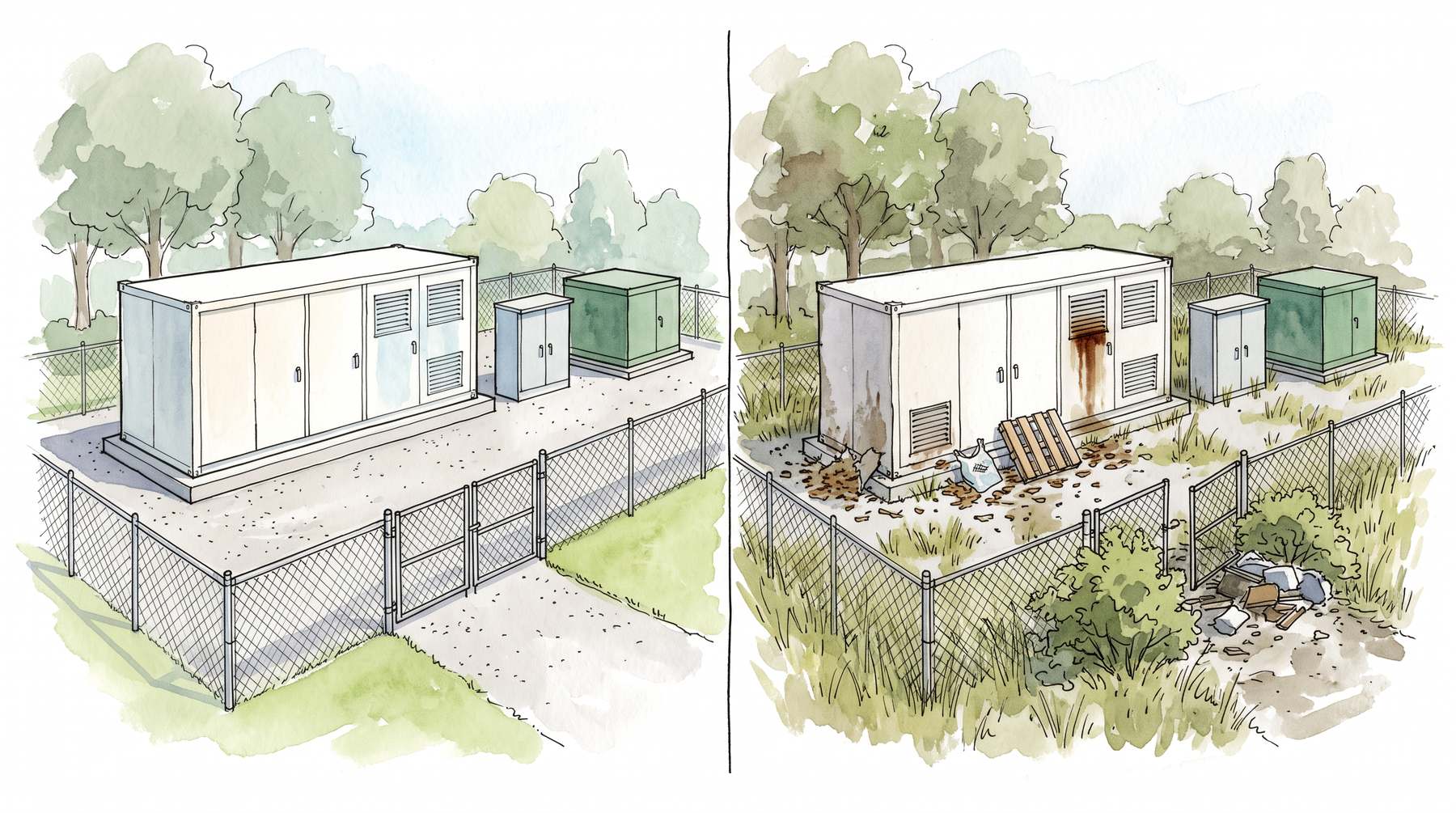
The same battery yard drawn twice. Year 1: clean pad, clear fence line, doors shut, gravel raked. Year 15 without care: weeds through the gravel, rust on the doors, a damaged vent, a blocked gate.
Figure 1. The same battery yard at year 1 and at year 15. Financing builds the left side. Only a funded O&M plan keeps it looking like that. Illustration, Gaiergy.

Gaiergy view

Treat a battery like a pump station or a substation. It is public infrastructure with a 20 to 25 year duty. Recommendation: consider buying the O&M, the monitoring and the end-of-life plan in the same contract that buys the battery, for the same term.

Section 2

Who can use energy contracts

The answerAlmost every kind of public or nonprofit owner has a legal path to pay for a battery through an energy contract. Cities, counties, states, schools, authorities, special districts, airports, housing authorities, industrial development agencies and nonprofits all have one. Federal agencies have their own. The path differs by owner type, and so does the money it can use.

Each card names the legal path, how the owner pays, and a real project with its source. Where no battery under an energy contract was found for an owner type, the card says so.

01

City or town

State ESPC law, service agreement, or utility host
Legal path
  • State energy savings contract law, such as New York Energy Law 9-103, New Jersey's Energy Savings Improvement Program (ESIP) or California Government Code 4217 (NY Energy Law 9-102, 9-103[1]; NJ P.L.2009 c.4; P.L.2012 c.55[11]; Cal. Gov. Code 4217.10-.19[12])
  • Or a power purchase and battery services agreement adopted by ordinance (Santa Barbara Council minutes 2026-03-10[13])
How it pays
  • Savings repay a tax-exempt lease, or a service fee comes from the operating budget

Project: San Diego, nearly 4 MWh of batteries inside an energy and water savings contract financed by a tax-exempt lease of nearly $112 million over 25 years (City of San Diego EWSPC[14]). Santa Barbara adopted a police station Power Purchase and Battery Energy Storage Services Agreement on 2026-03-10; size UNCONFIRMED (Santa Barbara Council minutes 2026-03-10[13])

02

County

State ESPC law or long-term power purchase
Legal path
  • County ESPC laws in most states reviewed (Section 6)
  • Or a power purchase or energy-as-a-service contract approved through the budget (Montgomery County Council 2021[15])
How it pays
  • Per-kWh price plus a resilience charge from the utilities budget (Montgomery County Council 2021[15])

Project: Montgomery County, Maryland, Brookville bus depot: 25-year power purchase agreement, first-year energy charge 12.3 cents/kWh, a 2 MW battery on the council slide (Montgomery County Council 2021[15]). Battery MWh UNCONFIRMED

03

State agency or state university

State ESPC law, NYPA, campus power purchase
Legal path
  • State agency ESPC laws (Section 6), or in New York, the New York Power Authority (NYPA) (NY PAL 1005(17)[16])
How it pays
  • Campus power purchase price from the operating budget, or NYPA financing repaid by the campus

Project: Sonoma State University, 30-year contract signed 2021, a 1.55 MW battery bank with 4.1 MW of solar, almost $1 million of savings in 2026 (Sonoma State 2026[17]). MW or MWh UNCONFIRMED. SUNY Fredonia: 500 kW of storage under a NYPA-managed power purchase agreement (SUNY Fredonia 2020[18])

04

School district

State ESPC law, school rules
Legal path
  • State ESPC law; New York schools also need Education Department approval and are capped at 18 years (8 NYCRR 155.20[19])
How it pays
  • Guaranteed savings repay the contract

Projects: Greenburgh Central School District, New York: $20.5 million ESPC with a 775 kW AC battery VENDOR (RWE 2024, Greenburgh[20]). Newark Board of Education, New Jersey: a $95 million ESIP with Johnson Controls, about 17 MW of solar by power purchase agreement and combined heat and power units; the only battery named is storage for a stadium wind turbine's lighting, size not given (Newark Board of Education ESIP page[21])

05

Public authority or special district

Water, sewer, transit, college districts
Legal path
  • State ESPC laws that cover districts, such as California Government Code 4217 (Cal. Gov. Code 4217.10-.19[12])
How it pays
  • Shared bill savings or a service fee to a third-party owner

Project: Irvine Ranch Water District, California: 6.25 MW / 35.7 MWh at six facilities, owned and operated by Macquarie Capital, about $500,000 a year of energy savings (IRWD 2018[22]). Contract form UNCONFIRMED

06

Airport

Same contracts, plus FAA rules
Legal path
  • Any contract above, inside the federal airport revenue and land rules (Section 8)
How it pays
  • Airport revenue, which stays at the airport (49 USC 47107[23])

Project: Fresno Yosemite International Airport: a 2,000 kW / 3,828 kWh battery under an energy services agreement at a fixed $0.2107/kWh for 20 years (Fresno Council ID 26-566[24])

07

Public housing authority

HUD energy performance contract
Legal path
  • HUD-approved energy performance contract, The contract period shall not exceed 20 years (24 CFR 990.185[5])
  • HUD's 2024 notice does not name batteries as a measure (HUD PIH 2024-27[25]); a HUD staff deck names Solar Plus Battery Storage (HUD Energy Branch slides 2023[26])
  • New Jersey lets the utility board allow a housing authority to use the HUD process inside ESIP (NJ P.L.2012 c.55[27])

Projects: no housing authority battery under an energy contract was found. Grants lead: Worcester Housing Authority, 125 kW / 261 kWh, $521,640 state grant, awarded 2026-09-18 (Mass. DOER 2026[28]). NYCHA has a battery planned with NYPA at Borinquen Plaza; size UNCONFIRMED (NYCHA 2023[29]). In New Jersey, the Newark Housing Authority used two HUD-approved energy performance contracts, $134 million in all, with cogeneration units that give power during outages; no battery was included VENDOR (Constellation, Newark Housing Authority[30])

08

Industrial development agency

New York IDAs and their counterparts
Legal path
  • New York IDAs may assist a renewable energy project, which points to equipment in Real Property Tax Law 487; that law lists various types of batteries (NY GML 854[31]; NY RPTL 487[32]). Reading the two together to cover a stand-alone battery is GAIERGY VIEW
How it pays
  • Sales tax exemption, payments in lieu of taxes, or conduit bonds for a private owner (NY GML 858[33]; NY GML 874[34])

Projects: the New York City IDA closed 14 battery projects in fiscal 2025, nearly 100 MW (NYCIDA FY2025[35]). All found are privately owned. Section 15 covers the IDA role

09

Nonprofit hospital, university or housing group

Private contract, direct pay
Legal path
  • Public ESPC laws in New York, New Jersey and California name public bodies, so a private nonprofit signs an ordinary private contract instead GAIERGY VIEW (NY Energy Law 9-102, 9-103[1]; NJ P.L.2009 c.4; P.L.2012 c.55[11]; Cal. Gov. Code 4217.10-.19[12])
  • The US Environmental Protection Agency (EPA) notes ESPCs are mostly used by government and nonprofit entities (US EPA, ESPC and ESA page[4])
How it pays
  • Service fee, loan or cash; tax-exempt nonprofits can take the storage credit as a direct payment (Section 9) (26 USC 6417[36])

Project: Hackensack Meridian Health, New Jersey: a 30-year energy-as-a-service agreement, $134 million of work, nearly 98% of it solar and battery storage VENDOR (ENFRA, HMH project page[37]). Battery size UNCONFIRMED

10

Federal agency

Its own ESPC and UESC laws

Federal agencies sign ESPCs for up to 25 years under 42 U.S.C. 8287(a)(1) and utility contracts under 42 U.S.C. 8256 (42 USC 8287[7]; 42 USC 8256[38]). Example: Marine Corps Recruit Depot Parris Island, a 4.0 MW / 8 MWh battery inside a $91 million project VENDOR (Ameresco 2019, Parris Island[39]). Sections 5 and 6 treat the federal contracts as one variant among many.

Gaiergy view

The owner type sets three things: which law the contract sits under, whether the owner can take the tax credit as cash, and how long the term can run. Recommendation: consider settling those three questions before choosing a contractor.

Section 3

What a battery is, and why each part is there

The answerA battery site has about 23 working parts. Only one of them stores energy. The others convert, control, protect, connect and watch it. Most failures start in those other parts: controls caused 46% of classified failures and the balance of system 43%. Cells caused 11% (EPRI 2024 root cause paper[2]).

A system integrator puts battery modules in containers, adds cooling and fire suppression, and connects them to the inverter. A construction contractor installs the system and connects it to the grid (PNNL 2020[40]). The Pacific Northwest National Laboratory (PNNL) groups the hardware into the storage block, the balance of system, the power conversion system, controls and communication, and grid integration (transformer, busbars, breakers and meters) (PNNL 2020[40]).
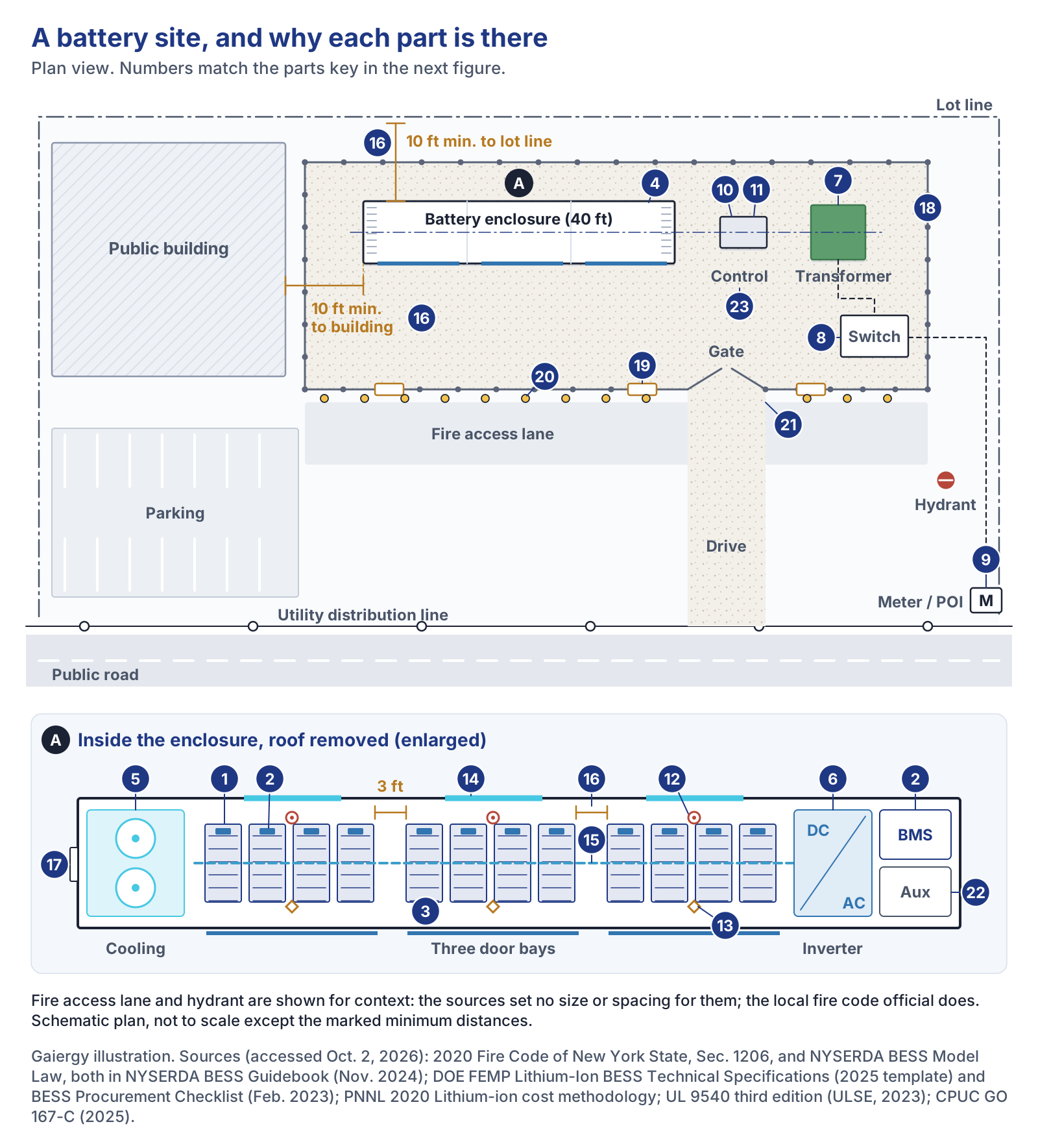
Plan view of a fenced battery site with 23 numbered parts, from cells and racks to the utility meter, with a key that gives one line on why each part is there.
Figure 2. An outdoor battery site in plan view; the numbers match the parts key in the next figure and the cards below. Gaiergy graphic based on PNNL, the New York fire code and the DOE Federal Energy Management Program (FEMP) specification cited in the cards.
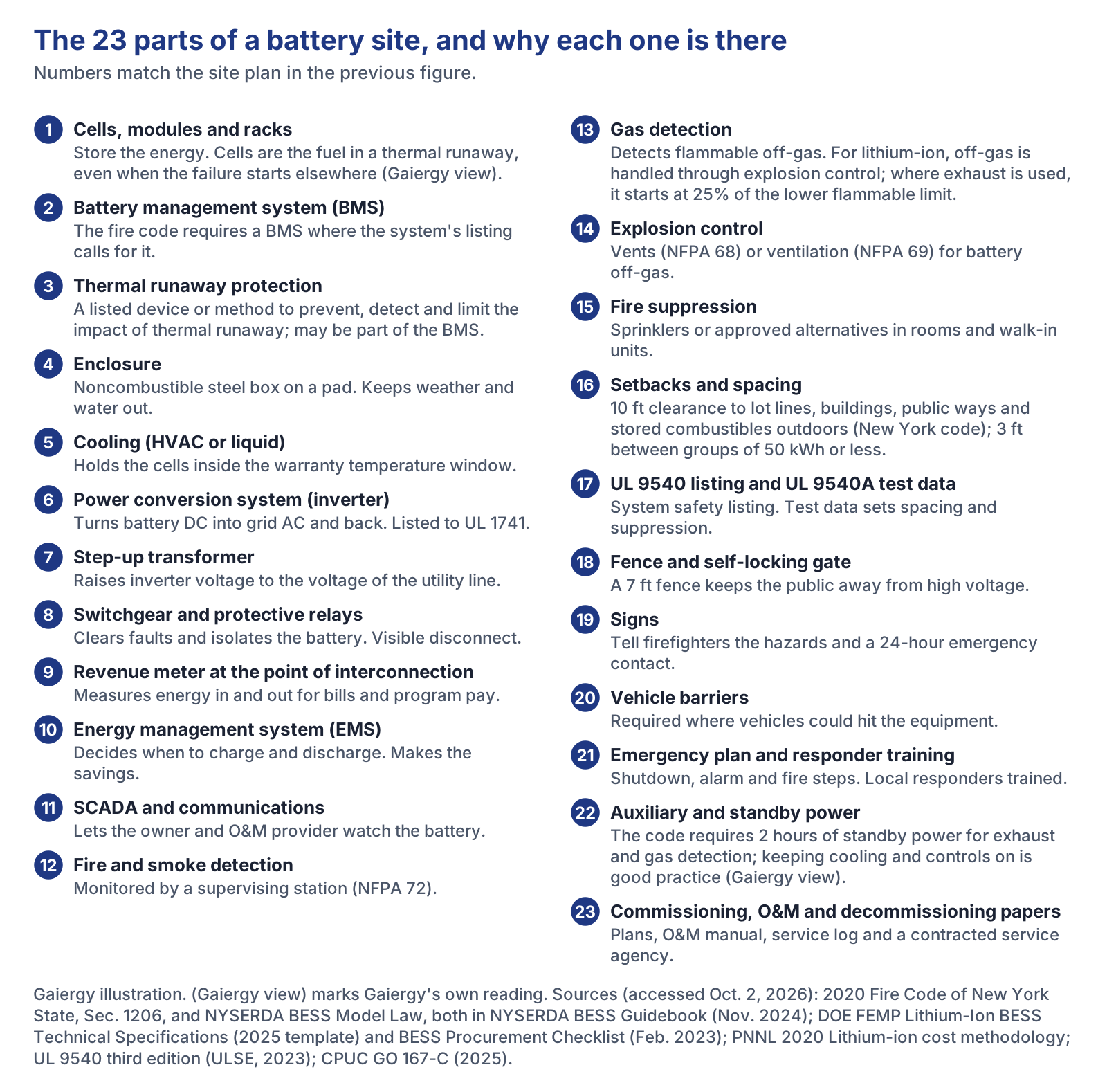
The 23 parts of a battery site in a numbered key, each with what it does and why it is there.
Figure 3. The 23 parts of a battery site and why each one is there; the numbers match Figure 2. Gaiergy graphic based on the PNNL, New York fire code and FEMP sources cited in the cards below.

Store and convert

Parts 1 to 9
01

Cells, modules and racks

Store the energy. Cells are the fuel in a thermal runaway, even when the failure starts elsewhere GAIERGY VIEW.

02

Battery management system

Watches cell voltage, current and temperature, and puts the system in a safe state on a fault. The fire code calls for one where the system's listing calls for it (NYSERDA BESS Guidebook 2024[41]).

03

Thermal runaway protection

A listed device or method to prevent, detect and limit the impact of thermal runaway; it may be part of the battery management system. The fire code calls for it for lithium-ion (NYSERDA BESS Guidebook 2024[41]).

04

Enclosure on a pad

Noncombustible steel box. Keeps out weather and water. Outdoor walk-in units over 4,028 cubic feet count as indoor rooms (NYSERDA BESS Guidebook 2024[41]; FEMP Li-ion BESS spec 2025[42]).

05

Cooling: air conditioning or liquid

Holds cells inside the warranty temperature window (FEMP Li-ion BESS spec 2025[42]).

06

Inverter (power conversion)

Turns battery DC into grid AC and back. Listed to UL 1741, a UL Standards and Engagement (UL) standard, for grid use (NYSERDA BESS Guidebook 2024[41]; FEMP BESS procurement checklist 2023[43]).

07

Step-up transformer

Raises inverter output to the utility line voltage (PNNL 2020[40]).

08

Switchgear and relays

Clear faults and isolate the battery, plus a visible disconnect for the utility (FEMP Li-ion BESS spec 2025[42]).

09

Revenue meter

Measures energy in and out for bills, demand savings and program payments (PNNL 2020[40]; FEMP BESS procurement checklist 2023[43]).

Control and watch

Parts 10 and 11
10

Energy management system

The site controller. Decides when to charge and discharge. This is what turns the battery into savings. FEMP asks for a written sequence of operations and dispatch updates when tariffs or loads change (PNNL 2020[40]; FEMP Li-ion BESS spec 2025[42]).

11

Supervisory control and data acquisition (SCADA), data and communications

Lets the owner and the O&M provider watch the battery. FEMP asks for 15-minute data, at least 36 months stored, alarms, a separate internet connection and agency cybersecurity rules (FEMP Li-ion BESS spec 2025[42]).

Protect people and property

Parts 12 to 20
12

Smoke and flame detection

Monitored by a supervising station (NYSERDA BESS Guidebook 2024[41]).

13

Gas detection

Detects flammable off-gas. Where exhaust ventilation is used, it is designed to keep gas below 25% of the lower flammable limit and has 2 hours of standby power. For lithium-ion, the code handles off-gas mainly through explosion control, not a stand-alone ventilation rule (NYSERDA BESS Guidebook 2024[41]).

14

Explosion control

Vent panels or ventilation, because battery off-gas can ignite in a closed box. UL 9540, third edition (2023), added explosion control (NYSERDA BESS Guidebook 2024[41]; ULSE 2023[44]).

15

Fire suppression

In rooms and walk-in units: sprinklers at 0.3 gpm per square foot, or other agents approved by large-scale tests (NYSERDA BESS Guidebook 2024[41]).

16

Spacing and setbacks

10 feet from lot lines, buildings, public ways and stored combustibles outdoors, so a fire does not reach neighbors or exits. This is the New York code; other codes and local zoning can differ (NYSERDA BESS Guidebook 2024[41]).

17

UL 9540 listing and UL 9540A test

System safety listing and fire test data. They justify spacing and suppression choices (NYSERDA BESS Guidebook 2024[41]).

18

Fence and gate

A fence with a self-locking gate; the New York model law suggests 7 feet as a default each town can edit (NYSERDA BESS Guidebook 2024[41]).

19

Signage

Hazards, suppression type and a 24-hour emergency contact for firefighters (NYSERDA BESS Guidebook 2024[41]).

20

Vehicle barriers

Bollards where a vehicle could hit the units, as in a parking lot (NYSERDA BESS Guidebook 2024[41]).

Keep it running and plan its end

Parts 21 to 23
21

Emergency plan and responder training

Shutdown, alarm and fire procedures, drills and training of local firefighters (NYSERDA BESS Guidebook 2024[41]; CPUC GO 167-C[45]).

22

Station and standby power

The code calls for 2 hours of standby power for exhaust ventilation and gas detection (NYSERDA BESS Guidebook 2024[41]). Keeping cooling and controls on too is good practice GAIERGY VIEW.

23

Commissioning, O&M manual, decommissioning plan

Paper, not hardware, but the fire code lists all three, plus a contracted service agency and a service log (NYSERDA BESS Guidebook 2024[41]).

Code note: the New York code cited above is the 2020 Fire Code of New York State, Section 1206, as reprinted by NYSERDA. NYSERDA says these rules are based on the 2021 International Fire Code (IFC), where they sit in Section 1207 (NYSERDA BESS Guidebook 2024[41]). Whether the 2024 IFC is the same is UNCONFIRMED. New York adopted a newer code in 2025 (Section 10).
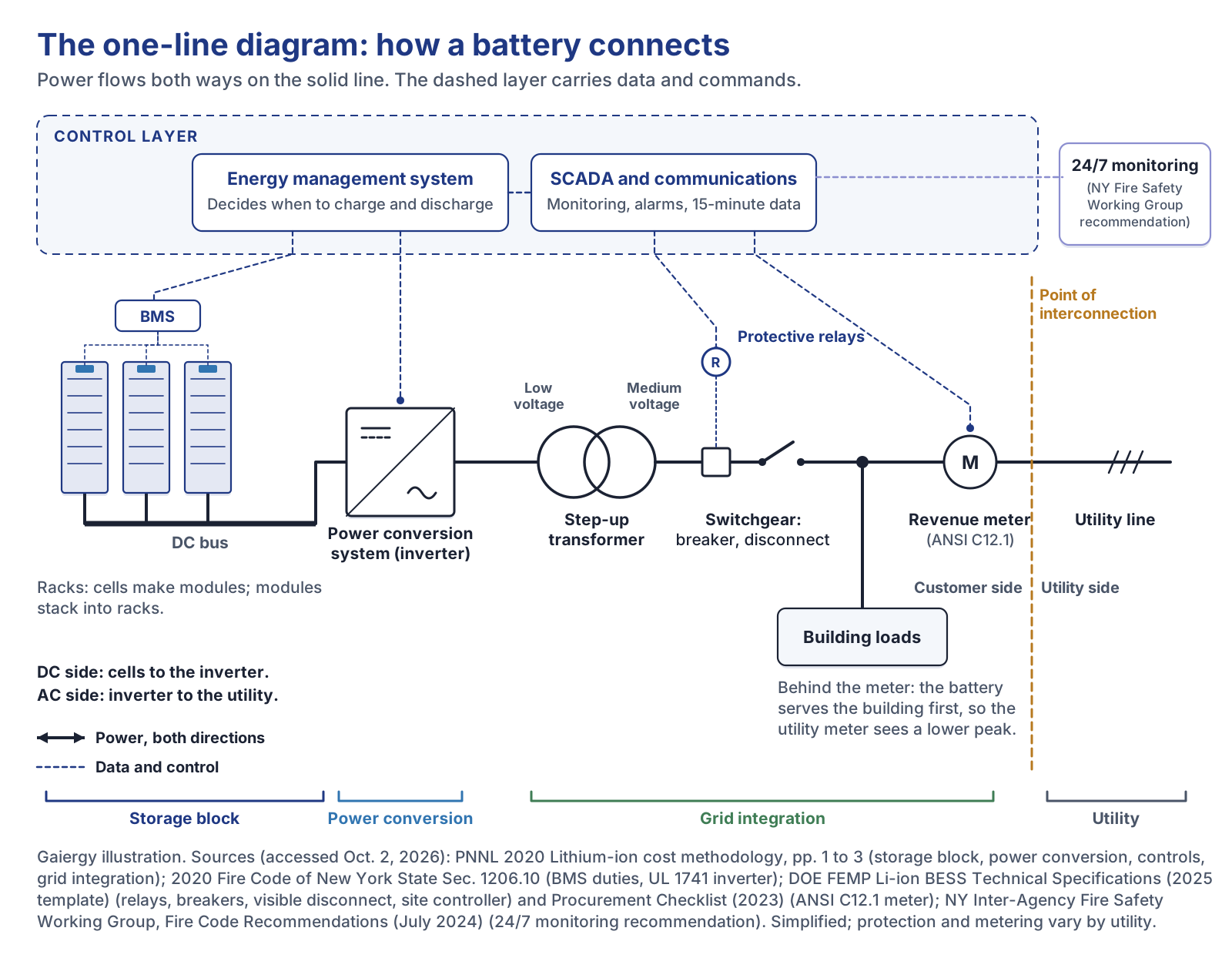
One-line electrical diagram from cell to rack, battery management system, inverter, transformer, switchgear, revenue meter and the utility line.
Figure 4. How power flows: cell, rack, battery management system, inverter, transformer, switchgear, meter, utility. Gaiergy graphic based on PNNL (PNNL 2020[40]).
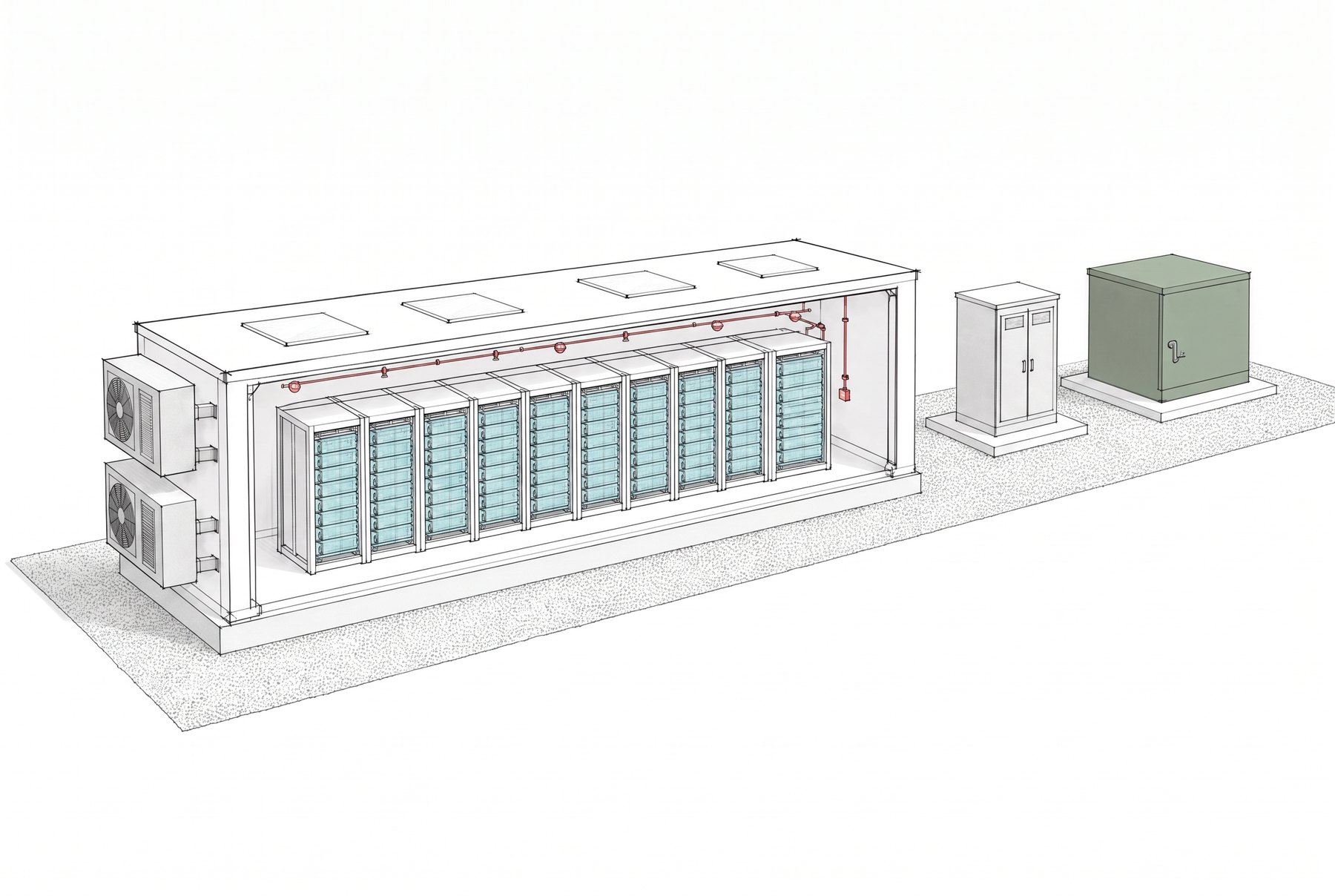
Cutaway of one white battery enclosure showing battery racks, the cooling unit, fire and gas detectors, and roof vent panels.
Figure 5. Inside one battery enclosure: racks, cooling, fire and gas detection and explosion venting. Illustration, Gaiergy.
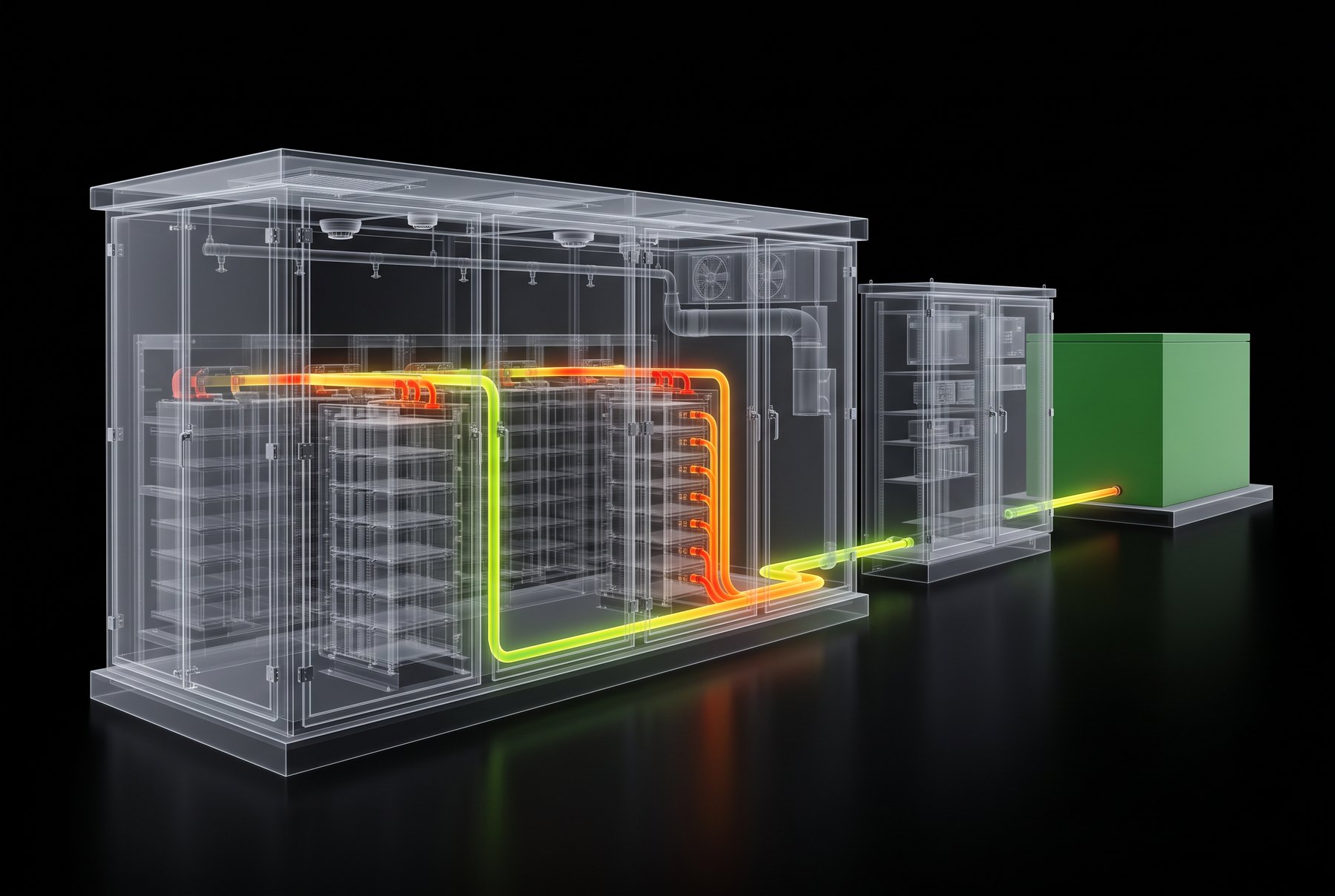
The same battery enclosure drawn as an x-ray: the racks, cooling loop, wiring and safety systems that sit behind the closed doors.
Figure 6. What sits behind the doors. The parts that cause most failures (controls, wiring, cooling and safety systems) are the parts nobody sees from the fence. Illustration, Gaiergy.

The three-piece set at a public site

A typical small public battery site shows three pieces from the fence: the battery enclosure, a small control and communications cabinet, and the transformer. Figures 7 and 8 show the set in plain form.
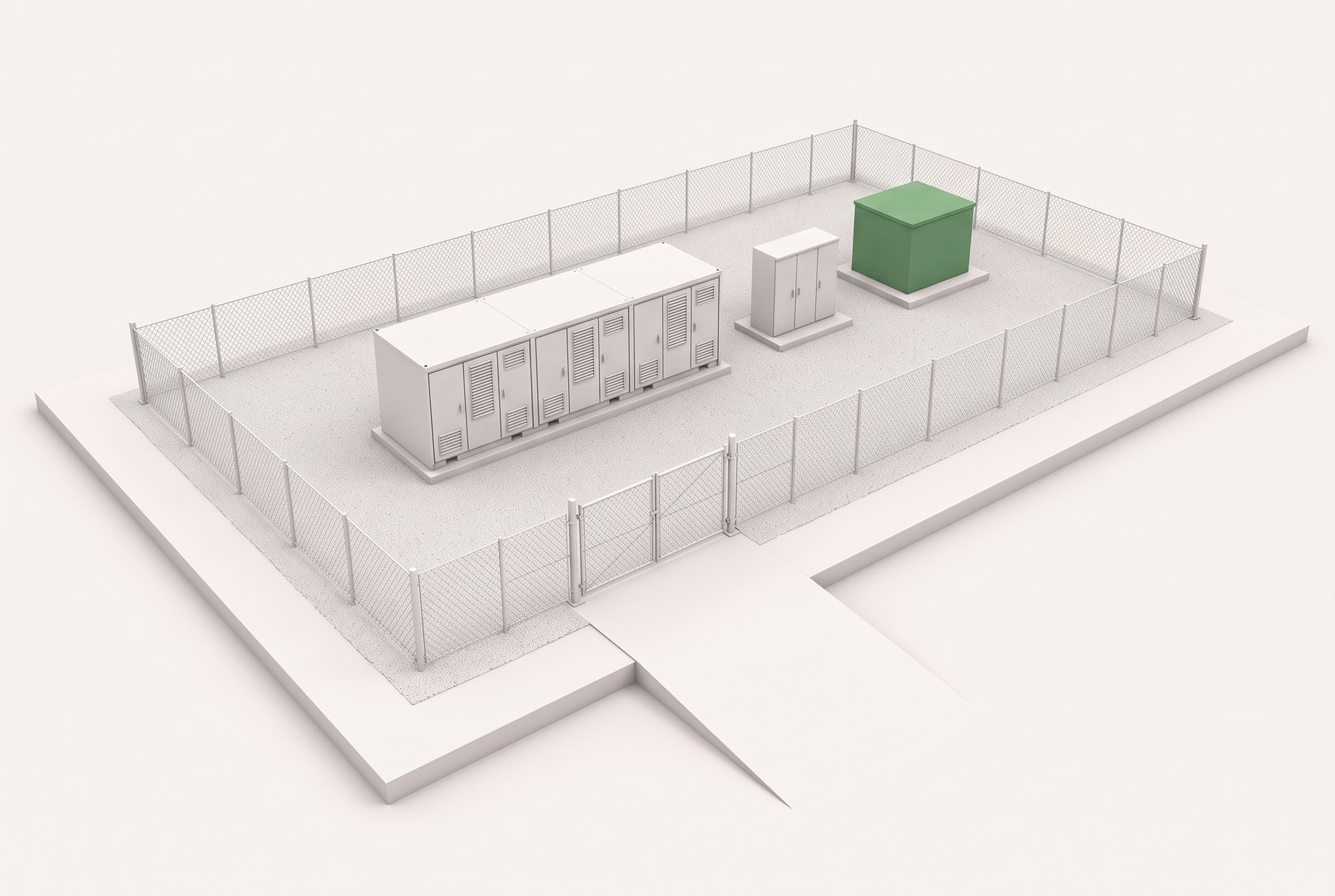
Clay model of the three-piece battery set on one straight line: a white enclosure on a low plinth, a small gray cabinet and a plain green transformer cube.
Figure 7. The three pieces a neighbor sees: battery enclosure, control cabinet and transformer. Illustration, Gaiergy.
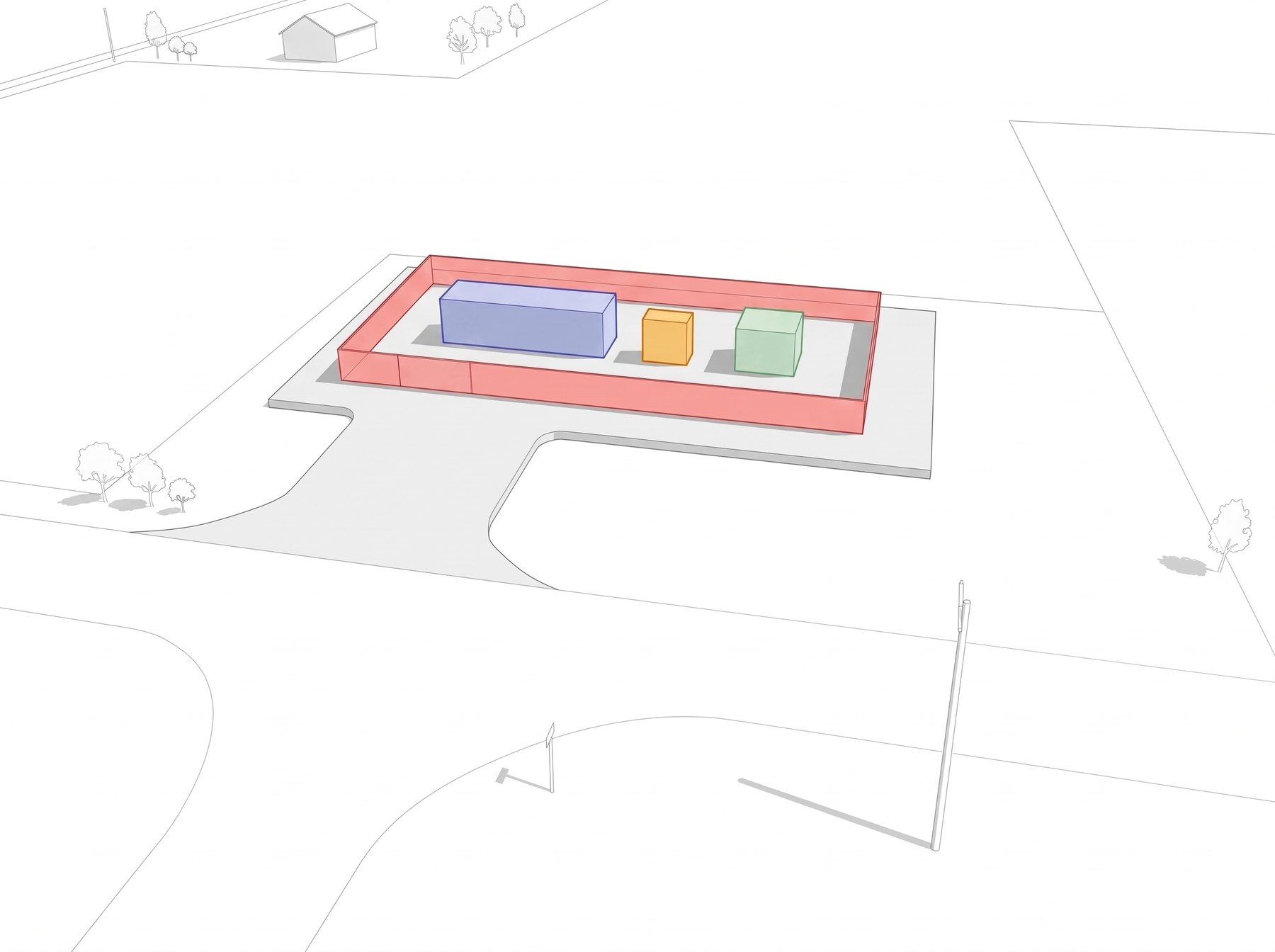
Massing model of a container battery site in plain colored blocks: enclosure, cabinet, transformer, fence and access drive.
Figure 8. A container site in plain blocks: enclosure, cabinet, transformer, fence and drive. Illustration, Gaiergy.
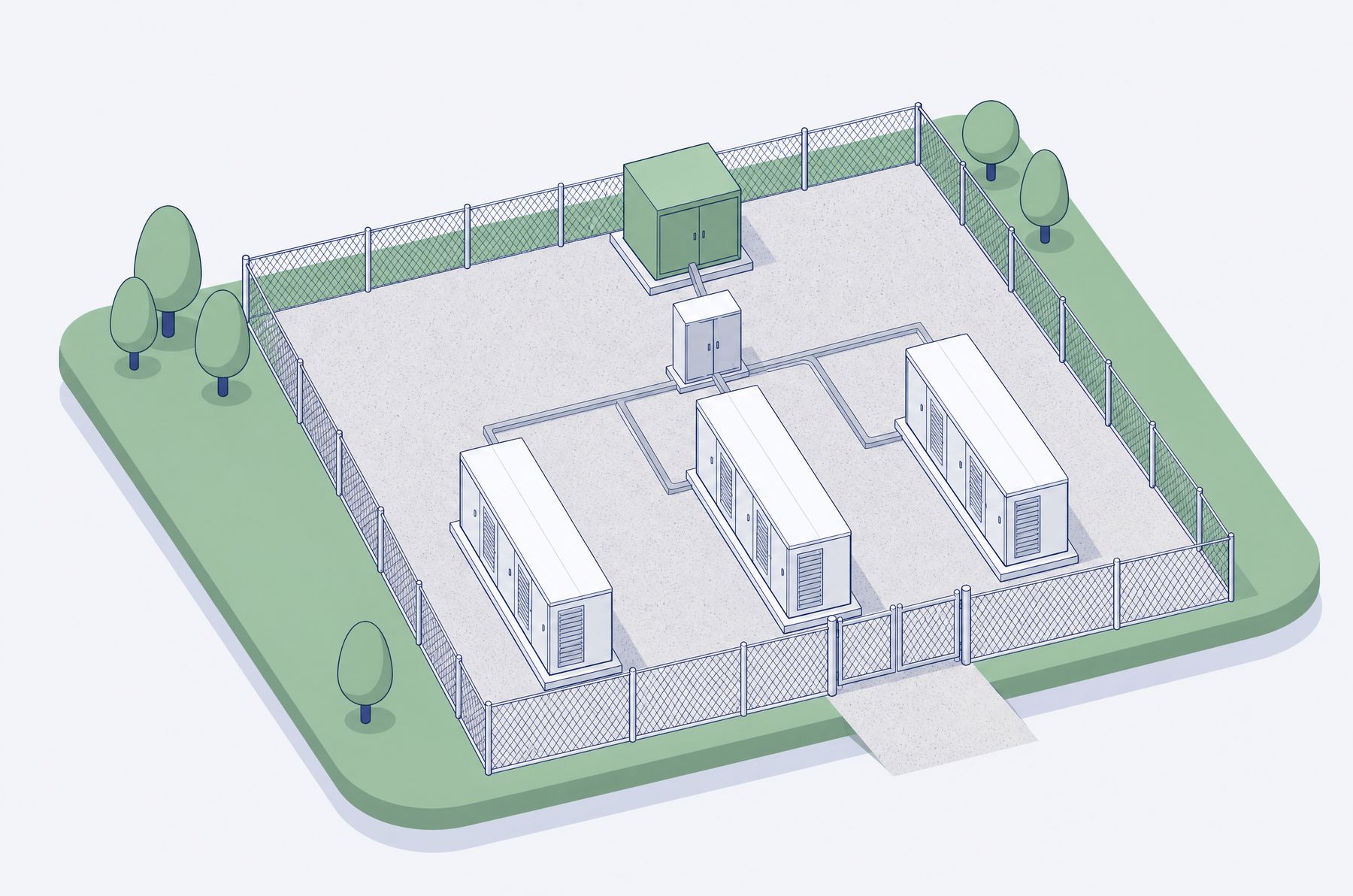
A larger battery yard: three white enclosures side by side, all tied into one shared gray control cabinet and one plain green transformer, inside a fence with a gate and short drive.
Figure 9. A utility-grade yard: three enclosures share one control cabinet and one transformer. The US Energy Information Administration counts systems of at least 1 MW as utility scale (EIA Today in Energy 41813[46]). Illustration, Gaiergy.

The building-scale version

A battery that serves one building uses the same parts, smaller. FEMP's template specification describes this case: a behind-the-meter lithium-ion battery in self-contained enclosures on a pad, with cooling, a sequence of operations, commissioning to the National Fire Protection Association standard NFPA 855 or the IFC, and optional backup through a transfer switch and microgrid controller (FEMP Li-ion BESS spec 2025[42]). Typical cabinet size for this class of system is UNCONFIRMED.

Where it can go

  • FEMP: It is typically not feasible to place lithium-ion BESS on roofs or in buildings (FEMP BESS procurement checklist 2023[43])
  • Consider the site's 100-year flood plain and surge levels (FEMP BESS procurement checklist 2023[43])
  • Outdoor lot: 10 feet from buildings, lot lines and public ways, or 3 feet behind a 1-hour fire barrier that extends 5 feet above and 5 feet beyond the unit (NYSERDA BESS Guidebook 2024[41])
  • Wall mounting only for units of 20 kWh or less (NYSERDA BESS Guidebook 2024[41])

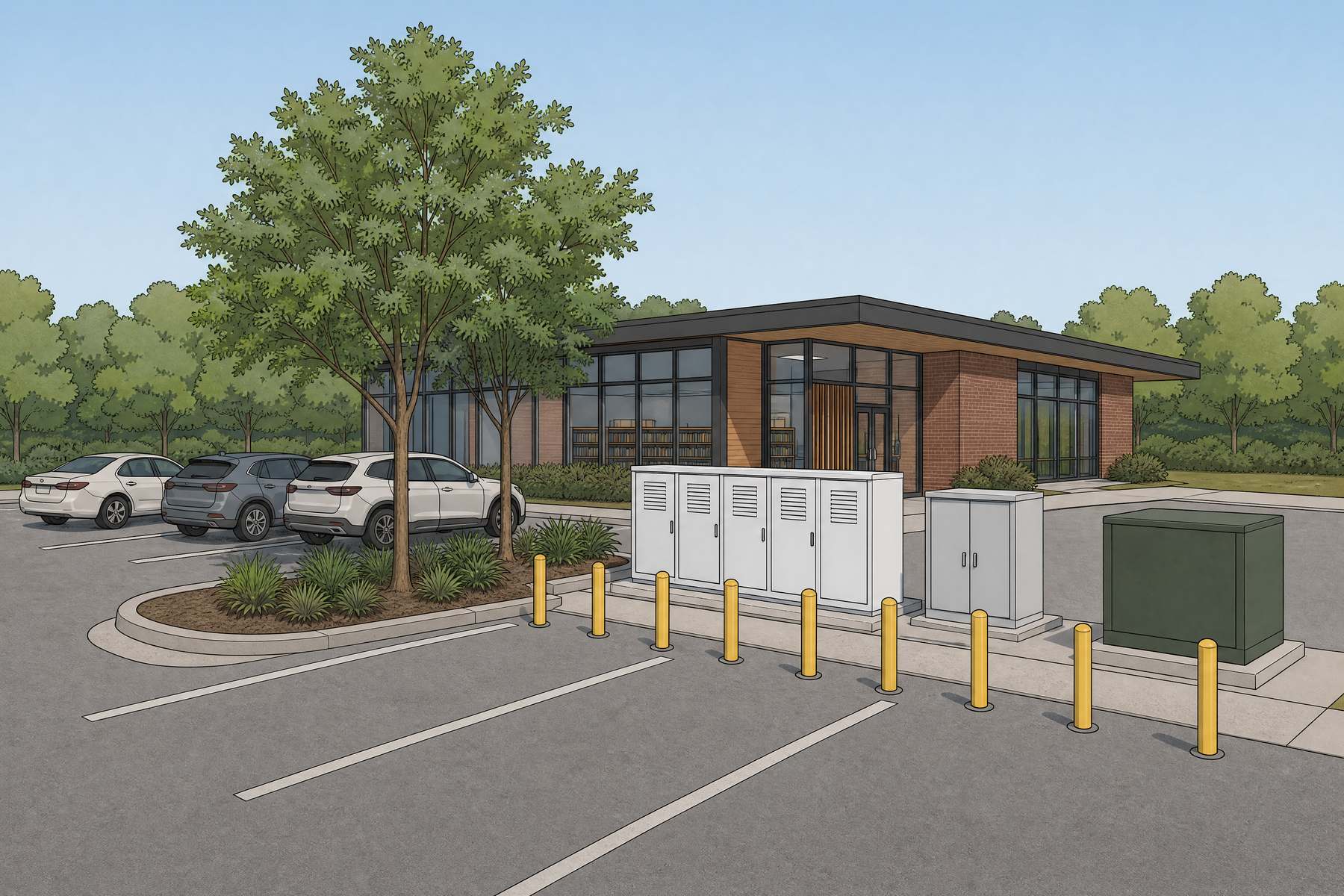
Parking lots and garages

  • Open garages: flame detection, suppression, 10 feet from parked cars and exits (NYSERDA BESS Guidebook 2024[41])
  • Vehicle barriers wherever a car could hit a unit (NYSERDA BESS Guidebook 2024[41])
  • FEMP expected service life: 10 years for the battery and its equipment (FEMP BESS procurement checklist 2023[43]), so a 20 to 25 year contract needs augmentation or replacement GAIERGY VIEW
Building-scale battery cabinets in a public parking lot, set behind steel bollards with clear space around them.
Figure 10. Building-scale cabinets in a parking lot, with vehicle barriers and clear space. Illustration, Gaiergy.
Section 4

What a battery earns a public owner

The answerA battery earns money four ways. Two of them carry most contracts: lower demand charges and paid peak programs. Grid services can add income. Backup power has real value, but it does not pay the bill on its own (PNNL-37058[47]).

1. Lower demand charges

  • Demand charge: set by the highest interval in the bill period, usually 15 minutes (NREL/BR-6A20-68963[10])
  • FEMP counts battery savings from lower peak demand and time-of-use charges (FEMP M&V Guidelines 5.0[48])

Pays most contracts

2. Paid peak programs

  • Utility demand response pays per kW reserved and per kWh delivered
  • Rates in the cards that follow

Pays when the battery shows up

3. Grid services

  • Capacity, transmission peak and market income
  • Federal law lets grid services revenue fund an ESPC (42 USC 8287[7])

Variable: guarantee with care

4. Backup power

  • Real value in an outage
  • No cash savings on its own (PNNL-37058[47])

A benefit, not a payment source

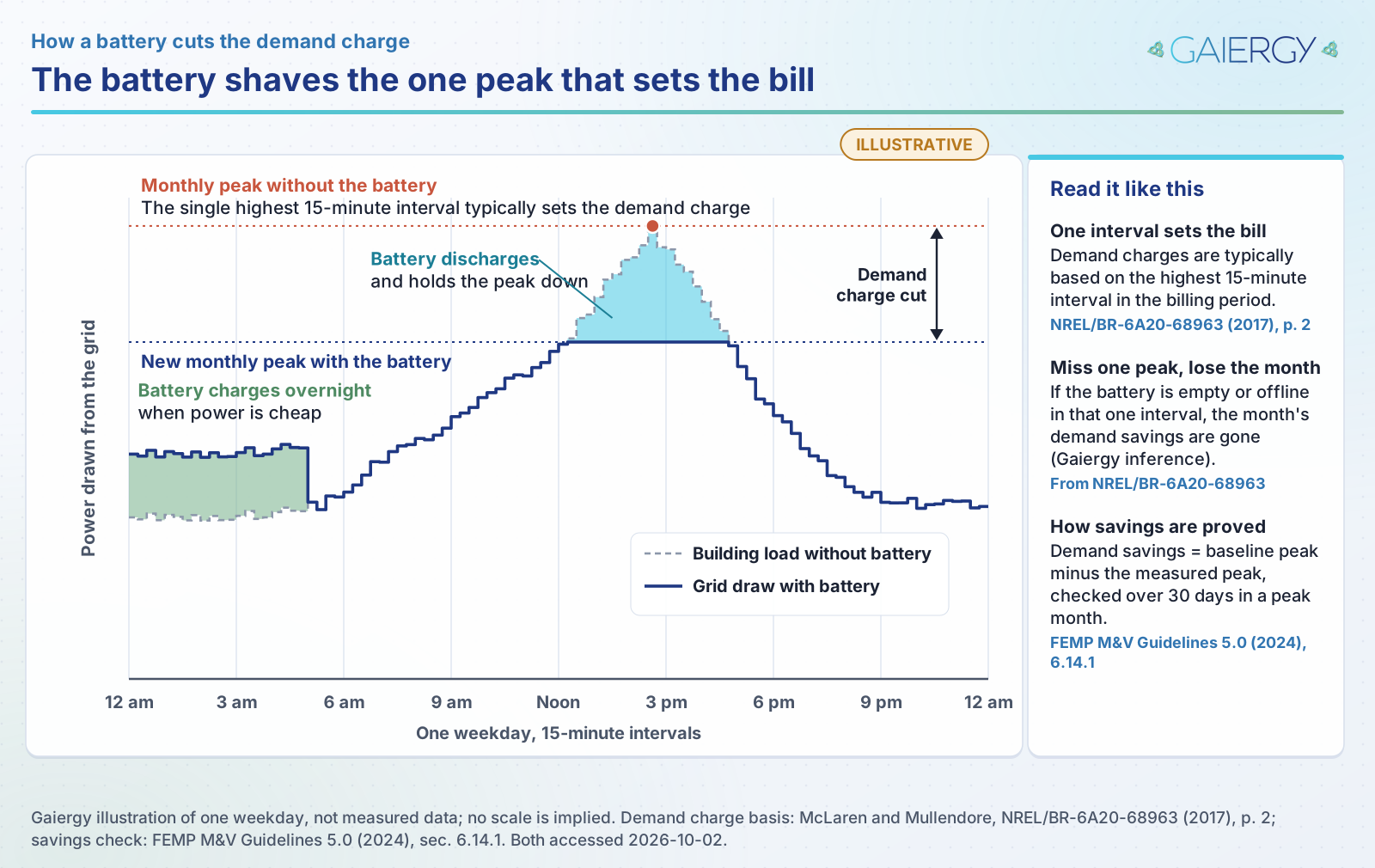
One day of building load in 15-minute steps. Without the battery the afternoon peak sets the demand charge. With the battery the peak is shaved flat and the battery recharges at night.
Figure 11. Peak shaving in one day. The battery charges at night and discharges through the afternoon peak, so the highest 15-minute interval drops. Illustration, Gaiergy; not data from a real site.

1. Lower demand charges

Most commercial and public accounts pay a demand charge. It is typically based on the highest average electricity usage occurring within a defined time interval (usually 15 minutes) during a billing period (NREL/BR-6A20-68963[10]). A battery that discharges during that interval lowers the bill. FEMP's measurement rules treat a battery as a measure that cuts peak demand and time-of-use energy charges (FEMP M&V Guidelines 5.0[48]). At San Diego International Airport, peak demand charges were about 40% of the airport's monthly electricity costs when it added a 2 MW / 4 MWh battery VENDOR (Cleantech San Diego 2019[49]).

2. Paid peak programs

Utilities pay customers to cut load when the grid is tight. A battery can deliver that cut without turning anything off. These rates were on utility and regulator pages on 2026-10-02:

National Grid, Upstate New York

$2.75 / kW-month (National Grid Upstate NY DR page[50])
  • Commercial System Relief Program (CSRP): $2.75/kW-month plus $0.18/kWh (National Grid Upstate NY DR page[50])
  • Distribution Load Relief Program (DLRP): $5.00/kW-month plus $0.18/kWh, only for customers served by New Krumkill Substation (National Grid DLRP flyer[51])

National Grid's Dynamic Load Management (DLM) programs, Term-DLM and Auto-DLM, pay only for load relief on the substation and feeders listed in each request for proposals (National Grid DLM RFP 2027[52])

Massachusetts: National Grid and Eversource

$200 / kW-summer (National Grid MA ConnectedSolutions[53])
  • ConnectedSolutions daily dispatch for batteries, 30 to 60 events a summer, 2 to 3 hours each (National Grid MA ConnectedSolutions[53]; Mass Save ConnectedSolutions 2023[54])
  • 5-year incentive rate lock for batteries in daily dispatch (Mass Save ConnectedSolutions 2023[54])

Open to National Grid electric customers on a commercial electric rate who pay into the energy efficiency fund (National Grid MA ConnectedSolutions[53])

Con Edison, New York City

$6 to $25 / kW-month (Con Edison Smart Usage Rewards[55])
  • Distribution Load Relief Program (DLRP) reservation: Tier 1 networks $18, Tier 2 networks $25, plus $1/kWh in events (Con Edison Smart Usage Rewards[55])
  • Commercial System Relief Program (CSRP): $6 to $18 by location, plus $1/kWh in events (Con Edison Smart Usage Rewards[55])

Two programs, two rate scales

PG&E, Southern California Edison and SDG&E, California

$2 / kWh (CPUC ELRP page[56])
  • Emergency Load Reduction Program for non-residential load cuts, including battery export with permission (CPUC ELRP page[56])
  • Pilot runs through 2027 (CPUC ELRP page[56])

Pays per event, not per month

3. Grid services and transmission peaks

Municipal electric utilities show how much a well-timed battery can earn. Sterling Municipal Light Department in Massachusetts installed a 2 MW / 3.9 MWh battery in 2016 for about $2.7 million. It reports savings of about $400,000 a year (Sterling MLD fact sheet[57]). Sandia attributes the value mainly to cutting the monthly transmission peak and the yearly capacity peak (Sandia SAND2017-1093[58]). Sandia's study of the site makes the timing plain: the battery has to be fully charged and then discharge during the hour of monthly peak load (Sandia SAND2017-1093[58]). The Massachusetts Municipal Wholesale Electric Company (MMWEC) reports $33.8 million of member savings from peak forecasting and dispatch from 2017 to 2024 (MMWEC energy storage page[59]).

For federal agencies, the Energy Act of 2020 added grid services revenue to the list of things that count as energy savings and that may fund an ESPC (42 USC 8287[7]; 42 USC 8287c[60]). The statute does not define the term. Whether wholesale capacity and frequency regulation income count is UNCONFIRMED; Gaiergy reads the plain words as covering them GAIERGY VIEW. FEMP notes that savings from demand response and similar grid-interactive measures may be highly variable when they depend on utility signals, and suggests a reduced starting guarantee or a contractor reserve account until the savings are proven (FEMP GEB best practices 2024[61]).

4. Backup power

Resilience is real, but it rarely pays the contract. PNNL: resilience improvement measures do not always result in a reduction in energy or water consumption and therefore do not generate utility cost savings which are the primary driver behind performance contracts (PNNL-37058[47]). Federal ESPC law allows benefits ancillary to energy savings (42 USC 8287[7]); Gaiergy reads resilience as one GAIERGY VIEW. No federal rule was found that lets an agency count a dollar value of avoided outages toward the savings guarantee UNCONFIRMED.

Two methods close the gap. Bundling: at the Oklahoma City federal building, pairing grid-interactive measures with fast-payback measures helped offset the long payback periods typical of resilience technologies (PNNL-37058[47]). Mixing money: FEMP says appropriations can be combined with financing for costs that savings cannot carry (FEMP microgrid fact sheet 2025[62]).
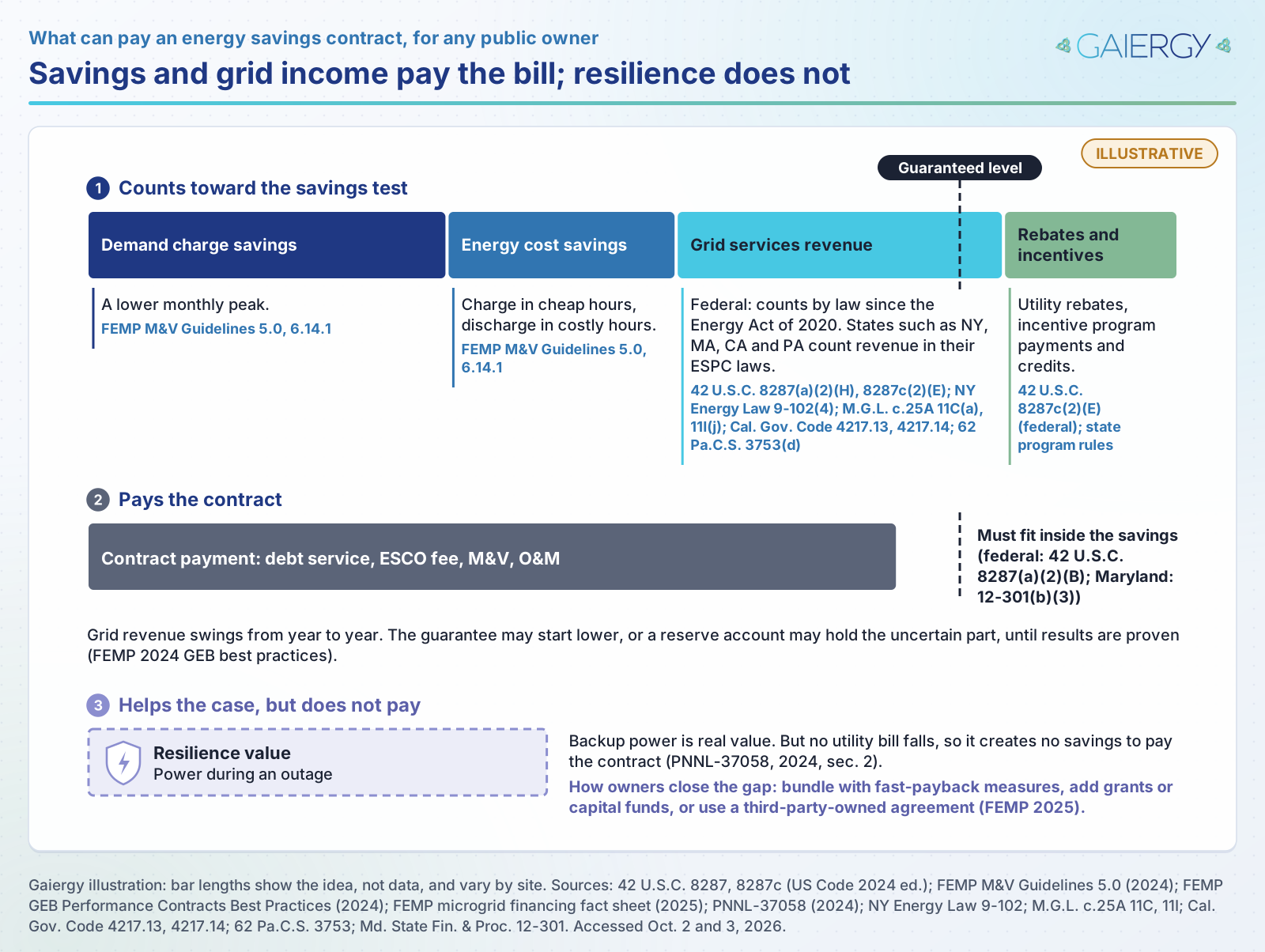
Stacked bar of what counts as savings for a battery contract: demand charge cut, time-of-use shift, peak program payments, grid services revenue; shown apart: resilience value, which does not count.
Figure 12. What can pay an energy savings contract for any public owner: demand and energy savings, grid services revenue, and rebates and incentives. Resilience value sits outside the stack. Illustration, Gaiergy, based on FEMP, federal law and state ESPC laws (FEMP M&V Guidelines 5.0[48]; 42 USC 8287[7]; NY Energy Law 9-102, 9-103[1]; M.G.L. c.25A[63]; Cal. Gov. Code 4217.10-.19[12]; 62 Pa.C.S. 3751-3758[64]).
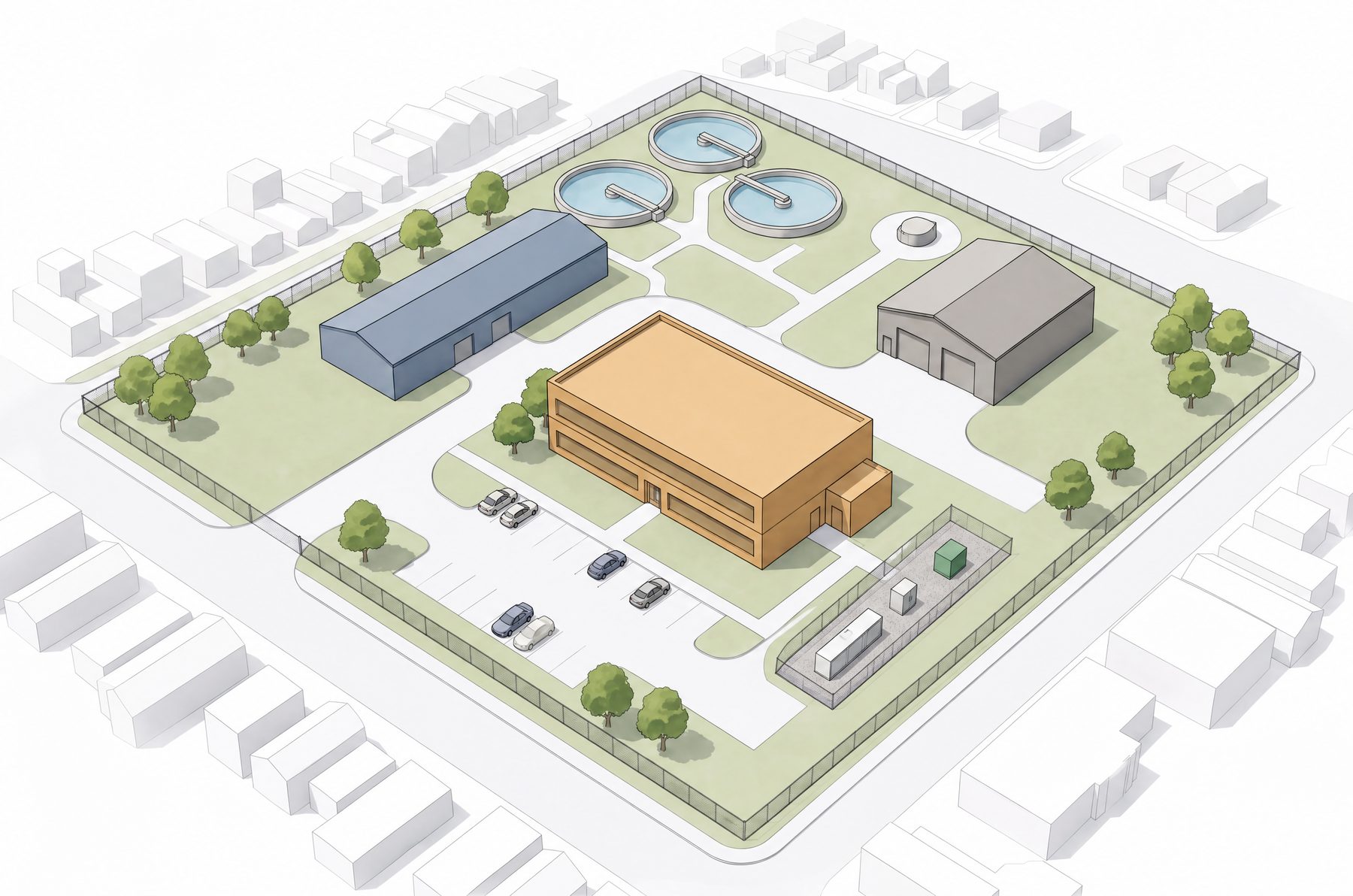
Axonometric view of a city water plant and public works yard with a fenced battery yard placed near the plant's electrical service, away from the street.
Figure 13. A city campus: the battery sits next to the plant's electric service, where it can cut the plant's peak. Illustration, Gaiergy.

Gaiergy view

Recommendation: size the savings guarantee on what can be measured every month, the demand charge cut and the program payments. Count grid services only after a year of results. Treat backup power as a benefit the community gets, not as a line in the payment plan.

Section 5

ESPC and UESC side by side, and six other paths

The answerAn ESPC buys a guarantee: an energy service company (ESCO) promises the savings, and most state laws and the federal law build in maintenance and verification. A UESC buys convenience: the serving utility designs, finances and builds. Non-federal owners can use both. They run ESPCs under state law, and they reach a UESC through three routes: the utility competes as the ESCO, a procurement exemption, or a utility tariff or public power program.

How a city, county, state or school runs an ESPC

Every program found follows the same six steps, whatever the state (DOE ESPC toolkit App. A[65]; NYSERDA EPC guide 2013[66]; NJ DCA LFN 2009-11[67]; Cal. Gov. Code 4217.10-.19[12]):

  1. Governing body decisionA resolution or board vote to pursue the contract. DOE suggests a team from administration, finance, legal, procurement, facilities, maintenance (DOE ESPC toolkit App. A[65]).
  2. Choose the ESCOFrom a pre-qualified state pool or by request for proposals. DOE's model pool runs five years with an annual review (DOE ESPC toolkit App. D[68]).
  3. Investment grade auditNYSERDA advises having funds for the audit before the request goes out, because the cost will not be recovered if no project results (NYSERDA EPC guide 2013[66]).
  4. Guaranteed contract plus financingDOE tells owners to Competitively solicit financing (DOE ESPC toolkit App. A[65]). Common forms: lease-purchase, certificates of participation, tax-exempt lease (below).
  5. Build and commissionNew Jersey asks for an independent review of the system after commissioning (NJ DCA LFN 2009-11[67]).
  6. Measure and verify for the termNYSERDA points to the latest International Performance Measurement and Verification Protocol (NYSERDA EPC guide 2013[66]).

Financing forms

  • Tax-exempt lease: San Diego, nearly $112 million over 25 years (City of San Diego EWSPC[14])
  • Certificates of participation: Hawaii's airports, $167.7 million (Hawaii DOT 2013[69])
  • New Jersey: lease-purchase with the ESCO, a lender, a county improvement authority or the state economic development authority (NJ DCA LFN 2009-11[67])

Non-appropriation clause

  • New York: the contract is executory only to the extent money is appropriated (NY Energy Law 9-102, 9-103[1])
  • Florida: annual renewal subject to the agency making sufficient annual appropriations (Fla. Stat. 489.145[70])
  • New Jersey energy savings obligations do not count against debt limits (NJ DCA LFN 2009-11[67])

State program offices

  • Colorado Energy Office: pick a pre-qualified ESCO or procure your own; open to local governments, schools, state agencies and nonprofits (Colorado Energy Office EPC[71])
  • Virginia: statewide pre-qualified ESCO contract through 2029 for local and other public bodies (Virginia contract E194-82899[72])
  • Washington: an interagency agreement with the Department of Enterprise Services, whose engineers manage the ESCO (WA DES ESPC program[73])

Model documents

  • DOE posts a model request for proposals, ESCO base contract and owner MOU, free to edit (DOE model ESPC documents[74])
  • None of the model documents names batteries; a battery scope, M&V plan and O&M schedule have to be added GAIERGY VIEW
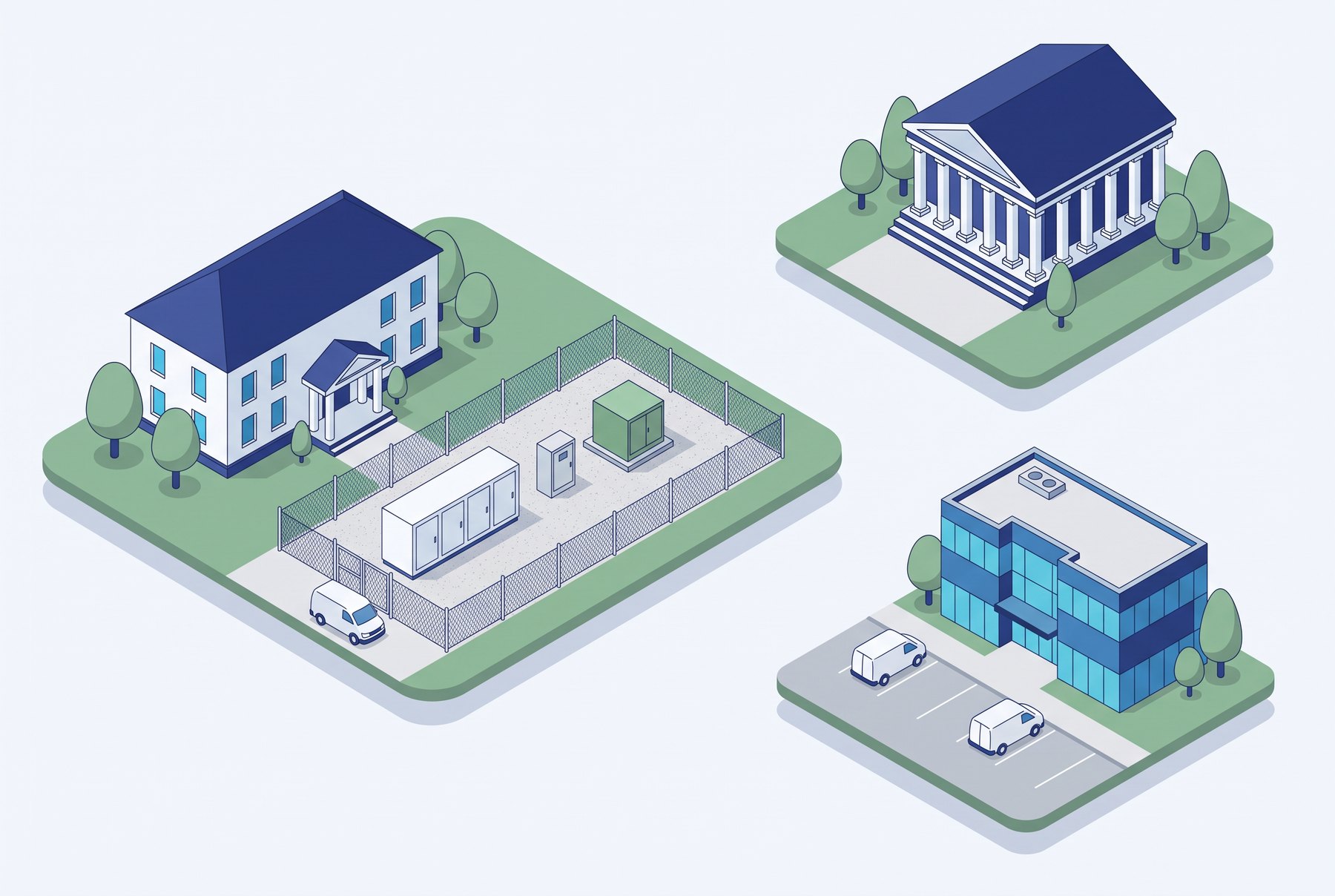
Editorial isometric scene: a city hall with its fenced battery yard, a bank that finances the work, and an energy services company that builds and maintains the battery while the city pays from savings.
Figure 14. An ESPC: a bank finances, the ESCO builds and maintains the battery, and the public owner pays from the savings. Illustration, Gaiergy.
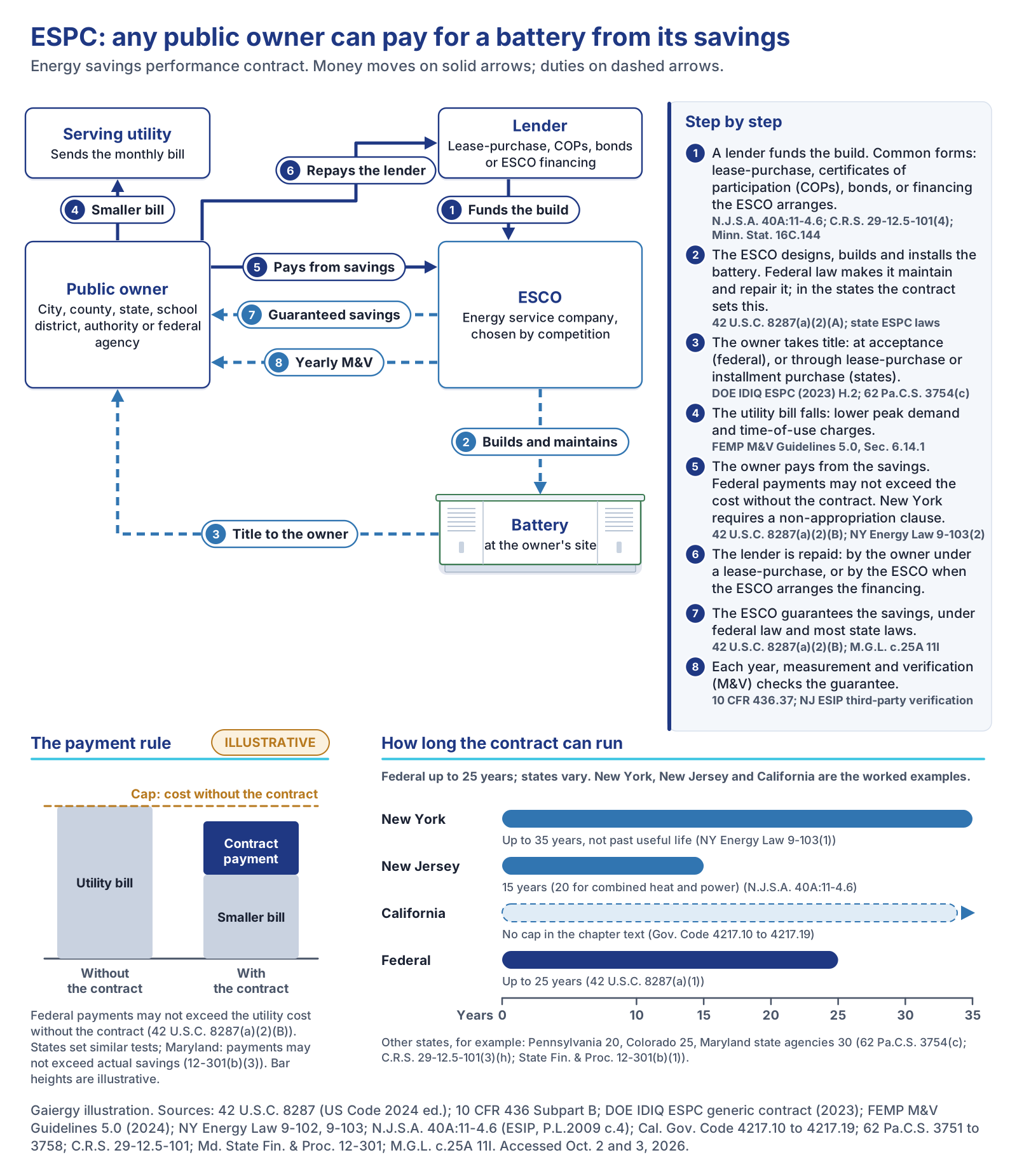
ESPC money and duty flow for any public owner: lender to ESCO, ESCO builds and maintains the battery, owner pays from savings, ESCO guarantees savings, measurement and verification each year.
Figure 15. ESPC money and duties for any public owner: the ESCO finances, builds, maintains and guarantees; the owner pays from savings. Gaiergy graphic.

The federal ESPC: one variant

Scale: from 1997 to 2020, DOE IDIQ ESPCs leveraged $7.5 billion of investment to save more than $17 billion in guaranteed cost savings (FEMP ESPC fact sheet[78]). Oversight matters: the Government Accountability Office found overstated cost and energy savings on 14 of 20 ESPC projects it reviewed in 2015 (GAO-15-432[79]).

UESCs for non-federal owners

No state has a UESC statute like the federal one GAIERGY VIEW. Non-federal owners reach the same result by three routes (RCW 39.35C[80]; N.J.S.A. 40A:11-5[81]; Xcel MN tariff A43[6]):

ROUTE A

The utility competes as the ESCO

Under the state ESPC law
  • Washington: A local utility shall be offered the initial opportunity to participate in the development of conservation projects, and storage is named (RCW 39.35C[80])
  • Texas: a provider includes an affiliate of an energy services firm (Tex. Local Gov't Code ch. 302[82])
  • Georgia: proposals from at least two qualified providers (O.C.G.A. 50-37[83])
  • Most other laws define the provider by experience, so a utility affiliate can qualify and then has to win the competition GAIERGY VIEW
ROUTE B

A procurement exemption

Buy from the utility or a public power body
  • New Jersey: no bidding for the rendering of any service by a public utility under tariffs filed with the utility board (N.J.S.A. 40A:11-5[81]); same rule for boards of education (N.J.S.A. 18A:18A-5[84]). It fits a battery only if one is offered by tariff; none was found GAIERGY VIEW
  • California: Government Code 4217.12 lets a public agency sign an energy service contract after public hearing findings; Berkeley used it without bidding (Cal. Gov. Code 4217.10-.19[12]; Berkeley Council 2024[85])
  • New York: General Municipal Law 103 has no utility exception (NY GML 103[86]); a sole source is allowed only under the State Comptroller's sole-source test, where one supplier can meet the need (NY Comptroller procurement guide[87]), and a battery rarely fits it GAIERGY VIEW
ROUTE C

Utility tariff or public power program

The closest UESC look-alike
  • Xcel Energy, Minnesota tariff A43: the utility owns and maintains the battery, the customer pays a monthly charge for 10, 15 or 20 years, and title passes to the customer at the end (Xcel MN tariff A43[6])
  • Xcel says the program is open to commercial, government and industrial customers in Minnesota and Wisconsin (Xcel Energy 2024[88])
  • Georgia Power's resiliency tariff puts a company-owned resource behind the customer's meter (Georgia PSC 2025[89])
  • Public power: NYPA in New York (NY PAL 1005(17)[16]); Ava Community Energy in California sleeves a developer's power to its cities (Ava Board 2024[90])

Xcel A43 terms

  • $450 a month program charge for projects that include batteries (Xcel MN tariff A43[6])
  • Annual carrying charge: 15.51% at 10 years, 12.68% at 15, 11.28% at 20 (Xcel MN tariff A43[6])
  • If an asset fails early without warranty or insurance, the customer pays the undepreciated value (Xcel MN tariff A43[6])

New Jersey: utility-owned at public hosts

  • PSE&G owned batteries at a high school, a hospital and a sewage plant under a utility board pilot; host sites lease land or roof (PSE&G to PJM 2018[91])
  • Pennington public works building: 574 kWh with 404 kW of solar (PSE&G 2018, Pennington[92])
  • PSE&G's current on-bill program for public customers lists no storage (PSE&G Engineered Solutions[93])

New York limits utility ownership

  • Public Service Commission, 2015: utility ownership of distributed resources will be the exception rather than the rule (NY PSC Case 14-M-0101[94])
  • At the customer location, utility ownership should not be necessary (NY PSC Case 14-M-0101[94])
  • So in New York the working UESC analog is NYPA GAIERGY VIEW
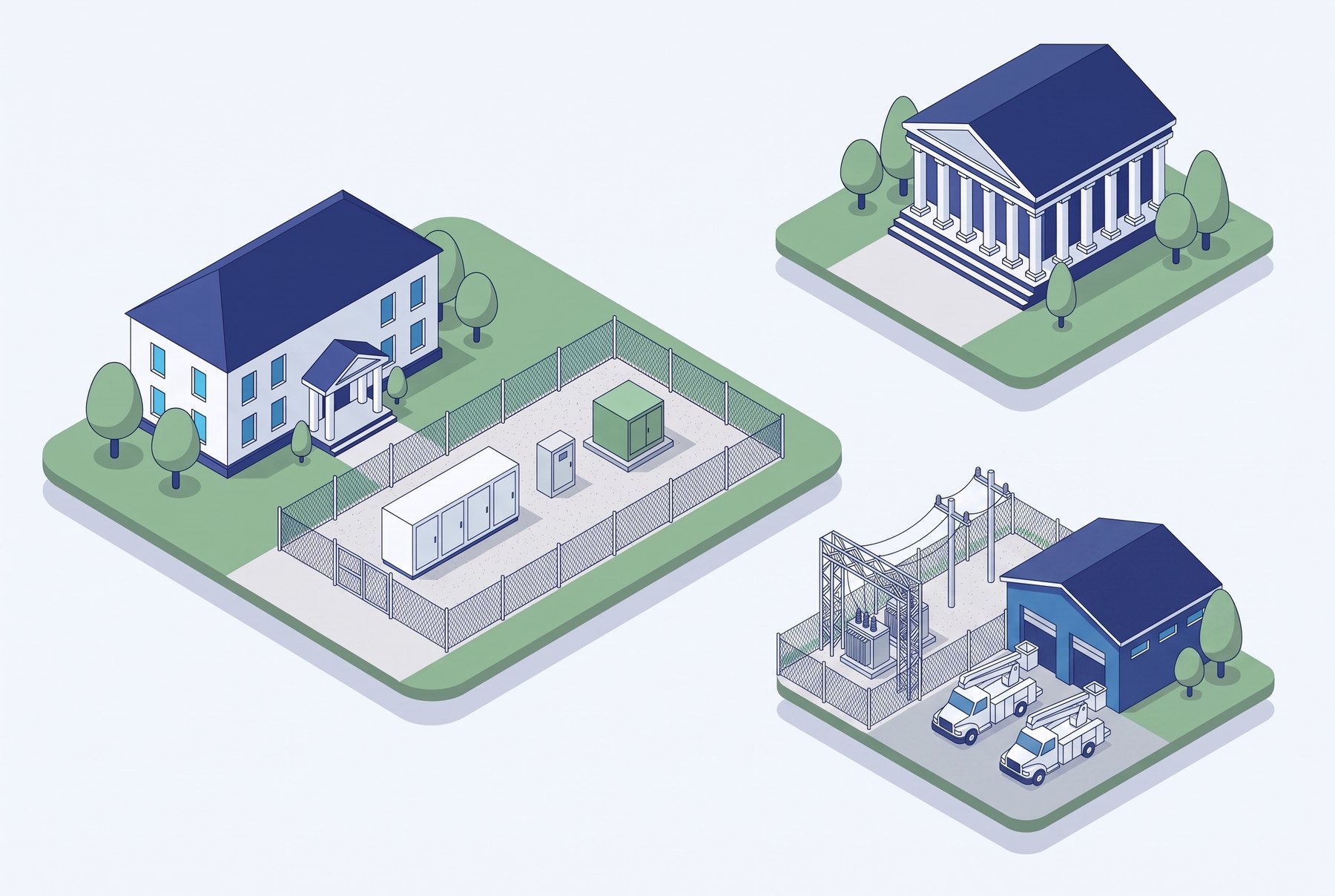
Matched isometric scene: the same city hall and battery yard, with the serving utility's substation and service depot as the contractor.
Figure 16. A UESC: the serving utility is the contractor. Nobody is shown maintaining the battery, because under a UESC that duty exists only if the contract says so. Illustration, Gaiergy.

The federal UESC

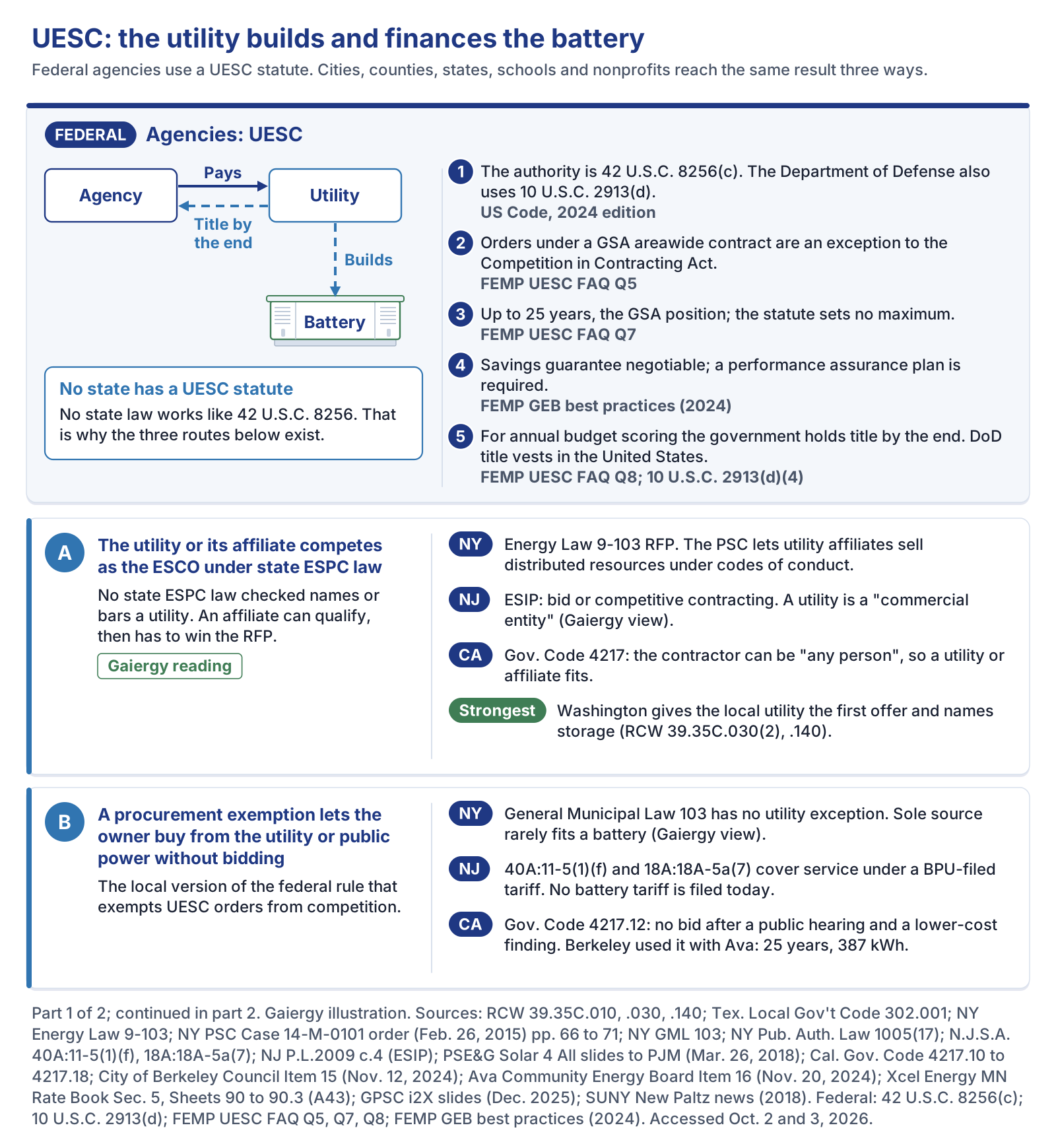
UESC money and duty flow for any owner: the serving utility designs, finances and builds the battery; the owner repays through the utility; a performance assurance plan instead of a statutory guarantee.
Figure 17. UESC: the utility builds and finances the battery, part 1 of 2. Federal agencies use a UESC statute; cities, counties, states, schools and nonprofits reach the same result three ways. Gaiergy graphic based on federal law, FEMP and the state sources above (42 USC 8256[38]; FEMP UESC FAQ[95]; RCW 39.35C[80]; N.J.S.A. 40A:11-5[81]; Xcel MN tariff A43[6]).
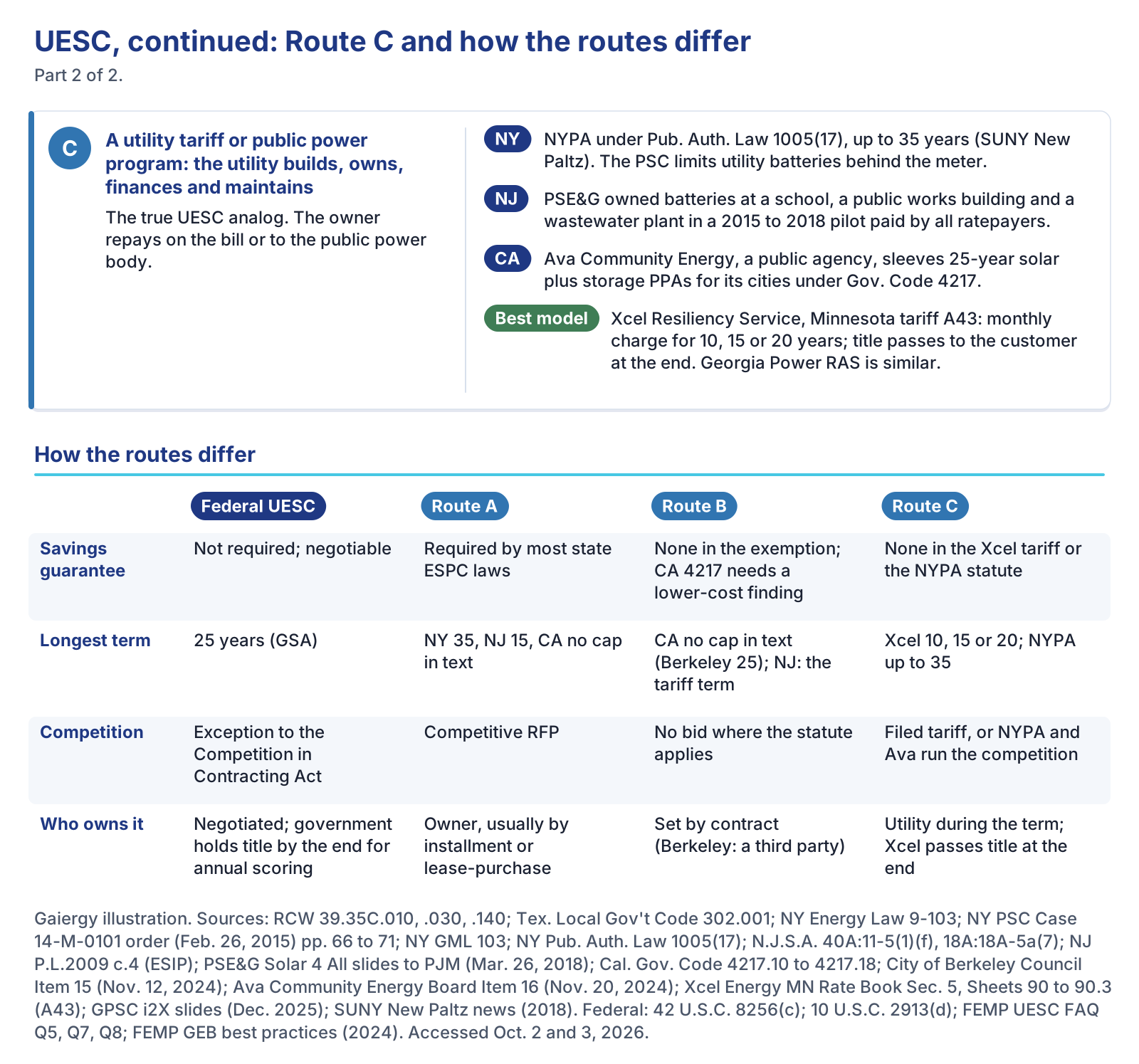
UESC part 2: Route C, a utility tariff or public power program where the utility builds, owns, finances and maintains the battery, and how the three routes differ.
Figure 18. UESC, continued: Route C, a utility tariff or public power program, and how the routes differ. Gaiergy graphic based on (42 USC 8256[38]; FEMP UESC FAQ[95]; RCW 39.35C[80]; N.J.S.A. 40A:11-5[81]; Xcel MN tariff A43[6]).
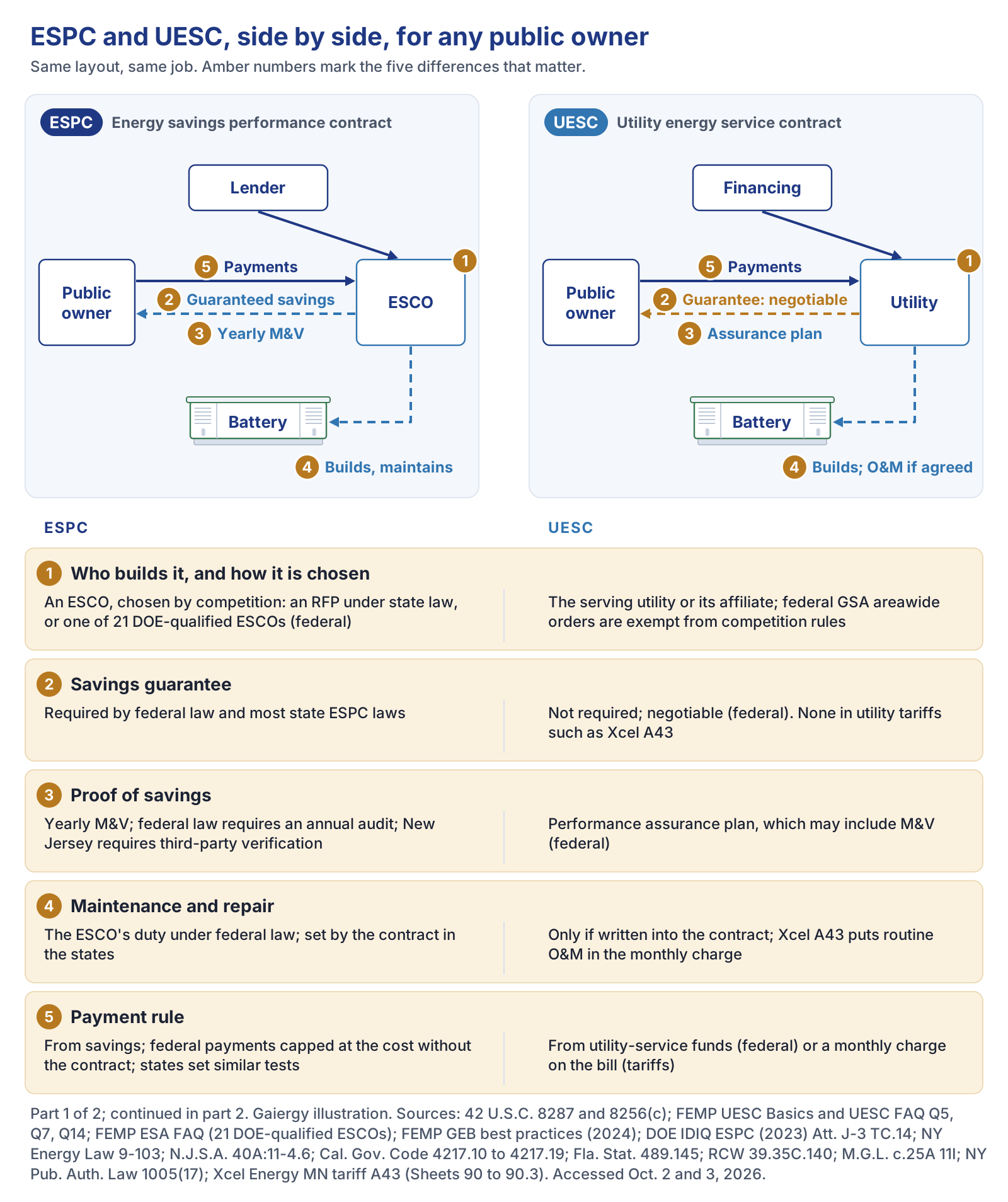
ESPC and UESC drawn with the same layout side by side, with the three non-federal UESC routes shown under the UESC column.
Figure 19. ESPC and UESC side by side for any public owner. The same layout shows the five differences that matter: who builds and how it is chosen, the savings guarantee, verification, maintenance and payment. Gaiergy graphic.
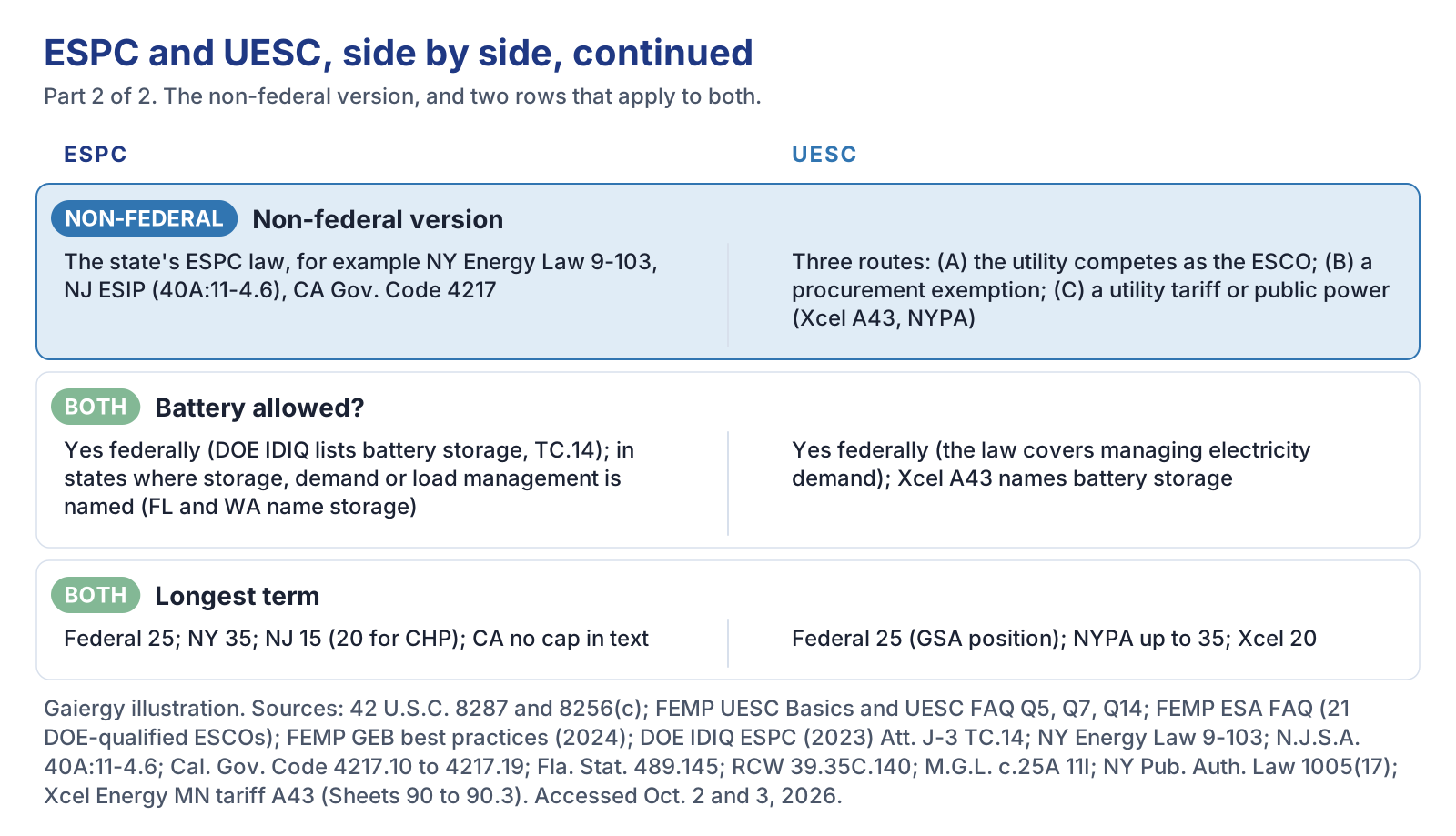
ESPC and UESC side by side, part 2: the non-federal version of each, and two rows that apply to both.
Figure 20. ESPC and UESC side by side, continued: the non-federal version of each, and two rows that apply to both. Gaiergy graphic.

The other paths

A public owner can also pay for a battery without carrying it on its own books, or without a savings guarantee. Each path below has a real public example.

Energy sales agreement inside an ESPC

ESCO owns, agency buys the output
  • A structure similar to a power purchase agreement that uses ESPC authority (FEMP ESA FAQ[76])
  • ESCO owns during the term to capture tax credits; agency takes title at fair market value by the end (FEMP ESA FAQ[76])
  • Typically at least 1 MW (FEMP GEB best practices 2024[61])
  • Batteries allowed with generation, as long as the combined system saves money (FEMP ESA FAQ[76])

Example: GSA land ports of entry in Texas and New Mexico, awarded a 2020 FEMP grant for solar plus battery under an ESPC energy sales agreement (FEMP AFFECT 2020 list[98]); built status UNCONFIRMED

Utility owns, public site hosts

Ratepayers pay GAIERGY VIEW
  • Utility builds, owns and runs the battery on or next to a public site
  • The host pays nothing for it, and also does not own it or get the peak savings

Examples: Duke Energy Florida, John Hopkins Middle School: announced 2020, a 2.5 MW battery and 1 MW solar canopy at a special needs shelter (Duke Energy 2020[99]); in-service date UNCONFIRMED (Duke Energy 2022[100]); Green Mountain Power's 4 MW Stafford Hill battery on a closed city landfill, with $30,600 a year of land rent to Rutland (US EPA 2016, Rutland[101])

Developer owns: power purchase agreement (PPA), services agreement or energy as a service

Fixed price, no capital
  • Developer designs, finances, builds, owns and runs it; the public owner pays a fixed rate
  • The developer keeps the tax credit
  • Terms in the examples run 20 to 30 years: Montgomery County 25 (Montgomery County Council 2021[15]), Berkeley 25 (Berkeley Council 2024[85]), Sonoma State 30 (Sonoma State 2026[17]), New York City 20 (NYC DCAS 2021[102])

Examples: Fresno Yosemite Airport, 20-year fixed $0.2107/kWh under two energy services agreements (Fresno Council ID 26-566[24]); West Boylston, Massachusetts, a 20-year shared savings contract with no utility capital (MMWEC 2026, West Boylston[103])

Public authority finances and procures

New York Power Authority (NYPA) model
  • NYPA may finance and build energy projects for any New York public entity (NY PAL 1005(17)[16])
  • Terms up to 35 years, capped at useful life (schools: the Education Department maximum); NYPA runs the procurement (NY PAL 1005(17)[16])

Example: State University of New York (SUNY) New Paltz, solar plus battery for the campus emergency shelter; costs beyond $461,000 of NYSERDA and Central Hudson funding were financed by NYPA and will be repaid by the College (SUNY New Paltz News 2018[104])

On-bill loan

Repay on the utility bill
  • PG&E on-bill financing: 0%, up to 120 months, government accounts eligible (PG&E OBF page[105]; PG&E OBF Handbook 2024[106])
  • Battery storage may use up to 50% of the loan funds, inside an efficiency loan (PG&E OBF Handbook 2024[106])
  • The only on-bill program found that takes a battery today

California rules let other utilities add storage, after each files for it (CPUC D.23-08-026[107])

Own it outright

Bonds, grants, cash
  • Concord, Massachusetts: the 2024 Special Town Meeting warrant asked to authorize up to $10.4 million of general obligation bonds for a 4.99 MW / 14.97 MWh battery, repaid first from light plant revenue (Concord 2024 Warrant Art. 1[108]); vote result UNCONFIRMED
  • Sterling, Massachusetts: about $2.7 million battery with state and federal grants (Sterling MLD fact sheet[57])

The owner carries all O&M unless it buys a service contract
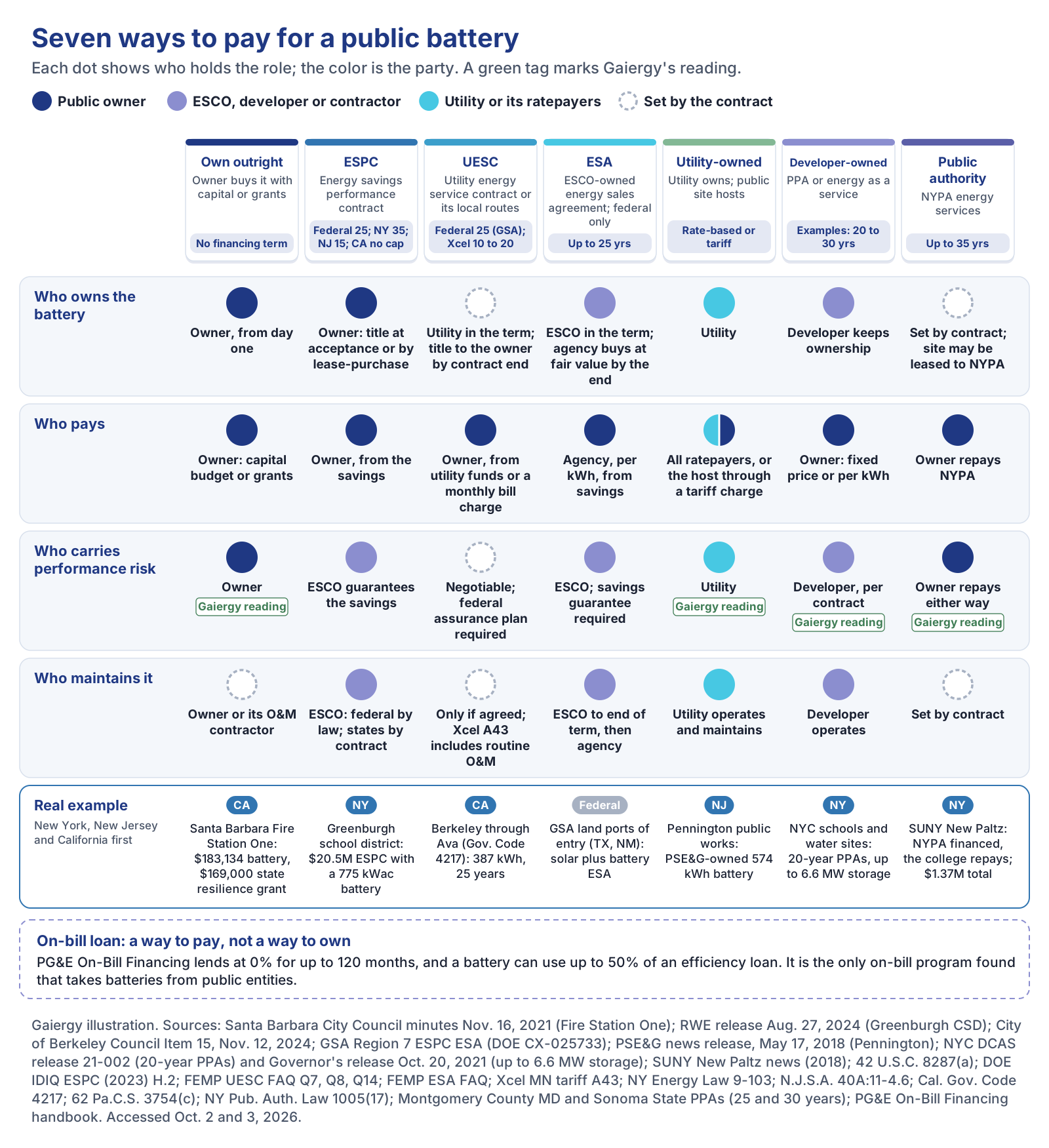
Seven ways to pay for a public battery compared in a grid: own outright, ESPC, UESC, energy sales agreement, utility-owned, developer-owned and public authority, showing who owns, who pays and who carries performance risk.
Figure 21. Seven ways to pay for a public battery: who owns it, who pays, who carries the performance risk, and the usual term. Gaiergy graphic based on the sources in the cards above.

How often ESCOs put batteries in public contracts

The ESCO industry reported $10.7 billion of revenue in 2024. K-12 schools were $3.22 billion and state and local government $1.80 billion (LBNL ESCO report 2026[109]). On a scale where 1 means never or rarely and 3 means very frequently, ESCOs rated battery storage 1.60 in state and local projects and 1.52 in kindergarten to grade 12 school projects, though LBNL still lists storage among the three most used energy security measures (LBNL ESCO report 2026[109]). 52% of ESCOs in the public market reported delays due to complex scopes such as microgrids (LBNL ESCO report 2026[109]).

Section 6

The law

The answerState laws decide what most public owners can do. They were written for lighting and boilers. Of 19 state laws reviewed, only Florida and Washington name energy storage, and most others allow a battery only by reading general words broadly GAIERGY VIEW. New York allows the longest term, New Jersey has the most checks, and California gives the most freedom. Federal law fits batteries well for federal agencies: up to 25 years under 42 U.S.C. 8287(a)(1).

New York, New Jersey and California: the worked examples

This report's examples come from these three states. The rest of the country has workable laws and paying programs too (Section 7 and the state cards below).

New York

Longest term

Energy Law 9-102 and 9-103

  • State agencies, municipalities, school districts, fire districts and public authorities (NY Energy Law 9-102, 9-103[1])
  • Up to 35 years, not past the equipment's useful life (NY Energy Law 9-102, 9-103[1])
  • Paid from a portion of the energy savings or revenues (NY Energy Law 9-102, 9-103[1])
  • Contract is executory only to the extent of money appropriated (NY Energy Law 9-102, 9-103[1])
  • May be procured by request for proposals instead of bidding; General Municipal Law 103 and 109-b then do not apply (NY Energy Law 9-102, 9-103[1])

Schools

  • Term: 18 years or the equipment's useful life, whichever is less (8 NYCRR 155.20[19])
  • Commissioner of Education approval before the contract takes effect (8 NYCRR 155.20[19])
  • Separate statement of maintenance and monitoring charges (8 NYCRR 155.20[19])

NYPA path

  • NYPA finances, procures and builds for any public entity, up to 35 years; schools: the Education Department maximum (18 years) (NY PAL 1005(17)[16]; 8 NYCRR 155.20[19])
  • NYPA's energy efficiency page says it generally works on projects over $500,000 (NYPA energy efficiency services[110])
  • Funds from NYPA notes, bonds or other NYPA funds (NY PAL 1005(17)[16])

Batteries in New York law

The Energy Law does not name storage. A battery fits Energy Law 9-102(4) only as equipment that will produce energy in connection with a facility (NY Energy Law 9-102, 9-103[1]). NYPA's subdivision 17 does not name storage either, but other parts of section 1005 do: NYPA may build energy storage projects, and subdivision 27-a covers facilities that store and discharge power and energy (NY PAL 1005(17)[16]). Whether subdivision 17's clean energy technology covers a battery: GAIERGY VIEW yes; no agency or court reading was found, UNCONFIRMED. NYPA has financed a battery for a public customer in practice (SUNY New Paltz) (SUNY New Paltz News 2018[104]).

A note on debt: New York General Municipal Law 109-b installment purchases are not debt, but their unpaid payments count as existing indebtedness when testing the debt limit (NY GML 109-b[111]). An Energy Law contract procured by request for proposals is exempt from 109-b (NY Energy Law 9-102, 9-103[1]).

New Jersey

Most checks

Energy Savings Improvement Program

  • Local units, boards of education, state agencies and higher education (NJ P.L.2009 c.4; P.L.2012 c.55[11])
  • Lease-purchase up to 15 years, 20 for combined heat and power (NJ P.L.2012 c.55[27]). What that limit does to a battery, and Gaiergy's recommendation: Section 13.4
  • Measures include demand response equipment; storage is not named (NJ P.L.2009 c.4; P.L.2012 c.55[11])
  • The utility board markets it as upgrades without upfront capital expense OR impact to taxpayers (NJ BPU ESIP memo 2026[112])

Third parties at every gate

  • The audit is not done by the ESCO later hired (NJ P.L.2012 c.55[27])
  • A qualified third party verifies the savings before the governing body adopts the plan; the plan is posted by the utility board (NJ P.L.2012 c.55[27])
  • ESCOs are hired by competitive contracting, not the professional services exception (NJ DCA LFN 2009-11[67])
  • The plan has to identify maintenance requirements necessary to ensure continued energy savings (NJ P.L.2012 c.55[27])

What the financing cannot cover

  • Lease-purchase and savings obligations shall not be used to finance maintenance, guarantees, or verification of guarantees (NJ P.L.2012 c.55[27])
  • So long-term battery O&M sits in the operating budget or a separate service contract GAIERGY VIEW
  • The utility board opened a docket in May 2026 to revise its request for proposals template (NJ BPU notice 2026[113]); whether it adds storage is UNCONFIRMED

California

Most freedom

Government Code 4217

  • State, counties, cities, districts, school and community college districts and joint powers authorities (Cal. Gov. Code 4217.10-.19[12])
  • Findings at a regularly scheduled public hearing with two weeks' notice: the cost will be less than the anticipated marginal cost of energy (Cal. Gov. Code 4217.10-.19[12])
  • load management techniques and equipment count as conservation measures (Cal. Gov. Code 4217.10-.19[12])

Procurement

  • An agency may request proposals and award on experience, technology and cost (Cal. Gov. Code 4217.10-.19[12])
  • It may use a pool of qualified ESCOs under Public Utilities Code 388; state agency contracts can run up to 35 years (Cal. Pub. Util. Code 388[114])
  • Berkeley signed a 25-year solar plus storage agreement under 4217 without bidding (Berkeley Council 2024[85])

Joining forces

  • Two or more public agencies may jointly exercise any common power through a joint powers authority (Cal. Gov. Code 6502[115])
  • A joint powers authority lets several small cities run one battery procurement together GAIERGY VIEW

All 19 states reviewed

Each card shows the statute, the longest term, and whether the law names storage, names peak demand or demand response, or lets market or utility revenue count. A gray chip means the text read does not say it. The governing sections were read on official legislature or code sites, or on Westlaw's public site for Maryland and New York schools. For NYPA, only the relevant subdivisions of section 1005 were read.
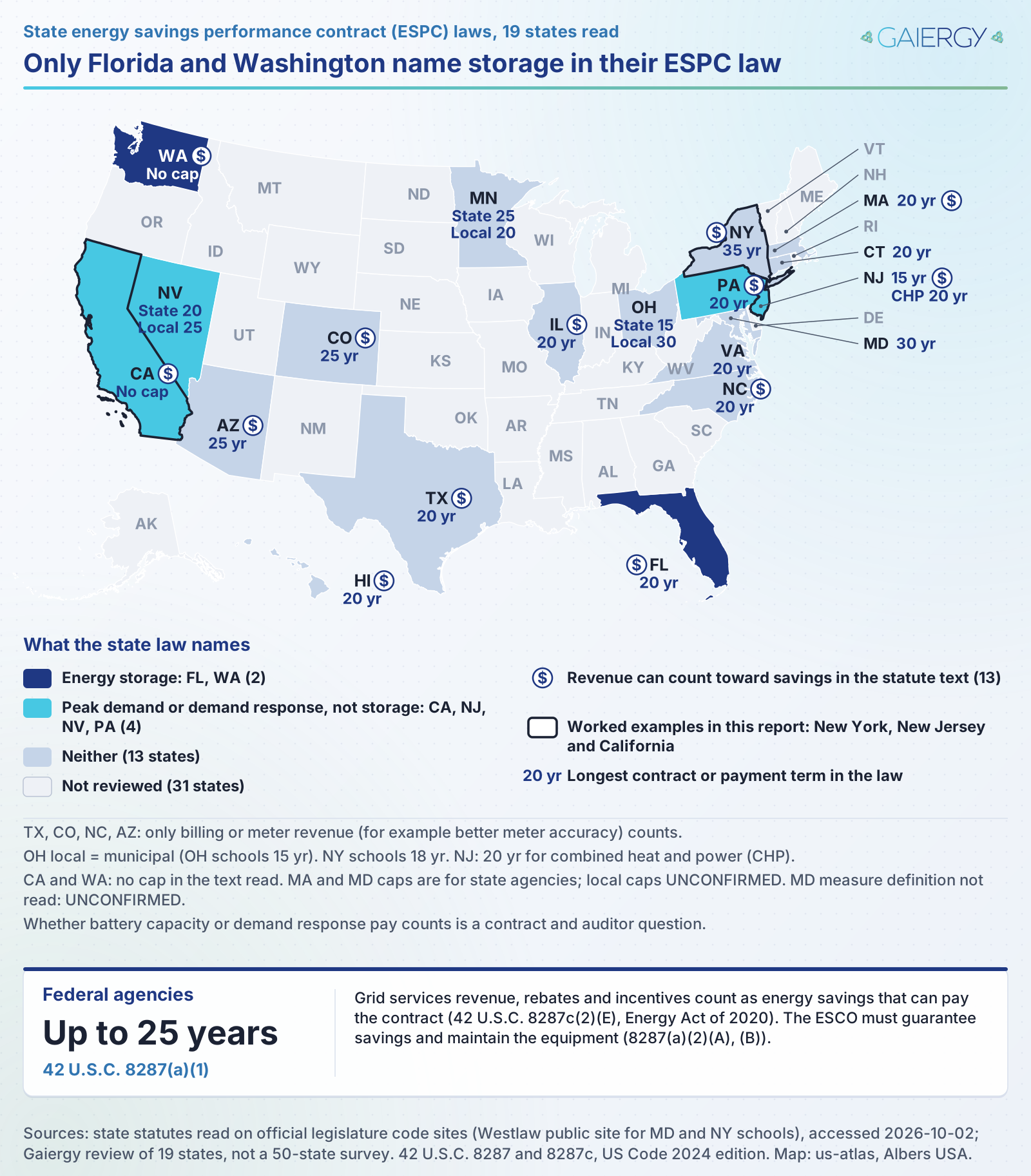
Map of the United States showing the 19 states reviewed, colored by whether the ESPC law names storage, names peak demand, or lets revenue count, with each state's maximum term.
Figure 22. What state ESPC laws say about batteries. Florida and Washington name storage. Where a cap is stated, terms run from 15 to 35 years; California and Washington state none in the text read. Gaiergy graphic based on the statutes cited in the state cards.
Card chips:Names storageNames peak demand or demand responseCounts revenueNot in the text read

Revenue is marked on wherever the law lets any revenue count, including billable revenue from better meters.

Florida

20 years
StorageDemandRevenue

Lists Energy storage systems and demand response programs; repayment from complete installation and acceptance (Fla. Stat. 489.145[70])

Washington

No cap in text read
StorageDemandRevenue

Distributed resources include energy storage, demand response; utility or Bonneville payments count, and energy savings may be sold to the local utility; energy as a service allowed until June 30, 2033 (RCW 39.35C[80])

Pennsylvania

20 years
StorageDemandRevenue

load shifting to reduce peak demand; revenue increases count toward the guarantee (62 Pa.C.S. 3751-3758[64])

New Jersey

15 years (20 for combined heat and power) (NJ P.L.2012 c.55[27])
StorageDemandRevenue

Measures include demand response equipment; plan lists PJM Interconnection (PJM) demand response revenue (NJ P.L.2009 c.4; P.L.2012 c.55[11]). Term runs from completion of the measures (NJ P.L.2012 c.55[27]). Whether a later amendment changed the term UNCONFIRMED

California

No cap in chapter
StorageDemandRevenue

load management techniques and equipment; may sell electrical generating capacity (Cal. Gov. Code 4217.10-.19[12])

Nevada

Local 25, state 20
StorageDemandRevenue

State law reaches costs of electrical energy and demand; state term 20 years after construction is completed (NRS 333A[116]); local up to 25 years (NRS 332; NRS 333A[117])

New York

35 years
StorageDemandRevenue

Paid from energy savings or revenues; capped at useful life; schools 18 years (NY Energy Law 9-102, 9-103[1]; 8 NYCRR 155.20[19])

Massachusetts

State 20; local UNCONFIRMED
StorageDemandRevenue

Payments may rest on revenues gained due to the contractor's services; measurement and verification (M&V) to FEMP standards (M.G.L. c.25A[63])

Hawaii

20 years
StorageDemandRevenue

Paid from cost savings, lease payments, or specified revenues; ESCO pays shortfalls in 30 days (HRS 36-41[118])

Illinois

20 years
StorageDemandRevenue

Savings may include renewable energy credits and carbon credits; valid without a prior appropriation (50 ILCS 515[119])

Maryland

30 years (state)
StorageDemandRevenue

State units; measure definition and local law UNCONFIRMED (Md. SFP 12-301[120])

Colorado

25 years
StorageDemandRevenue

Not debt under constitutional or home rule limits, up to a set share of assessed value; a meter guarantee counts billable revenue (C.R.S. 29-12.5[121])

Arizona

25 years
StorageDemandRevenue

Shortest of useful life, financing term or 25 years; revenue from improved meters counts; M&V per the International Performance Measurement and Verification Protocol (IPMVP) or FEMP (A.R.S. 34-105[122])

Minnesota

State 25; local 20
StorageDemandRevenue

Both from final installation (Minn. Stat. 16C.144[123]; Minn. Stat. 471.345[124])

Ohio

Local 30; state and schools 15
StorageDemandRevenue

Municipal: lesser of system life or 30 years (ORC 717.02[125]). State: 15 years, 20 for cogeneration (ORC 156.04[126])

Texas

20 years
StorageDemandRevenue

Independent engineer reviews savings before signing; billable revenue gains count (Tex. Local Gov't Code ch. 302[82])

North Carolina

20 years
StorageDemandRevenue

From installation and acceptance; measures may capture lost revenue (N.C.G.S. 143-64.17[127])

Connecticut

20 years
StorageDemandRevenue

Term and package payback both capped at 20 years (C.G.S. 16a-37x[128])

Virginia

20 years
StorageDemandRevenue

100% performance guarantee bond; annual reconciliation (Va. Code 45.2-1702[129])

Revenue language in most of these laws was written for meters or generation. Whether a capacity or demand response payment from a battery counts toward a guarantee is a contract and auditor question that these texts do not settle GAIERGY VIEW.

Federal law

42 U.S.C. 8287: the ESPC

  • Contracts solely for the purpose of achieving energy savings and benefits ancillary to that purpose (42 USC 8287[7])
  • Up to 25 years under 8287(a)(1) (42 USC 8287[7])
  • An agency may not set a policy that limits the term to less than 25 years (42 USC 8287[7])
  • Grid services revenue, incentives, rebates and credits may fund the contract (Energy Act of 2020) (42 USC 8287[7])
  • Agencies may not limit recognition of O&M savings (42 USC 8287[7])

Is a battery an energy conservation measure?

  • Statute: measures that improve energy efficiency and involve, among others, energy consuming devices and required support structures (added in 2020) (42 USC 8259[130])
  • FEMP: efficiency can be improved by managing electricity load through the use of batteries (FEMP ESPC scope FAQ 2022[8])
  • The DOE IDIQ contract lists Battery energy storage under peak shaving and load shifting (DOE IDIQ ESPC contract 2023[75])
  • Equipment on the ground, not on a building, still counts as applied to a Federal building (FEMP ESPC scope FAQ 2022[8])

Long payback is allowed if the whole contract pays back

  • A measure that alone would not pay back in 25 years is permissible only if the ESPC as a whole has a payback period within the twenty-five-year contract period (FEMP ESPC scope FAQ 2022[8])
  • Agencies shall use performance contracting for at least 50% of the measures found in facility evaluations (42 USC 8253[131])

Defense rules

  • DoD is directed to consider bundling quick-payback measures with resilience projects, counting ESPC and UESC funding (10 USC 2911[132])
  • By fiscal 2030, critical mission loads at 99.9% availability (10 USC 2920[133])
  • Defense UESCs: equipment title vests in the United States (10 USC 2913[134])

One regulation lags the statute. The DOE rule at 10 CFR 436.31 still reads applied to an existing Federally owned building or facility and lacks the 2020 wording (10 CFR 436 Subpart B[135]). The same rule says its permissive terms shall be liberally construed, and FEMP applies the broader statute (10 CFR 436 Subpart B[135]; FEMP ESPC scope FAQ 2022[8]). Gaiergy reads the statute as controlling where the two differ GAIERGY VIEW.
Section 7

Beyond New York, New Jersey and California

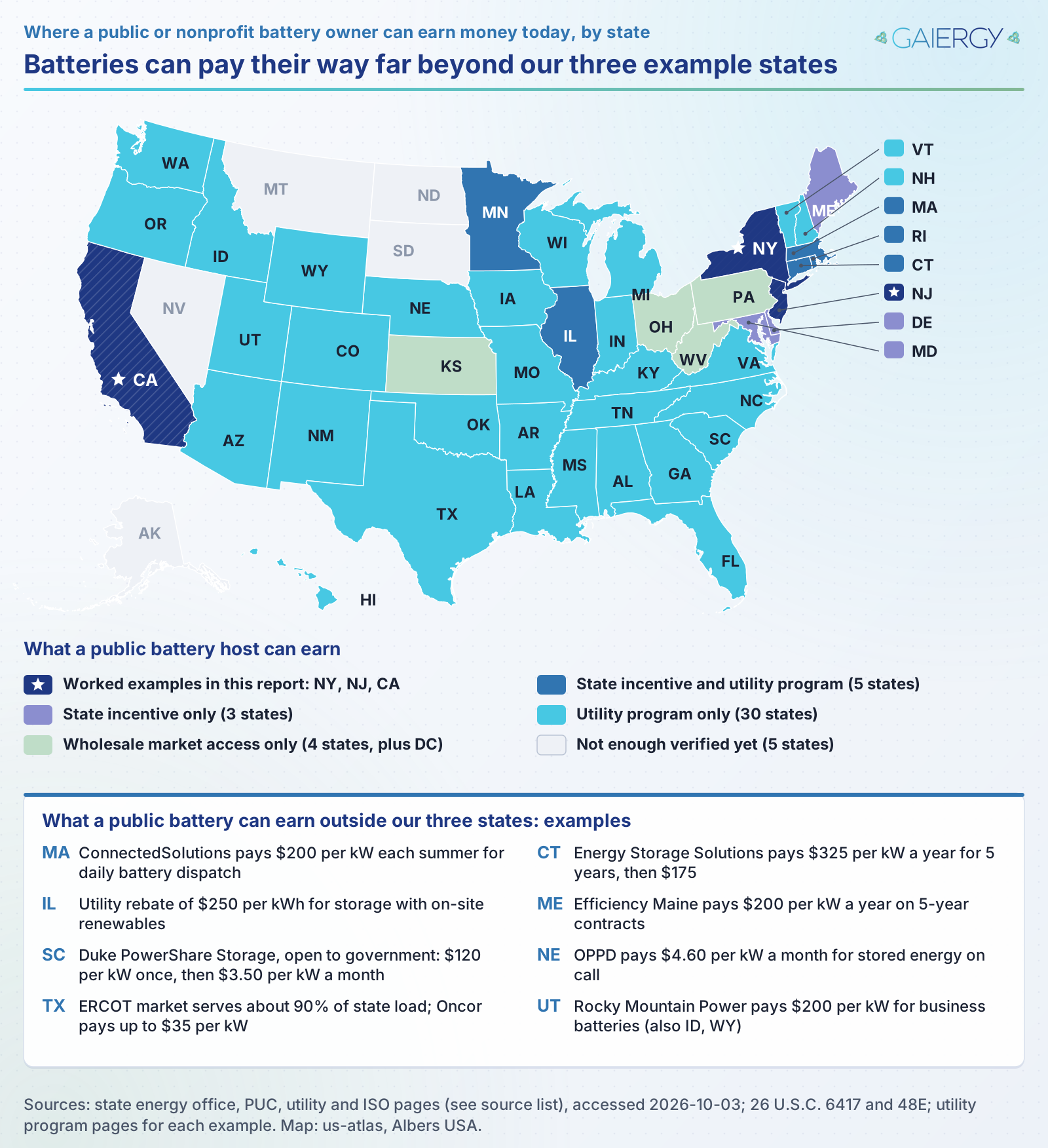
The answerThe worked examples in this report come from three states, but batteries can pay their way far beyond them. In 42 of the other 47 states, Gaiergy found at least one open state incentive, utility program or wholesale market that a commercial account can join (Gaiergy review of state energy office, utility, regulator and grid operator pages, October 3, 2026).
Map of the United States colored by the kind of battery money found in each state, with one strong example per region.
Figure 23. What can pay a public or nonprofit battery host, state by state, with one strong example per region. Gaiergy graphic from program pages accessed 2026-10-03 and EIA-860M; sources for each example are in the cards below.

One strong example per region

Massachusetts

New England
$200 per kW each summer

National Grid ConnectedSolutions pays business batteries on daily dispatch, 30 to 60 summer events (National Grid MA ConnectedSolutions[53])

Connecticut

New England
$325 per kW a year

Energy Storage Solutions: $325 per kW for years 1 to 5, then $175 for years 6 to 10, small and medium business class; the battery discharges on a set schedule each summer (Energy Storage Solutions, April 1, 2026 changes[136])

Maine

New England
$200 per kW a year

Efficiency Maine pays $200 per kW a year on five-year contracts for battery output at the summer peak; applications July 1, 2026 to June 30, 2027 (Efficiency Maine PON EM-003-2027[137]; Efficiency Maine ESS summary[138]). Town and school eligibility UNCONFIRMED

Illinois

Midwest
$250 per kWh, once

ComEd rebate for a storage device paired with on-site solar at a business site over 100 kW (ComEd DG rebate page[139])

Nebraska

Great Plains
$4.60 per kW a month

Omaha Public Power District pays any commercial customer with stored energy of 100 kW or more, plus $0.25 per kWh during events (OPPD Business Curtailment[140])

South Carolina

Southeast
$120 per kW, then $3.50 a month

Duke Energy PowerShare Storage is open to government and other nonresidential participants: a one-time $120 per kW credit, then $3.50 per kW each month (Duke Energy release, PowerShare Storage SC[141])

Texas

ERCOT
Up to $35 per kW

ERCOT carries about 90% of the state's load (ERCOT, About[142]). Oncor's 2026 load management program pays up to $35 per kW of summer peak reduction; batteries are not named UNCONFIRMED (Oncor 2026 Commercial Load Management manual[143])

Utah, Idaho, Wyoming

Mountain West
$200 per kW

Rocky Mountain Power Wattsmart Battery: business batteries over 30 kW get a custom offer letter (Rocky Mountain Power Wattsmart Battery[144]). Government account eligibility UNCONFIRMED
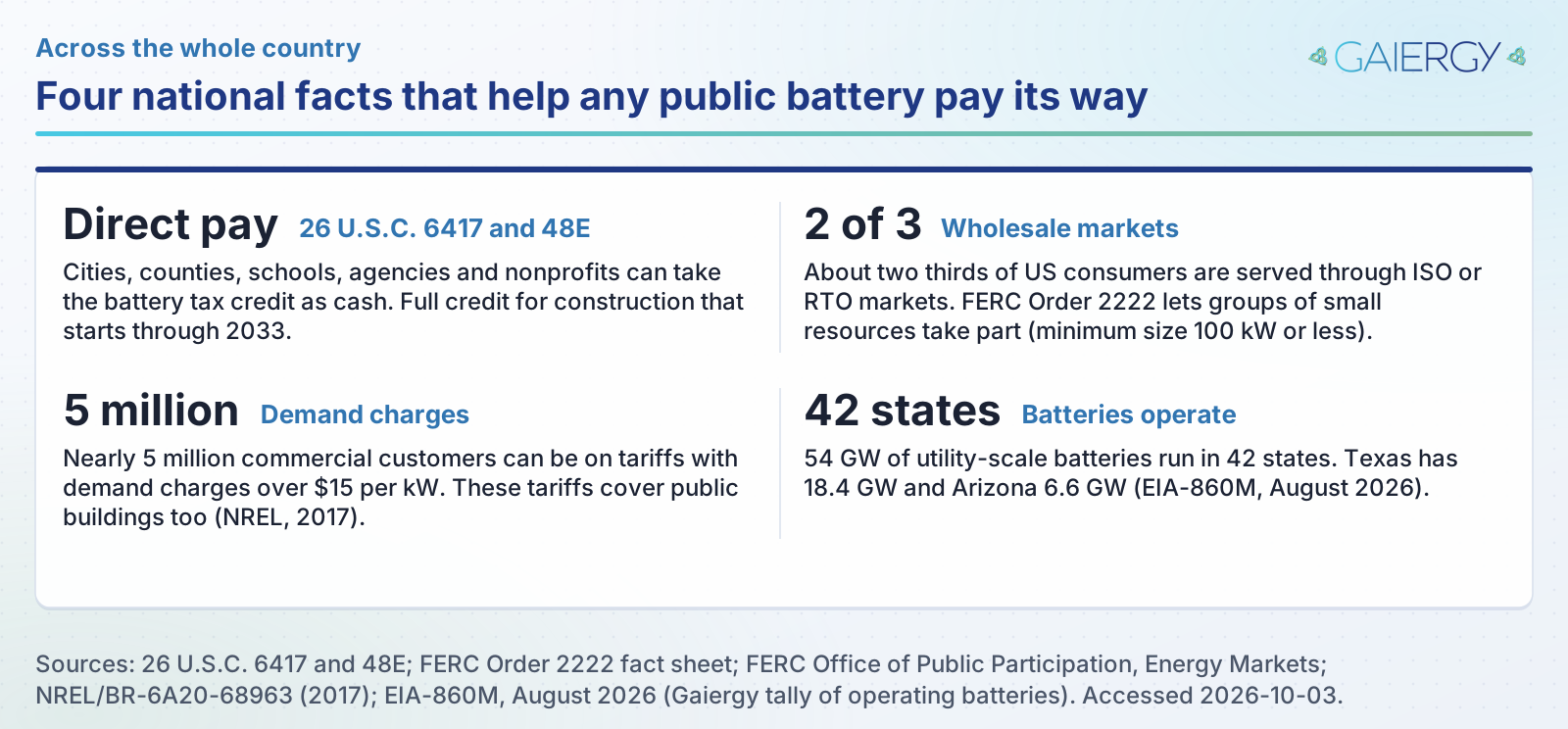
Four facts that hold in every state

Four national facts: direct pay of the battery credit, two thirds of consumers in wholesale markets, 5 million customers with demand charges over $15 per kW, and 54 GW of batteries operating in 42 states.
Figure 24. Four facts that hold in every state. The 54 GW in 42 states is Gaiergy's sum of EIA data for August 2026, not an EIA total. Gaiergy graphic based on (26 USC 6417[36]; IRS elective pay FAQ[145]; 26 CFR 1.6417-2[146]; 26 USC 48E[147]; 26 USC 45Y[148]; FERC, Energy Markets[149]; FERC Order No. 2222 fact sheet[150]; NREL/BR-6A20-68963[10]; EIA-860M, August 2026[151]).

Check eligibility first

  • Several of these programs do not name cities, schools or other public owners. Efficiency Maine asks for a business in good standing (Efficiency Maine PON EM-003-2027[137]); Rocky Mountain Power's page speaks of commercial batteries (Rocky Mountain Power Wattsmart Battery[144]). Recommendation: confirm with the program office before counting a city, school or authority as eligible.
  • Many utility demand response programs reviewed do not say whether a battery may take part (Gaiergy review, October 2026).
  • Some money is not open yet. Texas adopted a backup power grant rule, effective May 27, 2026, that covers public schools, libraries and town halls at up to $500 per kW (16 TAC 25.513[152]); application opening date UNCONFIRMED (PUCT Texas Energy Fund page[153]).
  • Rates are as published on October 3, 2026 and change from year to year.

Gaiergy view

No state is a dead end. Where a state has no battery incentive, a utility peak program, a wholesale market or direct pay of the federal credit can still carry part of the cost, and an energy contract can pair the battery with savings measures the law already names (Section 6). Recommendation: consider checking all four before deciding a battery will not work in your state.

Section 8

Airports are different

The answerAn airport can use the same contracts as a city. Three federal rules change the deal. Airport money stays at the airport. Airport land earns fair market rent. Federal grants now name storage, with conditions. In October 2025 the FAA moved to cancel one $6.7 million grant to Indianapolis International Airport for a solar array with battery storage; the airport later confirmed the grant was rescinded and never received (press reports). The FAA's airport grant programs themselves remain open.

Rule 1: airport revenue stays at the airport

An airport that takes federal grants gives a written assurance that its revenues will be expended for the capital or operating costs of the airport, the local airport system, or other local facilities tied to air transportation (49 USC 47107[23]). The same limit applies to any airport that is the subject of federal assistance (49 USC 47133[154]). The Federal Aviation Administration (FAA) bars payments that exceed the fair and reasonable value of services provided to the airport (FAA revenue use policy 1999[155]).

Paying an ESCO or developer

Airport revenue can pay for power, savings or resilience used at the airport. Keep the price defensible as fair value; a competitive procurement is the usual proof GAIERGY VIEW.

A city-wide ESPC that includes the airport

Airport revenue pays only the airport's share, so a pooled contract needs a written split by facility GAIERGY VIEW. Hawaii's airports used a separate airports contract financed with $167.7 million of certificates of participation (Hawaii DOT 2013[69]).

Grid income from an airport-owned battery

Revenue from a sponsor's own activity on airport property is airport revenue (FAA revenue use policy 1999[155]). So battery market income stays in the airport system GAIERGY VIEW.

Rule 2: airport land earns fair market rent

The FAA reads the self-sustaining assurance to mean the airport receive fair market value for the provision of nonaeronautical facilities and services (FAA revenue use policy 1999[155]; 49 USC 47107[23]). At California Redwood Coast-Humboldt County Airport, the FAA had to approve the ground lease and release 11.1 acres for nonaeronautical use. It approved on March 2, 2021. The rent was paid in kind: a 300 kW net-metered solar array was estimated, when the lease was negotiated, to save the county more than $44,000 a year, which was shown to be equivalent to the fair market value of the lease (CEC-500-2026-006[156]).

Rule 3: federal grants now name storage, with conditions

Airport Improvement Program (AIP)

  • The FAA Reauthorization Act of 2024 added renewable energy generation and storage infrastructure to the airport power supply and microgrid category of airport development (49 USC 47102[157])
  • A battery can be eligible on its own for power supply and redundancy, if it is justified and is a usable unit of work. To count as part of a microgrid, a stand-alone battery links to an existing generator or is bought in the same project that makes a working microgrid (FAA R-PGL 25-02[158])
  • Tenant share, such as rental car facilities, is prorated out (FAA R-PGL 25-02[158])
  • Substation upgrades qualify only at on-airport, airport-owned substations (FAA R-PGL 25-02[158])

Money and paperwork

  • The discretionary set aside uses at least 35% of the discretionary fund, up to $200 million a year, in fiscal 2025 to 2028, and energy projects can compete for it (FAA R-PGL 25-02[158])
  • An energy assessment under 49 U.S.C. 47140 is needed only when the project serves demand more than five years out (FAA R-PGL 25-06[159]; 49 USC 47140[160])
  • The AIP Handbook in force (2019) has no battery language (FAA Order 5100.38D Chg 1[161]). FAA expects the final rewritten handbook in summer 2027 (FAA page, accessed 2026-10-02) (FAA draft AIP Handbook page[162])

Other FAA programs

  • Voluntary Airport Low Emissions (VALE): now open to all commercial service airports (FAA R-PGL 25-02[158]), though the FAA page still says nonattainment areas only (FAA VALE page[163]). No battery category found UNCONFIRMED
  • Zero emission vehicle pilot: covers chargers, not stationary storage (FAA ZEV guidance v2[164])
  • Airport Infrastructure Grants: $14.5 billion over five years; fiscal 2026 is the final $2.89 billion (FAA AIG page[165]). Battery eligibility follows the FAA's broader reading GAIERGY VIEW

AIP is open and awarding in 2026

  • Congress provided $4.0 billion of regular AIP funding in February 2026 (AAAE, May 12, 2026[166])
  • Award rounds in fiscal 2026: May 12 (over $653 million) (AAAE, May 12, 2026[166]), July 1 (about $1.1 billion) (AAAE, July 1, 2026[167]), August 20 (nearly $615 million) (FAA, August 20, 2026[168]) and September 25 ($84.4 million) (FAA, September 25, 2026[169])
  • Batteries qualify through AIP's project definition: renewable energy generation and storage infrastructure and a microgrid (49 USC 47102[157])

Airport Safety and Resilient Infrastructure Discretionary Program (ASRID)

  • A discretionary program inside AIP, 49 U.S.C. 47115(j), named by Pub. L. 118-63 section 714(a) (49 USC 47115[170])
  • Authorized at $200 million a year for fiscal 2025 to 2028; an authorization, not an appropriation (49 USC 47115[170])
  • The fiscal 2025 supplemental of about $50 million runs under ASRID rules and is available through fiscal 2027 (FAA AIP supplemental 2025 to 2027[171]). Whether ASRID received fiscal 2026 funding: UNCONFIRMED
  • Its own text targets flood resilience and runway safety (49 USC 47115[170]); a battery's eligibility comes from the AIP definition above

One canceled grant, not the programs

  • In October 2025 the FAA moved to cancel one $6.7 million grant to Indianapolis International Airport for a solar array with battery storage PRESS ONLY (Fox59 2025[172]). The grant came from the FAA's fiscal 2023 AIP supplemental (FAA FY23 AIP Supplemental list[173])
  • The airport later confirmed the grant was rescinded and never received PRESS ONLY (IndyStar, October 2025[174])
  • The FAA's airport grant programs themselves remain open (AAAE, May 12, 2026[166]; FAA, September 25, 2026[169])
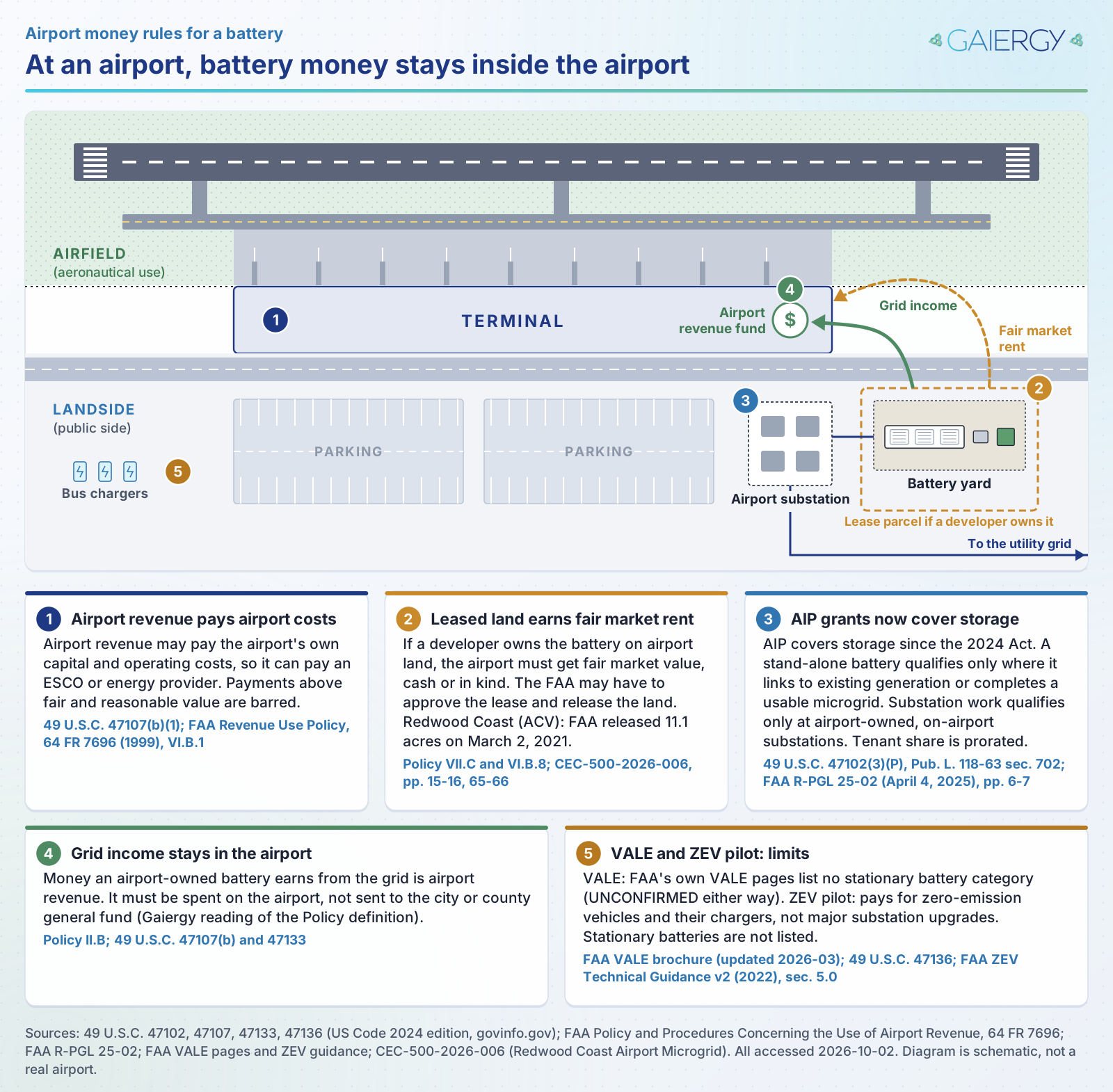
Airport money rules as a diagram: what airport revenue can pay for, fair market rent on airport land, grant eligibility under AIP, and what must stay inside the airport system.
Figure 25. The airport money rules in one picture: revenue use, land rent and grant eligibility. Gaiergy graphic based on 49 U.S.C. 47107 and 47102, the FAA revenue policy and FAA Reauthorization Program Guidance Letter (R-PGL) 25-02 (49 USC 47107[23]; 49 USC 47102[157]; FAA revenue use policy 1999[155]; FAA R-PGL 25-02[158]).
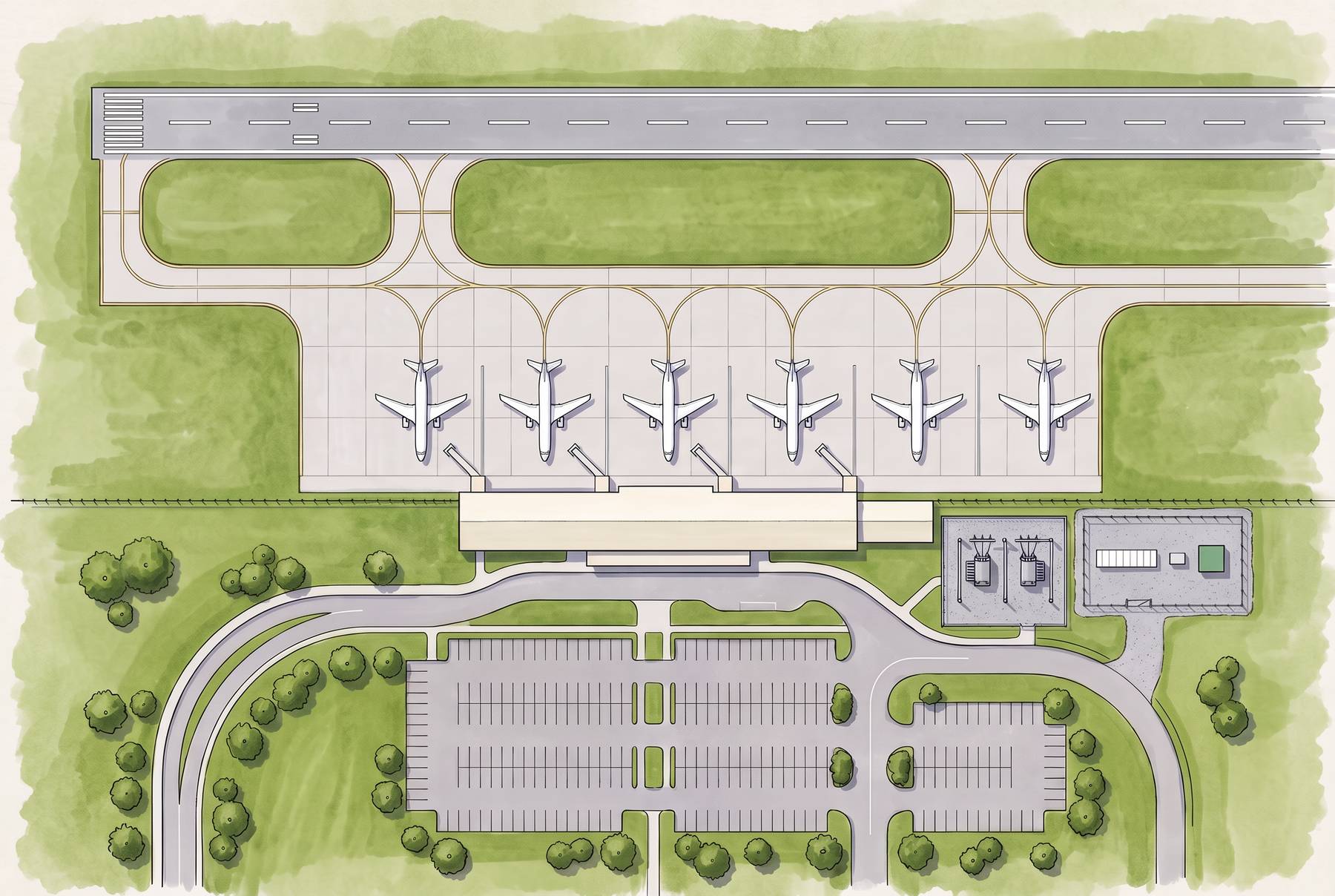
Illustrative airport master plan: the battery yard sits landside, away from the airfield, next to the terminal substation and a parking structure.
Figure 26. At an airport, the battery yard sits landside, away from the airfield, next to the terminal's own substation. Illustration, Gaiergy.

Airport projects and how they were paid for

Redwood Coast, California (ACV)

Public energy authority owns; installed 2021
2.3 MW / 8.9 MWh (RCEA, RCAM page[175])
  • Redwood Coast Energy Authority owns the generation; PG&E owns the microgrid lines; the county owns the airport (RCEA, RCAM page[175])
  • Upfront cost over $11.6 million; $5 million state grant (CEC-500-2026-006[156]; RCEA, RCAM page[175]) and a $6.6 million USDA Rural Utilities Service loan (CEC-500-2026-006[156]) (RCEA page: $6.5 million (RCEA, RCAM page[175]))
  • O&M $145,000 a year (CEC-500-2026-006[156])

Chattanooga, Tennessee (CHA)

Split ownership; commissioned 2018
560 kW / 510 kWh (EPB slide, DOE 2024[176])
  • Airport owns the solar, funded through an FAA VALE grant (Chattanooga Airport[177])
  • EPB, the city's utility, owns two 280 kW / 255 kWh battery units (EPB slide, DOE 2024[176])

Fresno Yosemite, California (FAT)

Developer owns; construction deadline September 3, 2027
2,000 kW / 3,828 kWh (Fresno Council ID 26-566[24])
  • Two energy services agreements, one for storage; developer designs, finances, builds, operates and maintains (Fresno Council ID 26-566[24])
  • $0.2107/kWh fixed for 20 years; savings expected over $10.5 million (Fresno Council ID 26-566[24])
  • Cost risks named: PG&E upgrades, a fire hydrant at the battery site, property tax status (Fresno Council ID 26-566[24])

Columbia, South Carolina (CAE)

Airport project; construction 2026 to 2027
$28 million total PRESS ONLY
  • Battery yard next to the terminal; utility spend cut by an estimated average 55% a year (CAE 2026[178])
  • Total cost $28 million, part-funded by FAA grants, passenger facility charges, state grants and tax credits PRESS ONLY (WIS 2026[179])
  • Battery size and airport ownership: press and vendor statements only UNCONFIRMED

JFK Lot 9, New York

Developer owns, with NYPA; under construction
7.5 MW battery (NYPA 2024, JFK[180])
  • Developer pays the full upfront cost of about $56 million (2020 estimate); no upfront cost to the Port Authority (PANYNJ 2020[181])
  • Battery used to cut airport energy use at peak times (NYPA 2024, JFK[180])

San Diego International (SAN)

Announced 2019
2 MW / 4 MWh VENDOR (Cleantech San Diego 2019[49])
  • Paired with 5.5 MW of airport solar to cut peak demand charges VENDOR (Cleantech San Diego 2019[49])
  • Owner and payment form: UNCONFIRMED

Large airport ESPCs have not included batteries in the cases found. Hawaii's airports ESPC, about $206 million, promised more than $606 million in guaranteed savings over 20 years from lighting, solar and cooling, with no battery listed (Hawaii DOT 2018[182]).

Section 9

The tax credit gates

The answerA city, county, state, school district, public authority or tax-exempt nonprofit that owns its battery can take the federal storage credit as a cash payment. A federal agency cannot, except through an ESCO that owns the battery. For an owner that qualifies, three gates decide whether the credit is full, cut or zero: domestic content, prohibited foreign entity content and tax-exempt bonds.

The credit

Who can take it as cash

City, county, school or authority owns

Direct pay
  • States, political subdivisions and their agencies and instrumentalities are applicable entities (26 USC 6417[36]; 26 CFR 1.6417-1[184])
  • Internal Revenue Service (IRS) examples include water districts and school districts (IRS elective pay FAQ[145])
  • Government-use bar switched off for the electing owner (26 USC 6417[36]; 26 CFR 1.6417-2[146])

Airport or port authority owns

Likely direct pay
  • Fits as a state or local instrumentality GAIERGY VIEW
  • Not named by the IRS for any specific authority UNCONFIRMED

Tax-exempt nonprofit owns

Direct pay
  • Applicable entities include any organization exempt from the tax imposed by subtitle A (26 USC 6417[36])
  • A Washington church received its direct payment in 2024, seven months after its battery and solar began operating (Clean Energy Group, Vashon UMC[185])
  • Qualified 501(c)(3) bonds can pay for a nonprofit-owned battery (26 USC 145[186]), but tax-exempt bond money cuts the credit by up to 15% (Gate 3)

Federal agency owns

No credit
  • Not an applicable entity; property used by the United States is barred (26 USC 6417[36]; 26 USC 50[187])
  • FEMP points agencies to private ownership under an energy sales agreement to capture incentives (FEMP microgrid fact sheet 2025[62])

ESCO owns and sells the output

Credit to the ESCO
  • A contract to operate a storage facility is treated as a service contract, unless the government operates it, bears significant nonperformance risk, shares in operating-cost savings, or has an option to buy at a fixed price rather than fair market value (26 USC 7701[188])
  • A taxable owner that leases to a government, or to a tax-exempt nonprofit for its exempt use, is barred (26 USC 50[187])

The owner rule is strict: the electing entity has to own the property, and credits owned by a third party do not qualify (26 CFR 1.6417-2[146]). Pre-filing registration is a condition of the election (26 CFR 1.6417-5[189]). An excessive payment is repaid with a 20% penalty unless there is reasonable cause (26 USC 6417[36]). Whether a city qualifies when an ESCO or lender holds title on the placed-in-service date is UNCONFIRMED.

The three gates

GATE 1

Domestic content (direct pay only)

For a direct-pay owner, the share of credit paid without domestic content falls to 0% for construction starting after 2025 (26 USC 45Y[148]; IRS Notice 2024-9[190]). Two ways out:

  • Meet domestic content
  • Maximum net output under 1 MW, as measured in AC (26 USC 45Y[148])
  • Or a Treasury cost or supply exception; attestation accepted for construction starting before the later of January 1, 2027 or further guidance (IRS Notice 2024-84[191])

Miss it: zero credit. How the 1 MW AC test applies to a battery: UNCONFIRMED

GATE 2

Prohibited foreign entity content

Storage that begins construction after 2025 is not eligible if it includes material assistance from a prohibited foreign entity (26 USC 48E[147]). The test is a cost ratio. The share of cost free of prohibited foreign entities has to reach:

  • 2026: 55%
  • 2027: 60%
  • 2028: 65%
  • 2029: 70%
  • After 2029: 75% (26 USC 7701[188])

Miss it: zero credit. IRS interim safe harbors are in Notice 2026-15 (IRS Notice 2026-15[192]). Whether the owner and recapture rules reach a government owner: UNCONFIRMED

GATE 3

Tax-exempt bond financing

The credit is cut by the lesser of 15 percent or a fraction tied to tax-exempt bond proceeds used for the project (26 USC 45[193]; 26 USC 48E[147]).

Miss it: up to 15% cut. Whether a municipal tax-exempt lease purchase used for an ESPC triggers the cut: UNCONFIRMED; bond counsel decides per deal
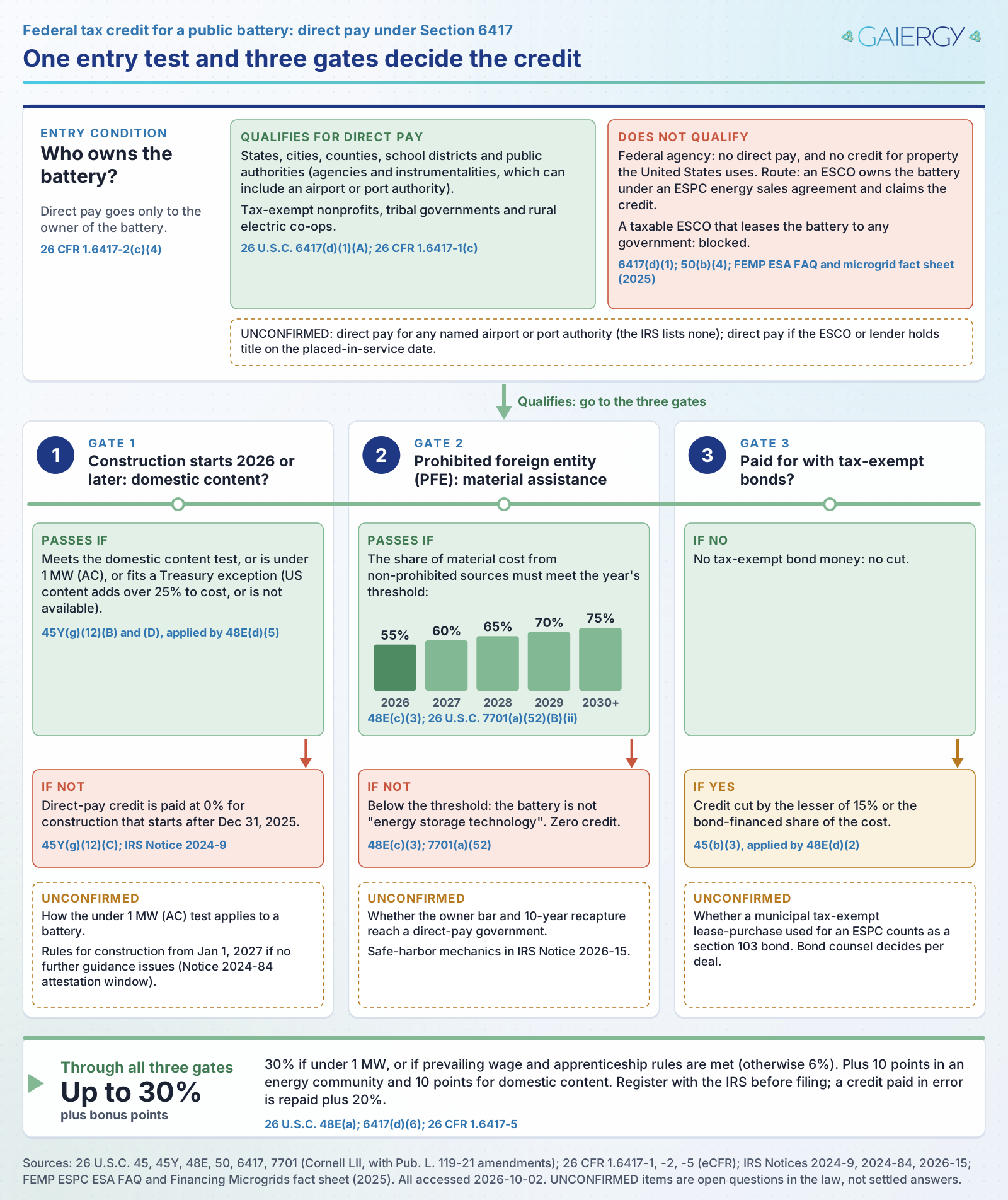
Three gates in a row on the path to the credit: domestic content or zero for direct pay, prohibited foreign entity content rising from 55% in 2026 to 75% after 2029, and a cut of up to 15% for tax-exempt bonds.
Figure 27. The path from a 30% credit to the cash payment, and the three gates that can close it. Gaiergy graphic based on 26 U.S.C. 48E, 45Y, 45 and 7701 (26 USC 48E[147]; 26 USC 45Y[148]; 26 USC 45[193]; 26 USC 7701[188]).

What happened in San Diego

San Diego's energy and water savings contract, financed by a tax-exempt lease of nearly $112 million and approved in early 2026, includes nearly 4 MWh of batteries. The city says the financing considered the elimination of anticipated Investment Tax Credits (ITC) for battery energy storage systems based on new federal program deadlines established in summer 2025, which also informed the removal of several sites (City of San Diego EWSPC[14]). The expected loss of the credit helped shape the scope.

Reference

Sources

What this section shows: every source cited above, in order of first use, with its web address and the date accessed.