
Takeaways
- The Garden State Energy Storage Program (GSESP) does not currently serve commercial and industrial batteries. Every megawatt awarded so far has gone to transmission-scale projects with an installed capacity of at least 5 MW. A 500 kW battery behind a warehouse meter is not eligible for anything that has been awarded to date.
- Phase 2, the distributed and behind-the-meter phase, is the piece that matters for commercial and industrial projects, and it has not opened. An executive order in January 2026 directed the Board of Public Utilities to launch it within 90 days. As of 12 August 2026 the incentive amounts have not been set.
- Smaller projects cleared at higher prices in Tranche 1. The 5 MW award cleared at $210,084 per MW of unforced capacity per year against $156,904 for the 200 MW award, a 34 percent premium for the smallest project in the tranche.
- The federal Investment Tax Credit is now a pass or fail test, not a sliding scale. Storage projects beginning construction in 2026 must show that at least 55 percent of costs come from sources that are not prohibited foreign entities. Fall below the applicable threshold and the credit is denied for that project or component, not reduced.
- Commercial Property Assessed Clean Energy financing, not the state incentive, is what actually produces day-one positive cash flow. It is the only element of the stack that converts capital cost into a long-dated assessment rather than requiring cash at closing.
What the Garden State Energy Storage Program actually awarded
New Jersey's storage target is 2,000 MW by 2030, and the Garden State Energy Storage Program (GSESP) is the Board of Public Utilities (BPU) vehicle for reaching it. That much is widely reported. What gets lost is the eligibility floor.
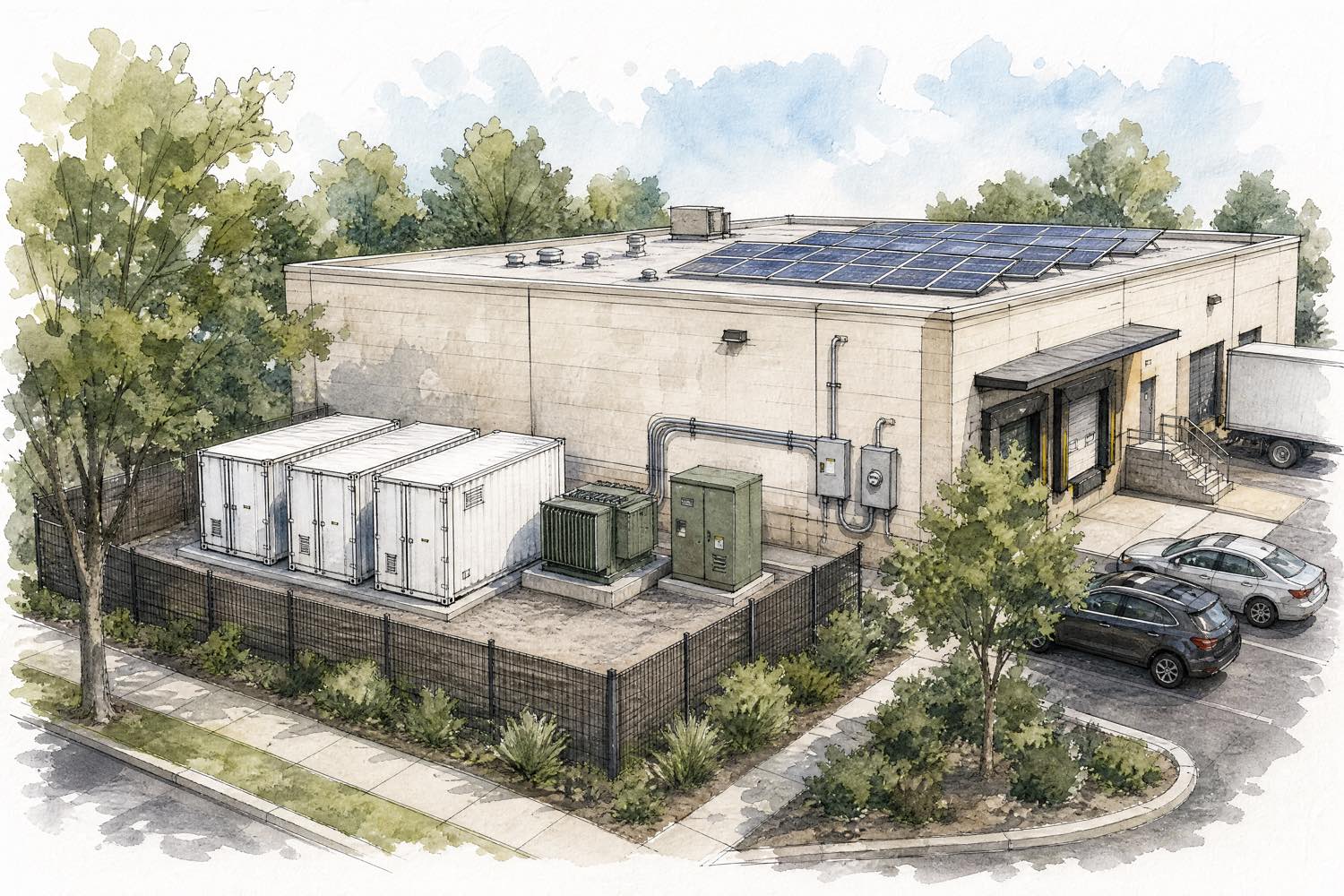
On 4 March 2026 the BPU awarded GSESP incentives to three projects totalling 355 MW. All three are transmission-scale, defined in the program as an installed capacity of at least 5 MW interconnected with PJM Interconnection, the regional transmission organization covering New Jersey.
| Project | Capacity (MW) | Clearing price ($/MW UCAP-year) |
|---|---|---|
| Woods Landing Storage LLC | 200 | 156,904 |
| Two Rivers Energy Storage LLC | 150 | 171,213 |
| North America Energy Storage Corp. | 5 | 210,084 |
Two conditions attach to those awards and both are worth reading closely by anyone modeling the revenue. Payments are fixed annual amounts, reduced in the first year if commercial operation is late, and reduced proportionally if availability falls below 7,900 hours in a year. That is roughly 90 percent of the 8,760 hours in a year, so an availability assumption below 90 percent starts eroding the incentive directly. An award is revoked outright if commercial operation is not achieved within 36 months, absent good cause.
The BPU opened Tranche 2 the same day, targeting a further 645 MW to bring Phase 1 to 1,000 MW. Pre-qualification closed 10 June 2026, final bids are due 7 August 2026, and a BPU decision is expected 28 October 2026. Tranche 2 incentives are fixed and paid over 15 years.
Tranche 1 cleared inversely to project size
The spread is worth pausing on. A pay-as-bid solicitation lets each bidder name its own price, and the smallest project named the highest one. Fixed development costs, interconnection studies, legal work and financing fees do not scale down with megawatts, so a 5 MW project carries a materially higher cost per MW than a 200 MW project and has to bid accordingly. That is a useful data point for anyone sizing a New Jersey project: small does not mean cheap per unit, and the program has so far been willing to pay the premium.
Phase 2 is the one that matters for commercial and industrial, and it is not open
Phase 2 of GSESP is the distributed phase. It is designed to provide distributed fixed incentives and distributed performance incentives for storage interconnected behind a retail meter, which is precisely the configuration a commercial and industrial host would build. It is intended to open the program to residential, commercial and community-scale projects.
It has not launched. A January 2026 executive order directed the BPU to launch Phase 2 within 90 days. The Board has said it will issue an order in 2026 establishing the actual incentive amounts and the balance of the Phase 2 requirements, and will set the size of the fixed incentives and the capacity to be awarded on an annual basis.
The federal Investment Tax Credit became a threshold test
The Investment Tax Credit for standalone storage sits in Section 48E of the Internal Revenue Code. The One Big Beautiful Bill Act (OBBBA) of 2025 left the credit in place but attached a condition that changes how a project has to be procured.
Section 48E now denies the credit where construction of an energy storage technology involves material assistance from a prohibited foreign entity. Compliance is measured by a material assistance cost ratio (MACR): the share of project cost that comes from sources which are not prohibited foreign entities. For energy storage technology the threshold is 55 percent for projects beginning construction in 2026, against 40 percent for qualified facilities in the same year, and it rises over time to 75 percent for projects beginning construction in 2030 and later. Companies with ties to China, Russia, Iran or North Korea are treated as prohibited foreign entities. The Internal Revenue Service issued Notice 2026-15 on 12 February 2026 setting out how the ratio is calculated.
This is a binary test and it deserves to be treated as one. In the words of the published analysis, if the material assistance cost ratio falls below the applicable threshold, the tax credit is denied for that project or component. A project that lands at 54 percent does not receive a slightly smaller credit. It receives no credit. Given that the global battery cell supply chain is concentrated in exactly the jurisdictions the rule targets, the ratio is a procurement constraint that has to be resolved at the equipment selection stage, well before a tax equity conversation.
What actually produces day-one cash flow
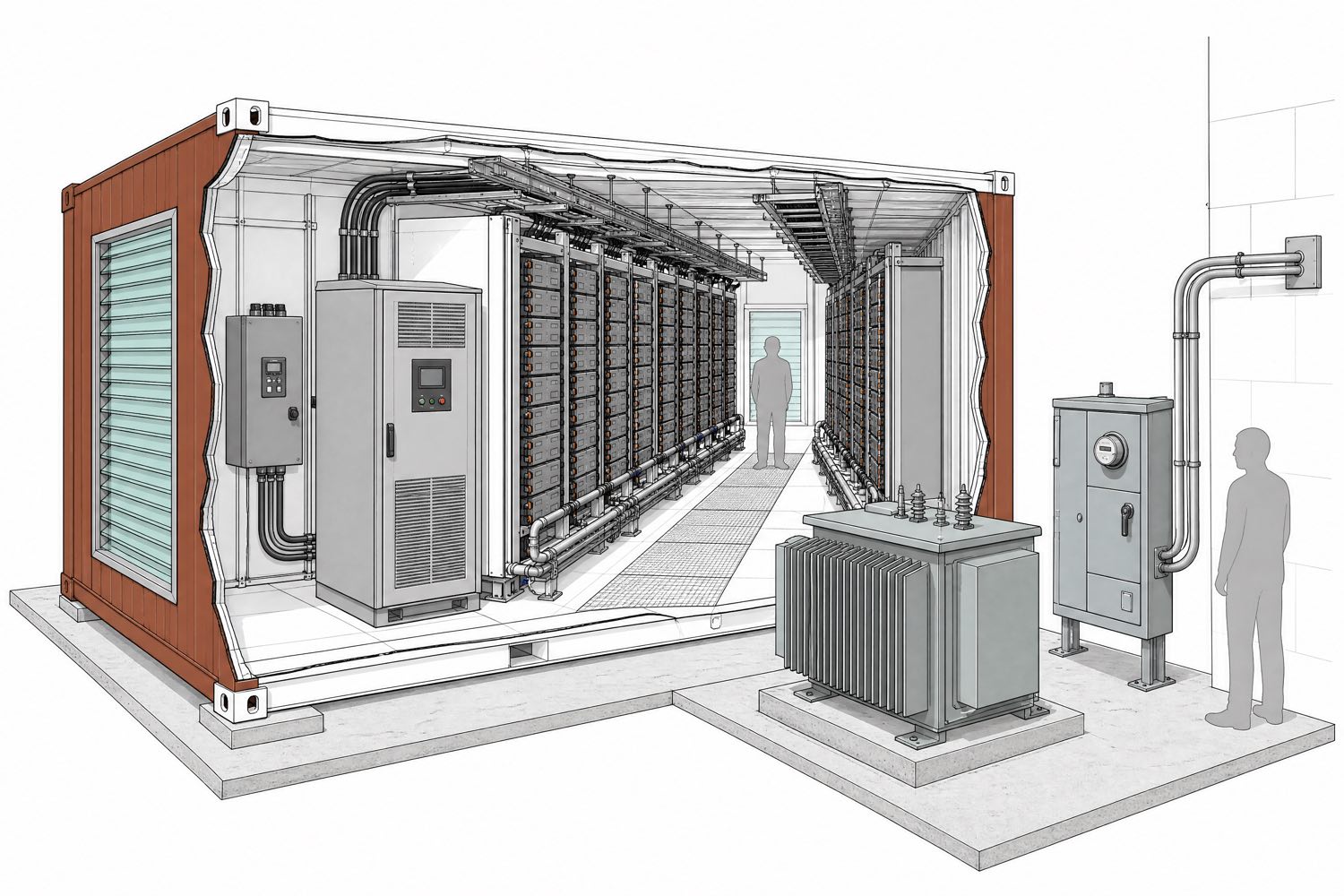
Strip out the state incentive that is not available and the picture simplifies. For a commercial and industrial battery in New Jersey reaching commercial operation in the near term, the stack has three live elements.
1. Demand charge and time-of-use management
This is the bill-side saving that does not depend on any program. It is also the one that is site-specific to the point that no general figure is meaningful. It is a function of the host's tariff, its load shape, and the coincidence of its peak with the utility's. It has to be modeled from twelve months of interval data, not estimated from a rule of thumb.
2. The Section 48E Investment Tax Credit
Available if, and only if, the material assistance cost ratio is met, as above. Its effect on day-one cash flow depends entirely on whether the project can monetise it directly or has to bring in a tax equity partner, which carries its own cost.
3. Garden State Commercial Property Assessed Clean Energy financing
This is the element that changes the shape of the cash flow rather than its size. Garden State C-PACE is administered by the New Jersey Economic Development Authority (NJEDA), and the enabling legislation names energy storage and microgrids as eligible improvements alongside energy efficiency, renewable energy, water conservation and resiliency work. It is repaid through an assessment on the property, similar in mechanics to a property tax or water bill charge, and the NJEDA describes terms of up to 30 years on a non-recourse basis, priced off the ten-year Treasury, with no mortgage or other security.
That structure is the actual answer to the day-one cash flow question. A battery bought with cash is negative on day one by definition. A battery financed over a 30-year assessment is positive on day one whenever the annual bill saving exceeds the annual assessment, which is a far easier test to pass than a simple payback calculation. The state incentive, when Phase 2 finally sets one, will improve that margin. It is not what creates it.
What to do before Phase 2 opens
- Pull twelve months of interval data for the host site and build the demand charge case on measured load, not on a nameplate assumption. The C-rate the site needs follows from the load shape, not from a catalog.
- Resolve equipment provenance early. The 55 percent material assistance cost ratio is a procurement decision with a tax consequence, and it is easier to satisfy at specification than to remediate at closing.
- Open the C-PACE conversation in parallel with engineering, not after it. The assessment structure affects the capital stack, and lender consent is usually the long pole.
- Model GSESP as an upside case, clearly labeled as unavailable today. When Phase 2 sets its incentive values the project that already has interval data, a resolved supply chain and a C-PACE lender in hand will be the one able to move.