
Takeaways
- The grant is small and the competition is narrow. The Illinois Finance Authority set total program funding at $1,000,000, an award range of $100,000 to $250,000 per project, and an anticipated 4 to 6 awards statewide.
- The grant buys planning, not construction. A twelve month performance period producing a construction-ready Community Geothermal Project Plan. For the Vandalia application, that was roughly 0.3 to 0.7 percent of the gross capital cost of the system being planned.
- There is no match requirement, and that is unusual enough to matter. The notice of funding opportunity records no cost sharing or matching requirement, which materially widens the field of municipalities that can realistically apply.
- Indirect costs are capped at a 10 percent de minimis rate, flowing down from the United States Environmental Protection Agency general terms and conditions. Budget the work as direct cost or absorb it.
- The strongest applications answer the questions with evidence already in hand. The scoring tables ask what has been completed, not what is intended. Work finished before the application is worth more than work promised inside it.
What the program actually is
The Illinois Finance Authority, acting in its capacity as the Illinois Climate Bank, issued notice of funding opportunity IFA-CPRG-05 on 1 December 2025, under CSFA number 560-03-3784. Applications were due 13 February 2026 at 5 PM Central, submitted through the AmpliFund system, which was the only accepted method of delivery.
The parameters, taken directly from the uniform summary at the front of the notice:
| Parameter | Value |
|---|---|
| Estimated total program funding | $1,000,000 |
| Award range per project | $100,000 to $250,000 |
| Anticipated number of awards | 4 to 6 |
| Cost sharing or matching requirement | None |
| Indirect cost restriction | 10 percent de minimis rate |
| Source of funding | Federal or federal pass-through |
| Performance period | 12 months |
Two of those lines shape strategy more than the rest. No match requirement means a municipality does not need to find local capital before it can apply, which is often the real barrier for a small town. The 10 percent indirect cap, flowing down from the United States Environmental Protection Agency general terms and conditions, means the budget has to be built almost entirely from direct, scoped, deliverable-linked tasks.
The ratio that defines the problem
Set the two numbers side by side. A planning grant of at most $250,000 is being asked to de-risk a build whose gross capital cost, as modeled in the Vandalia feasibility study, was $34.2 million. At the top of the award range that is 0.73 percent of the project. At the bottom it is 0.29 percent.
That ratio is not a complaint. It is the design of the program, and it explains what the application has to demonstrate. The Authority is not being asked to fund a project. It is being asked to judge whether a small amount of planning money will convert an idea into something a lender, a bond market or a Phase Two deployment grant can actually act on. Every question in the application is a version of that same question.
Which means the strongest position an applicant can be in is to have already done the expensive part.
How the application is structured, and what it rewards
The required components sit in Attachment A across three tables: applicant information and qualifications, project alignment and progress to date, and proposed use of Phase One funding and remaining tasks.
The middle table is where applications are won or lost. It asks, for each core program component, what progress has been made, and it asks for the evidence. In the Vandalia application that table reads as a list of completed artefacts: a finished feasibility study with per-household cost analysis, a completed capital cost breakdown, federal and state incentive identification, three-scenario financial modeling, break-even analysis, financing scenario comparison across municipal bond, Commercial Property Assessed Clean Energy and third-party energy services agreement structures, and demographic and economic analysis documenting energy cost burden.
It also, in several rows, says no. No formal letters of intent secured to date. No workforce compliance plan yet. No formal community engagement documentation yet.
Answer honestly in the progress table
The temptation in a competitive application is to dress up intent as progress. It is a bad trade. The third table exists precisely to capture what will be done with the money, and an honest "no" in table two is what justifies a funded task in table three. An application where everything is already complete has not made a case for needing the grant.
What the twelve months actually has to produce
The Authority points applicants to the deliverables listed in the Community Geothermal Planning and Pilots Plan. Abbreviated, they are: a site footprint with building stock detail; pre-construction and construction budgets; a construction timeframe; mechanical and civil drawings; a technical engineering report; a permitting plan; an outreach and marketing pathway to gain customer commitments; twenty year pro forma financials for system ownership; an ownership structure description; an estimate of customer bill savings in a typical participating residence; a plan to comply with Davis-Bacon and Related Acts and Build America Buy America requirements; a plan to engage registered apprenticeship programs; the system's expected coefficient of performance including blower and loop pump power; and the number and square footage of buildings by building type.
Read that list as a budget. It contains one item that is unambiguously expensive and physical, the technical engineering work, and one that is genuinely uncertain in cost and duration, the customer commitment campaign.
Put a real number on the test bore
In the Vandalia plan, the geological test boring program was scoped as one exploratory well at approximately $42,000, in months two to four, to confirm subsurface thermal conductivity and ground temperature profiles. That is a concrete, priced, early-months task tied to a named deliverable. Applications that describe engineering in the abstract are much harder to score.
Treat subscriber commitment as the schedule risk
The Vandalia plan set a target of commitments from at least 61 households, 25 percent of the residential total in the study, by the end of the twelve month period, alongside institutional anchor commitments from the school district and the hospital. Signing residents is the task least under a project team's control and the one most likely to determine whether the plan is genuinely actionable at month twelve. Sequence it to start in month one, not month six.
Name the workforce partner
The application identified the Okaw Valley Area Vocational Center as the local workforce development partner while stating plainly that the compliance plan itself was still to be developed. A named local institution is worth more than a paragraph of intent, and it costs nothing to secure at application stage.
The financial case, as filed
For completeness, these are the headline figures the Vandalia application carried, as submitted in February 2026.
| Line | As filed, February 2026 |
|---|---|
| Gross capital cost | $34.2 million |
| Federal incentives | $13.3 million |
| State and local incentives | $2.95 million |
| Net project cost | $17.9 million |
| Net cost per home | $26,026 |
| Year 1 annual savings | $838,811 |
| of which natural gas avoided | $661,115 |
| of which solar surplus | $67,696 |
| of which maintenance savings | $110,000 |
| Simple payback, 10 percent gas escalation case | 15.2 years |
| 30 year net present value, same case | $39.1 million |
The federal incentive figure rests on a specific and verifiable qualification. Vandalia's Energy Community designation under Internal Revenue Service guidance was confirmed, which the application states increases the geothermal Investment Tax Credit from 30 percent to 40 percent, worth $12.2 million of the $13.3 million federal total. Confirming an Energy Community designation is cheap, fast and can move a project's net cost by millions. It belongs at the front of the work plan, not the back.
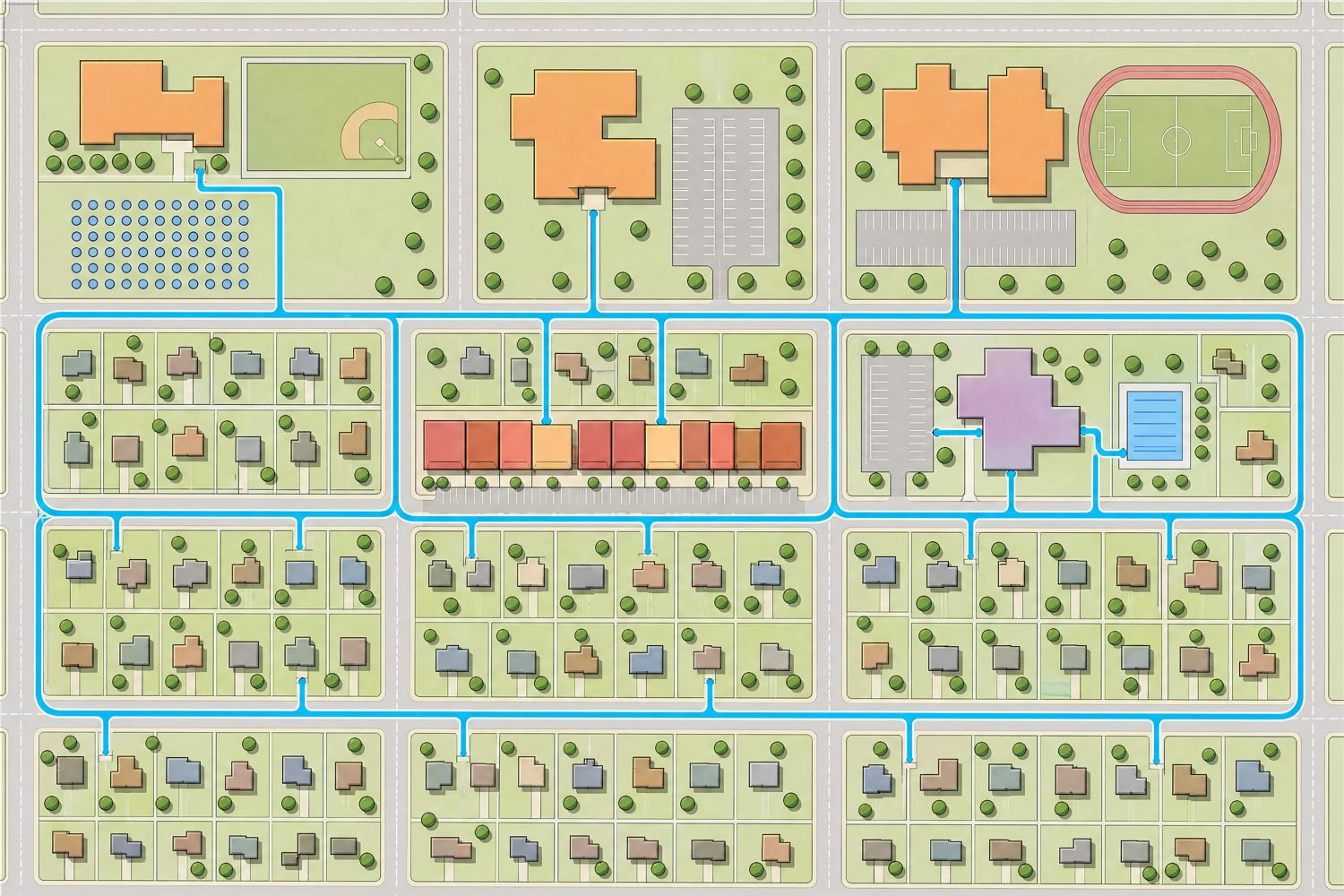
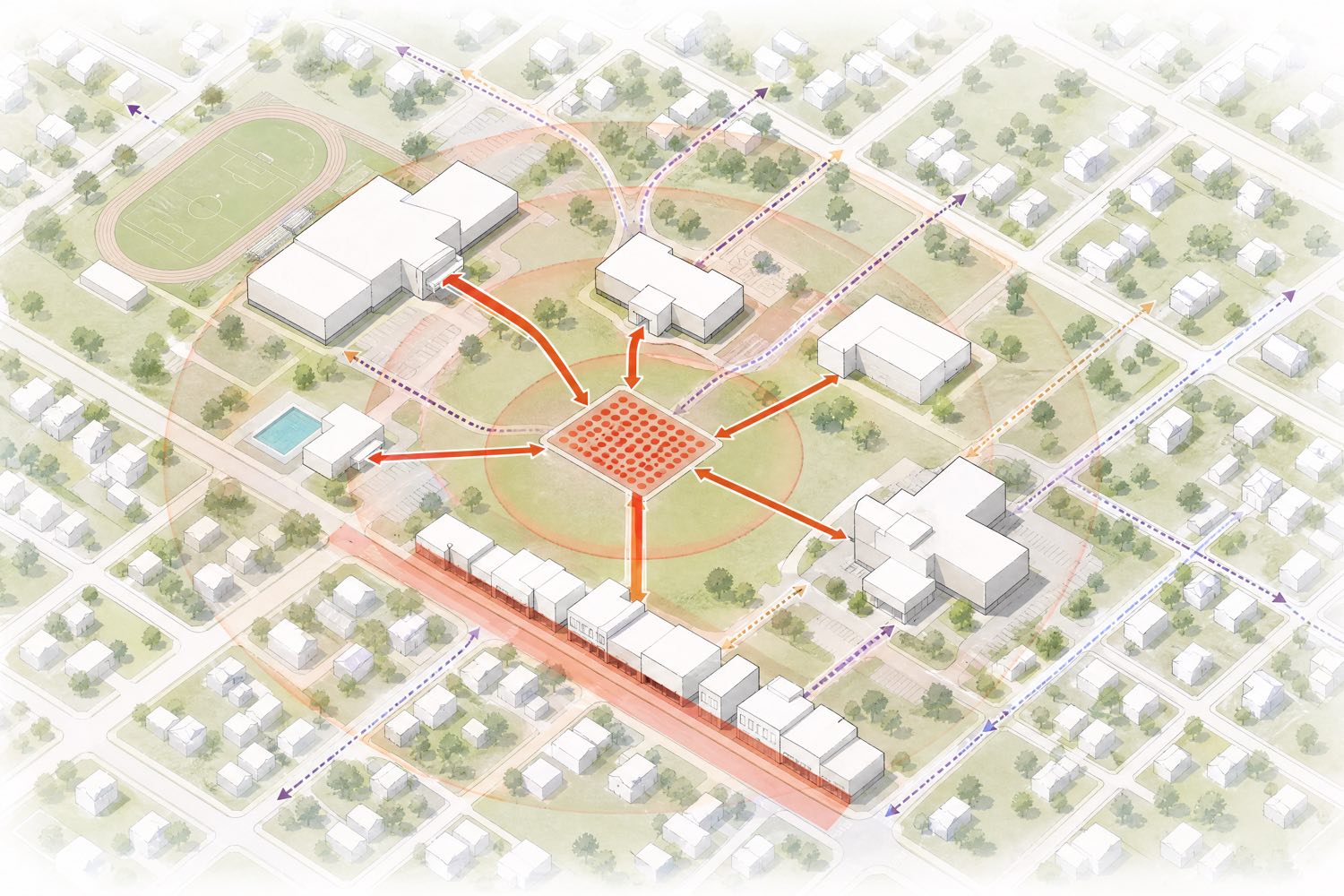
The as-filed application describes a fifth-generation thermal energy network with 175 vertical boreholes at 500 foot depth in a 13 by 14 grid on a 1.67 acre footprint, a collective network coefficient of performance of 5.5, an ambient loop running 45 to 95 degrees Fahrenheit, 16 miles of distribution, 1.46 MW of rooftop solar covering 158 percent of heat pump electricity demand, 2,005 tons of heating and 1,002 tons of cooling capacity, serving 241 residential homes, three schools with 1,460 students, SBL Fayette County Hospital, 15 to 20 commercial buildings and the municipal pool, avoiding 2,918 tons of carbon dioxide annually.
The current published scope on vandaliageothermal.com, accessed 12 August 2026, agrees on 2,005 tons of peak heating, 1,460 students and 1.057 million square feet conditioned, but states 152 boreholes rather than 175, 8 miles of ambient loop rather than 16, over 100 residential homes rather than 241, and 2,148 tons of carbon dioxide avoided annually rather than 2,918. Treat the as-filed financial figures in the table above as a February 2026 snapshot of a design that has since been reduced in scope, not as the current project.
The transferable lesson
A planning grant application is not a pitch for a project. It is an argument that a specific, bounded, twelve month body of work will remove the specific, bounded uncertainties that currently stand between a feasibility study and a financeable plan. The applications that read well are the ones that can name those uncertainties precisely, because someone has already done enough engineering and enough financial modeling to know what is genuinely unresolved.
That is why the feasibility study matters more than the prose. By the time the notice of funding opportunity is published, the work that makes an application competitive is largely already done or it is not.