
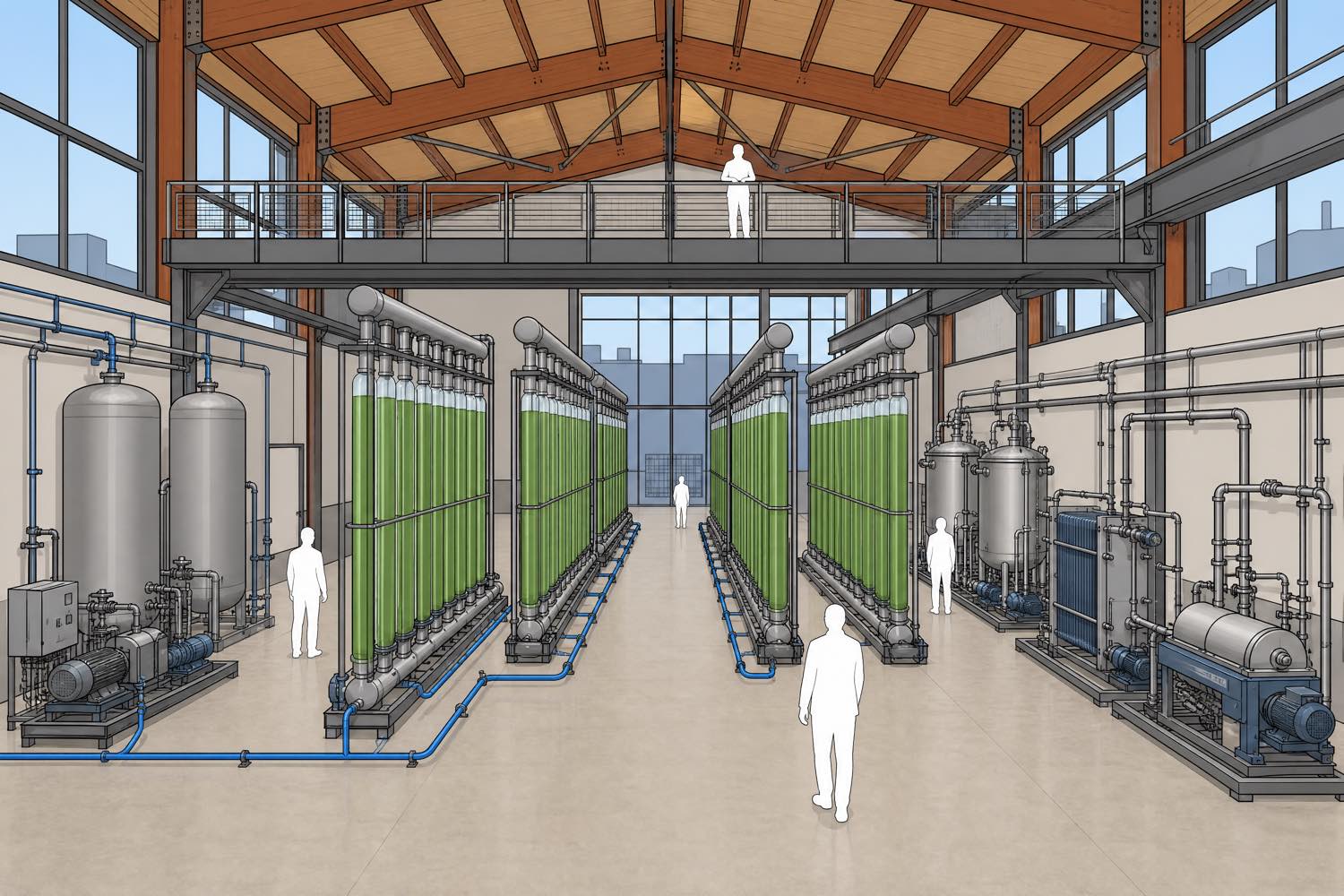
Takeaways
- The chemistry is genuinely good. Roughly 1.83 kilograms of carbon dioxide are fixed per kilogram of algal biomass produced, and algal uptake rates per unit area are far higher than terrestrial crops.
- The fuel economics are not close. Reported algal fuel production costs span roughly $300 to $2,600 per barrel against crude oil at roughly $40 to $80 per barrel. That is not a gap that incremental engineering closes.
- The benchmark to argue against is $494 per ton. The National Renewable Energy Laboratory open pond design case sets a minimum biomass selling price of $494 per ton ash-free dry weight, at modeled productivities of 25 to 52.5 grams per square meter per day. Note that this covers biomass production only; downstream conversion to fuels or products sits outside the model.
- Carbon dioxide cost is a first-order driver. A $1 per tonne change in the price of carbon dioxide moves biomass cost by about $2.2 per tonne, so proximity to a cheap, concentrated carbon dioxide source is a siting decision that dominates much of the process design.
- Utilization is not sequestration. Carbon fixed into a fuel returns to the atmosphere on combustion. Only durable products hold it. Any carbon claim has to state which of the two it is.
Start with the chemistry, because it is the part that works
Photosynthesis converts carbon dioxide and water into carbohydrate using light. In algal cultivation the practical expression of that is a mass ratio: approximately 1.83 kilograms of carbon dioxide fixed per kilogram of biomass produced, a figure that follows from the carbon fraction of typical algal biomass.
Algae are attractive for this because they do it fast and in a small footprint. They have no roots, stems or seeds to build, they grow suspended in a medium whose nutrient content can be controlled directly, and they can be harvested continuously rather than seasonally. Reported areal uptake rates far exceed those of terrestrial crops.
They also tolerate carbon dioxide concentrations well above atmospheric, which is what makes co-location with an industrial emitter interesting. Flue gas is a nuisance to its producer and a feedstock to a cultivation system.
So far, so promising. The difficulty is entirely downstream.
The cost problem, stated without euphemism
The National Renewable Energy Laboratory maintains a public design case for algal biomass production via an open pond algae farm. It models a hypothetical commercial-scale facility covering cultivation, harvest and dewatering, inoculation, circulation and storage. Its benchmark minimum biomass selling price is $494 per ton ash-free dry weight, at modeled areal productivities of 25 to 52.5 grams per square meter per day.
When the full chain is costed, the numbers separate badly. Reported algal biofuel production costs span roughly $300 to $2,600 per barrel, against crude oil trading in a range of roughly $40 to $80 per barrel. Even at the optimistic end of that band, algal fuel is several times the price of the commodity it would displace.
The gap that has not closed
What actually drives the cost
Two levers dominate, and they pull in different directions.
Productivity, in grams per square meter per day
This is consistently identified as the biggest single lever. It sets how much biomass a given capital investment in cultivation area returns, and cultivation area is the dominant capital item in an open pond system. The design case spread of 25 to 52.5 grams per square meter per day is itself more than a factor of two, which tells you how much of the economics is decided by strain, climate, light and contamination control rather than by equipment selection.
The price of carbon dioxide
National Renewable Energy Laboratory analysis indicates that a $1 per tonne change in the carbon dioxide price produces about a $2.2 per tonne change in biomass cost. The leverage is greater than one-for-one because more than a tonne of carbon dioxide is consumed per tonne of biomass, and because delivery and distribution of that gas carry their own costs.
For context on the direction of travel, the Department of Energy's National Energy Technology Laboratory has published future cost targets around $40 per tonne of captured carbon dioxide. Applying the sensitivity above, the difference between paying $40 and paying nothing for a co-located waste stream is roughly $88 per tonne of biomass, against a benchmark biomass price of $494 per ton. That is a material share of the cost, and it is decided by site selection rather than by process engineering.
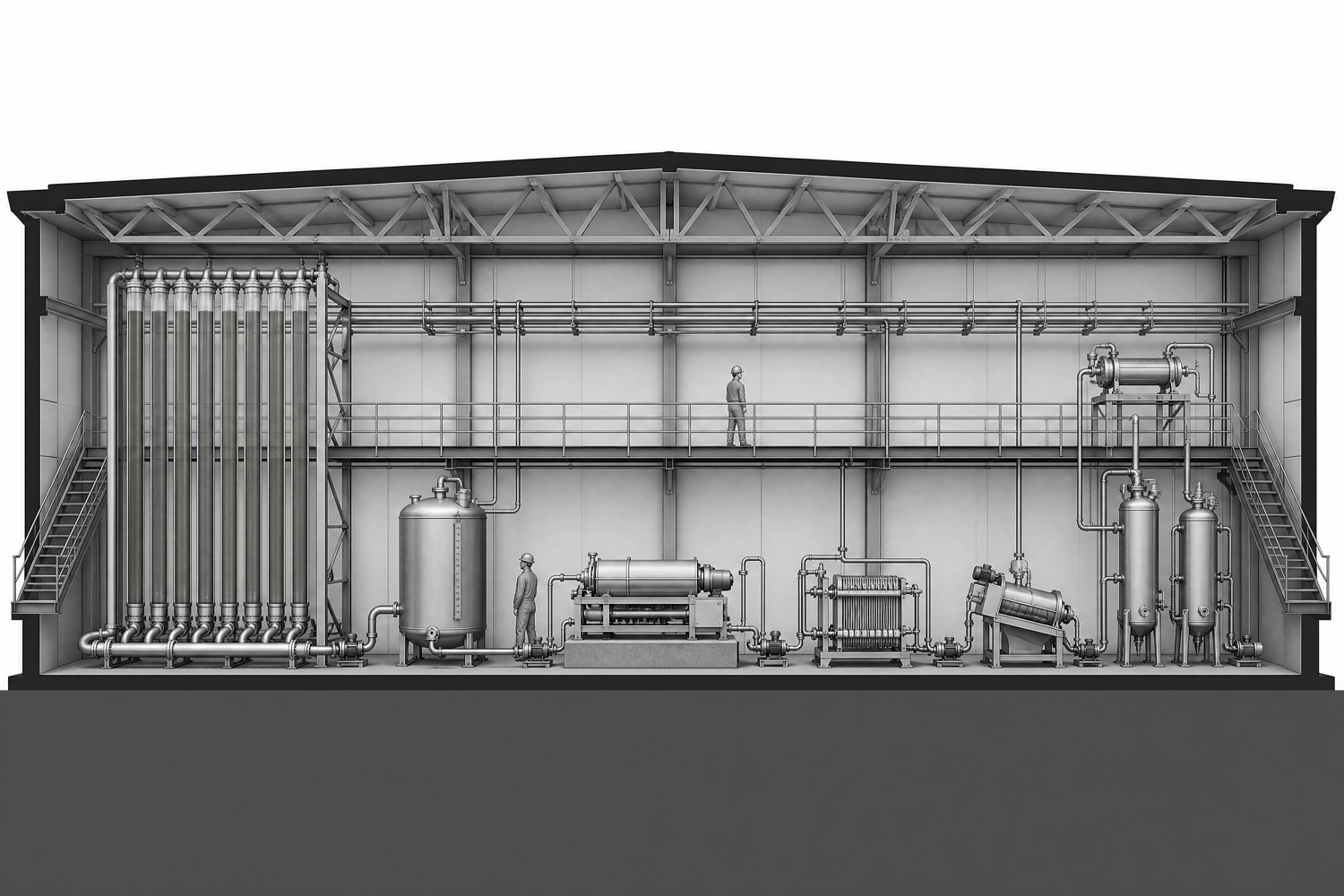
Why dewatering is the quiet villain
The section above is worth dwelling on. Algal culture leaves a reactor at very low solids content. Turning that dilute suspension into a usable dry biomass means removing an enormous mass of water from around a cell that is small, close to the density of water, and does not settle readily.
Every mechanical step in that train, centrifugation, membrane dewatering, pressing, consumes energy and capital in service of removing water rather than producing product. It is the reason the harvest and dewatering block appears in every design case and the reason it is a persistent research target. A process improvement that raises culture density before harvest reduces cost throughout the entire downstream train, which is why productivity and dewatering are not really two separate problems.
The distinction that most carbon claims get wrong
Growing algae on captured carbon dioxide is carbon utilization. Whether it is carbon removal depends entirely on what happens to the carbon next.
- Burn it as fuel and the carbon returns to the atmosphere within months. The climate benefit is displacement of a fossil fuel, which is real but is a different and smaller claim than removal.
- Feed it to livestock or people and most of the carbon is respired back out on a similar timescale.
- Convert it into a durable material, a polymer, a construction product, a soil amendment with a long residence time, and the carbon stays out for as long as the product lasts.
Only the third of these supports a removal claim, and even then the claim is bounded by the product's actual lifetime, not by its theoretical one. Any project that markets algal cultivation as carbon removal without naming the end product and its residence time is making a claim that cannot be verified.
Where the opportunity actually sits
None of the above says the field is uninteresting. It says the fuel framing is the wrong one, and has been for some time.
The configuration that survives scrutiny has three properties.
Co-location with a free or near-free carbon dioxide source
Given the $2.2 per tonne sensitivity, an industrial emitter that currently pays to manage its carbon dioxide is not a supplier to be negotiated with but a partner with an aligned interest. Siting decisions dominate.
A high-value product, not a commodity one
The economics do not close against a commodity priced in the tens of dollars per barrel. They can close against nutraceuticals, pigments, specialty proteins, cosmetic ingredients or specialty polymers, where the addressable price is orders of magnitude higher and the volume required is correspondingly smaller. The unglamorous truth is that the markets that can absorb algal production costs are small ones.
Revenue that does not depend on the carbon claim
A project whose economics require a carbon price to close is a project exposed to policy risk it cannot control. Where the carbon benefit is a genuine co-benefit of a product that already sells, the project is durable. Where it is the business model, it is not.