
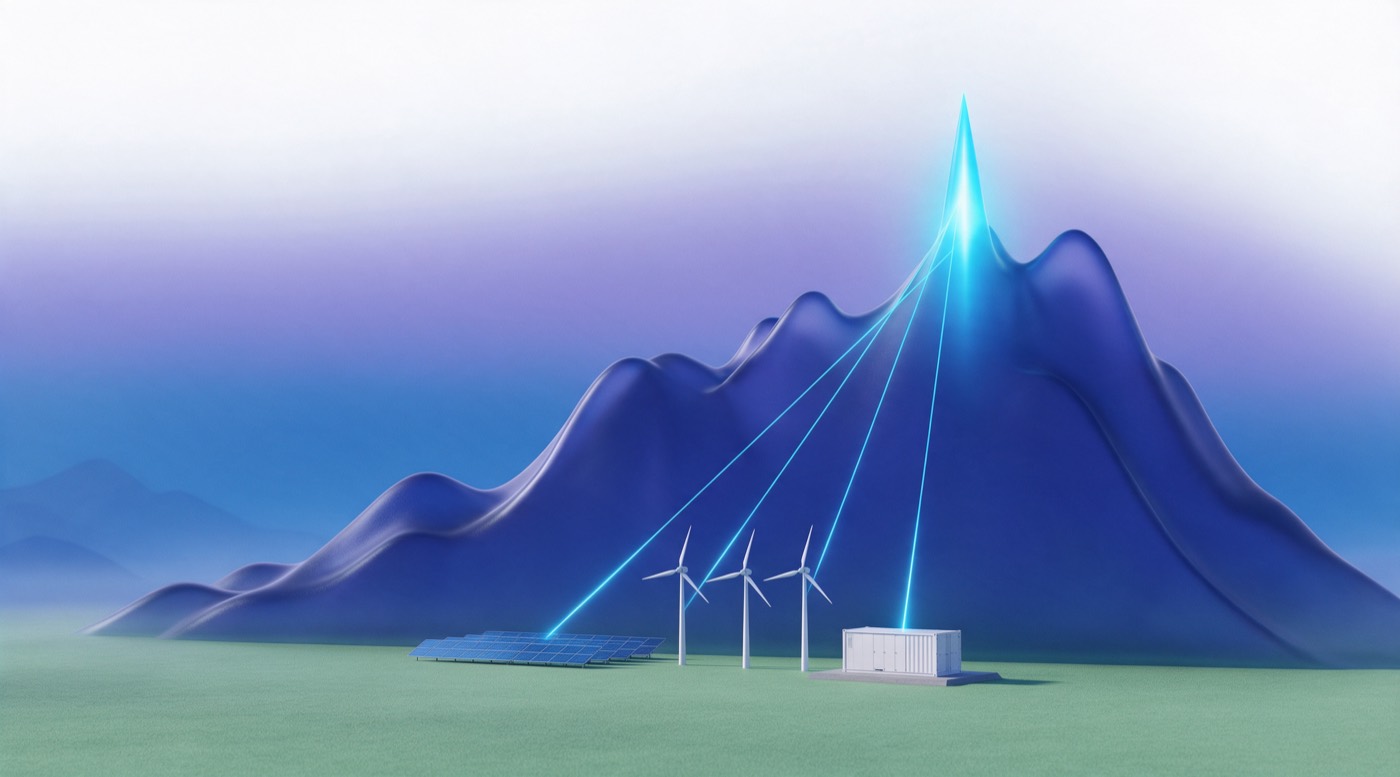
Takeaways
- 1 hourAlternative 3 measures one hour. The battery's export during the previous year's statewide peak hour sets the credit for the next 12 months. Source: NYSEG PSC No. 120, Rule 40.B.6.c.
- 3 to 7 pmA 4 hour battery covers it without guessing. Every peak hour from 2022 to 2025 fell between 5 pm and 7 pm. Push full power from 3 pm to 7 pm on every hot day and the peak hour is inside the block.
- JuneStart in June, not July. The 2025 statewide peak was June 24 at 6 to 7 pm, 31,857 MW. Solar has pushed the peak two hours later than it used to be. Source: NYISO summer 2025 review.
- $394kFull 5 MW in that hour is worth about $394,000 a year at the current NYSEG Alternative 3 rate of $6.57 per kW per month. Miss the hour and the number is $0. ESTIMATE, rate is refiled monthly.
- Alt 1 / 2Solar and wind get paid on every kWh, either all year (Alt 1) or in the summer afternoon window (Alt 2). They never face a one hour test. Source: NYSEG Rule 40.B.6.a and b.
- 30.8%2027 looks higher, not confirmed. The draft statewide reserve margin for 2027-28 is 30.8%, up from 25.6% in the 2026-27 study. The last time the margin rose 2.4 points, upstate capacity prices rose 38%. Final vote is in December 2026. Sources: NYSRC and NYISO, August 2026; Potomac Economics, May 2026. ESTIMATE.
- OpenOne item is UNCONFIRMED. NYISO's "ICAP market peak hour" is limited to July and August weekdays. NYSEG's tariff says "New York Control Area peak of the previous calendar year." Which hour NYSEG used for 2025 has not been confirmed. Run June through August regardless.
What ICAP is, in plain words
Applies to any generator or battery on the Value Stack tariff of any New York investor-owned utility, 5 MW AC or smaller: Con Edison, National Grid, NYSEG, RG&E, Central Hudson and Orange & Rockland. Each utility posts its own rates. The rule is the same.
ICAP means Installed Capacity. It is a payment for being ready on the one busiest hour of the year. It is not a payment for energy. Big power plants and big batteries sell capacity to NYISO in an auction. A battery of 5 MW or less on the Value Stack does not go to that auction. The local utility pays it a capacity credit instead, and every New York investor-owned utility uses the same menu of three "Alternatives" to work out that credit. The PSC wrote the rule once, in the VDER proceeding, and each utility carries it in its own tariff. This page quotes NYSEG's tariff because the Chatham and Copake sites are in NYSEG territory.
| Utility | Alternative 3 rate today | Statement |
|---|---|---|
| NYSEG (PSC No. 120) | $6.57 per kW per month, Rest of State and Lower Hudson Valley | VDER-CRED statement, read 2026-09-15 |
| National Grid, Niagara Mohawk (PSC No. 220) | $7.15 per kW per month | Statement No. 105, effective April 30, 2026, read 2026-09-15 |
| Con Edison (PSC No. 10) | $5.82 per kW per month in New York City, $2.39 in Westchester | Statement No. 98, effective November 1, 2025, read 2026-09-15 |
| RG&E, Central Hudson, Orange & Rockland | Not read for this page | Each posts its own VDER-CRED statement |
Source: NYSEG PSC No. 120, Rule 40.B.6.ii "Value Stack Capacity Component", Leaf 117.46.26.2.2 and 117.46.26.3.0, https://www.nyseg.com/documents/d/nyseg/psc120_section-40, read 2026-09-15. NYSERDA VDER FAQ, https://www.nyserda.ny.gov/All-Programs/NY-Sun/Contractors/Value-of-Distributed-Energy-Resources/Frequently-Asked-Questions, read 2026-09-15.
The tariff is direct about who gets which. Intermittent generation, meaning solar or wind, picks Alternative 1 or 2, and defaults to Alternative 1. Dispatchable generation, which the tariff defines as "all other electric generating equipment served under this Rule," must take Alternative 3. A standalone battery is dispatchable.
Source: NYSEG PSC No. 120, Rule 40.B.6.ii.2, https://www.nyseg.com/documents/d/nyseg/psc120_section-40, read 2026-09-15. NYSERDA 2019 VDER order overview slide 11: "Standalone storage must take Alt 3", https://www.nyserda.ny.gov/-/media/Project/Nyserda/Files/Programs/NY-Sun/2019-04-25-Updated-VS-Order-Overview-Slides.pdf, read 2026-09-15.
Alternative 1: solar and wind, every hour of the year
The credit is a cents per kWh rate applied to every kWh the project exports, in every month.
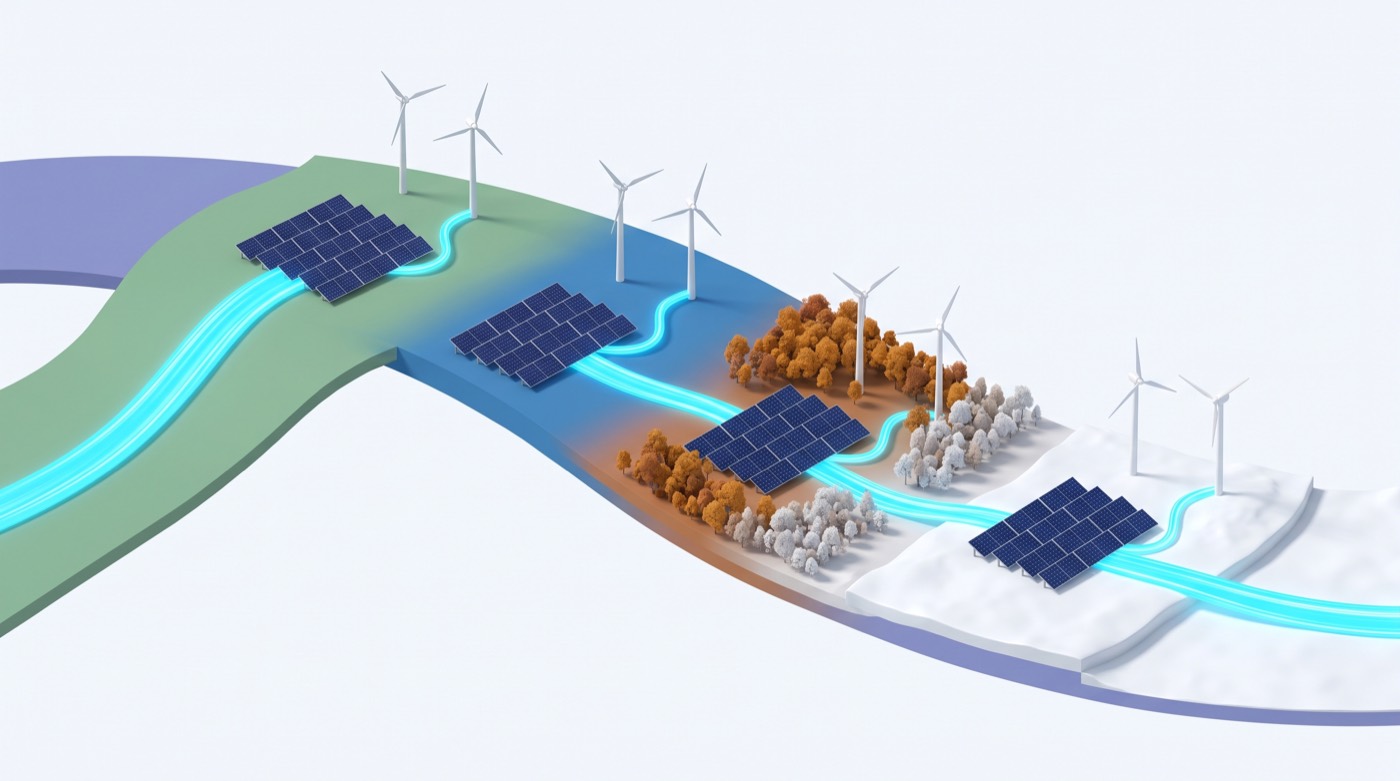 12345
12345- 1 Spring: the array and turbines export, the ribbon flows
- 2 Summer: same equipment, same ribbon
- 3 Autumn: same
- 4 Winter: same, even in snow
- 5 The ribbon never breaks and never changes width. Every kWh earns the same small credit
NYSEG takes the NYISO monthly capacity auction price, adjusts it, and spreads it over the expected annual output of a solar profile. The result is a flat rate on every exported kWh. On the current NYSEG statement that rate is $0.02030 per kWh for Rest of State projects qualified after July 26, 2018.
Source: NYSEG PSC No. 120, Rule 40.B.6.a "Alternative One", https://www.nyseg.com/documents/d/nyseg/psc120_section-40, read 2026-09-15. Rate: NYSEG VDER-CRED statement, Phase 2, "Alternative 1 ... ROS: $0.02030 / kWh ... All Exported kWh", https://www.nyseg.com/documents/40132/5890417/STAT+VDER+120_97.pdf/1a537816-85e3-82f3-ae45-de5d59ea589a?t=1756924068970, read 2026-09-15.
Alternative 2: solar and wind, summer afternoons only
The same capacity dollars, concentrated into about 240 summer weekday afternoon hours. Higher rate per kWh, zero outside the window.
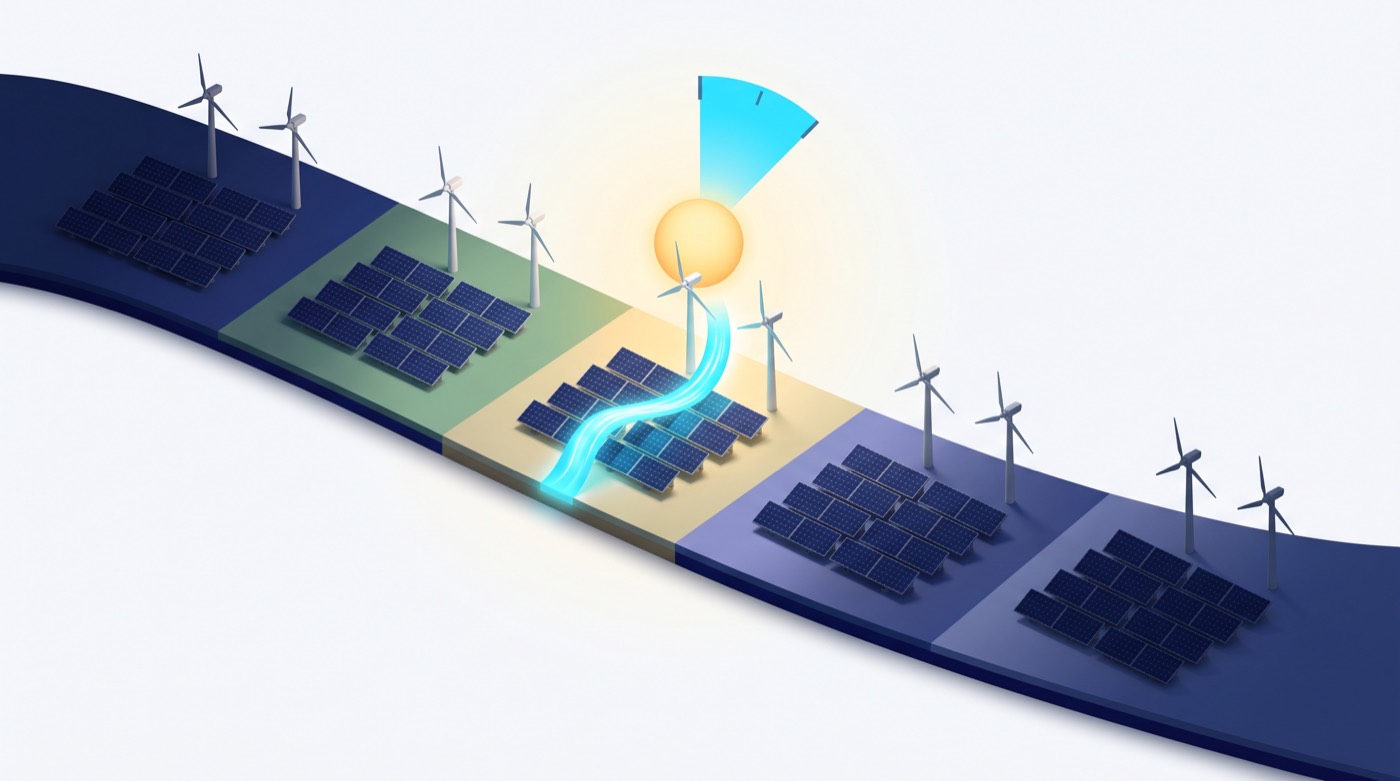 12345
12345- 1 Spring: dark, no credit
- 2 Summer: lit, the ribbon flows and earns
- 3 The clock wedge: 2 pm to 7 pm, weekdays, June 24 to August 31
- 4 Autumn: dark, no credit
- 5 Winter: dark, no credit
For projects qualified on or after July 27, 2018, NYSEG sums the 12 monthly NYISO capacity prices for the prior capacity year, adjusts them, and divides by the number of hours between Hour Beginning 2 pm and Hour Beginning 6 pm on non-holiday weekdays from June 24 to August 31. That is 240 or 245 hours. The rate per kWh applies only to exports in those hours. A solar project can choose Alt 2 because it produces in those hours anyway.
Source: NYSEG PSC No. 120, Rule 40.B.6.b.ii "Alternative Two", https://www.nyseg.com/documents/d/nyseg/psc120_section-40, read 2026-09-15. NYSEG VDER-CRED statement, "Alternative 2 ... Only applicable to June, July, and August generation", https://www.nyseg.com/documents/40132/5890417/STAT+VDER+120_97.pdf/1a537816-85e3-82f3-ae45-de5d59ea589a?t=1756924068970, read 2026-09-15.
Alternative 3: the battery, one hour
The credit is a $/kW monthly rate multiplied by the kW the project exported during the previous calendar year's statewide peak. Paid every month of the following year. Same rule at every New York investor-owned utility; NYSEG wording shown.
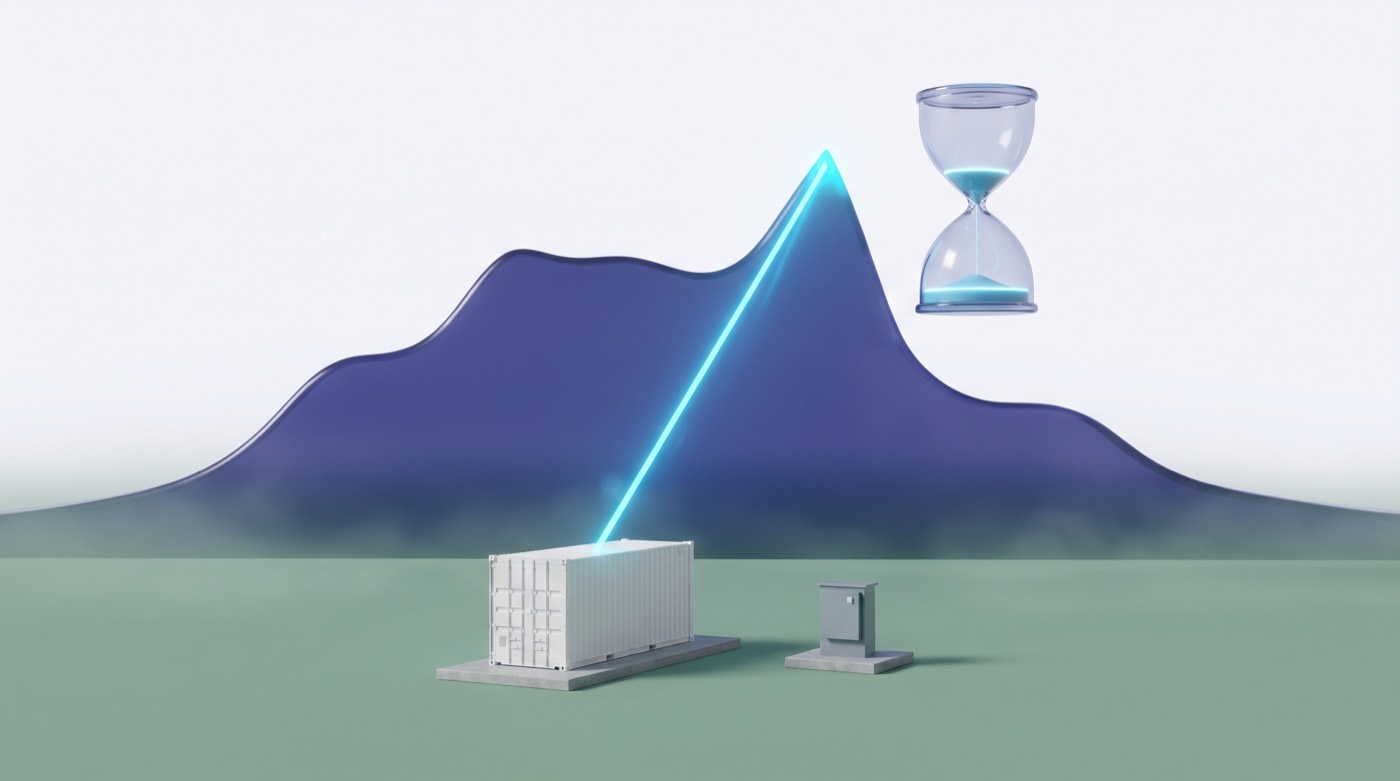 12345
12345- 1 The battery: 5 MW, on the Value Stack
- 2 The pad-mount transformer, its connection to the NYSEG grid
- 3 The one beam that counts: full export striking the exact summit, the statewide peak hour
- 4 One band of sand: one hour sets 12 months of credits
- 5 The rest of the year: unlit, earns nothing under Alt 3
This is the sentence that governs the battery:
"Alternative Three: shall be equivalent to the customer-generator's service classification capacity cost and shall be calculated by multiplying the customer-generator's net energy export during the New York Control Area peak of the previous calendar year by the customer's capacity component based on their Facility's net export generation."
Source: NYSEG PSC No. 120, Rule 40.B.6.c "Alternative Three", Leaf 117.46.26.3.0, Revision 1, effective July 1, 2023, https://www.nyseg.com/documents/d/nyseg/psc120_section-40, read 2026-09-15 (local copy: Sources/NYSEG_PSC120_Section_40_Rule40_ValueStack.pdf, page 9). NYSEG VDER-CRED statement, Phase 2: "Alternative 3 ... ROS: $6.57 / Capacity kw ... Based on kW coincident with NYISO Peak Hour", https://www.nyseg.com/documents/40132/5890417/STAT+VDER+120_97.pdf/1a537816-85e3-82f3-ae45-de5d59ea589a?t=1756924068970, read 2026-09-15. NYSERDA FAQ: "Alternative 3 - paid out according to each kWh injected into the grid during the single peak hour of the year", https://www.nyserda.ny.gov/All-Programs/NY-Sun/Contractors/Value-of-Distributed-Energy-Resources/Frequently-Asked-Questions, read 2026-09-15.
The state's reason for this rule is in the PSC record. The Joint Utilities wrote that the capacity credit "is meant to compensate DER for injections that offset demand at the single hour of the year that determines the amount of capacity that each entity must" procure. That single hour is the same hour that sets every utility's capacity obligation. So a battery that is exporting in that hour truly lowers what NYSEG has to buy.
Source: PSC Case 15-E-0751, Order Regarding Value Stack Compensation (April 18, 2019), Appendix D, Joint Utilities comments, p. 33, https://www.nyserda.ny.gov/-/media/Project/Nyserda/Files/Programs/NY-Sun/Updated-Value-Stack-Order-2019-04-18.pdf, read 2026-09-15.
One hour or one day? Both readings, side by side
Jason's operating view and the tariff wording, next to each other. They lead to the same summer plan.
What the tariff and NYSEG say
The measurement is the kW exported during the statewide peak hour. Not the peak day. NYSEG's own credit statement labels the Alt 3 rate "Based on kW coincident with NYISO Peak Hour." NYSERDA's FAQ says "the single peak hour of the year." A market operator that runs Alt 3 dispatch for New York batteries describes it as "the single hour of the NYCA's actual peak load."
The hour is confirmed only after the fact. NYISO posts it in late August.
Source: NYSEG VDER-CRED statement, link; NYSERDA FAQ, link; SYSO Technologies, June 16, 2026, link. All read 2026-09-15.
Jason's operating view
The state wants generators that show up when demand is highest. A battery proves that by pushing its full power on the day demand peaks. Nobody can predict the exact hour unless they see the whole state at once. So the battery does not try. It pushes full 5 MW across the whole afternoon window on every day that could be the peak day, June through August.
Under the tariff wording, this works for one reason: the peak hour sits inside that window. Cover the window on every candidate day and the one hour that counts is covered too. The plan is the same either way. The difference is only what the meter reader looks at afterward.
Where the peak hour has actually landed
Statewide (NYCA) summer coincident peak, 2022 to 2025, as posted by NYISO. Hour Beginning (HB) 17 means 5 pm to 6 pm.
| Year | Peak date | Peak hour | Load | Source |
|---|---|---|---|---|
| 2022 | Wed, July 20 | HB 17 (5 to 6 pm) | 30,505 MW | NYISO 2022 Peak Dates & Times |
| 2023 | Fri, July 28 | HB 17 (5 to 6 pm) | 28,735 MW | NYISO 2023 Peak Dates & Times V2 |
| 2024 | Mon, July 8 | HB 17 (5 to 6 pm) | 28,990 MW | NYISO 2025 Final ICAP Forecast, Dec 20 2024 |
| 2025 | Tue, June 24 | HB 18 (6 to 7 pm) | 31,857 MW | NYISO Summer 2025 Hot Weather Operations, NYSRC Nov 14 2025 |
Source: All four documents read 2026-09-15. NYISO notes in the 2022 and 2023 documents: "The ICAP market peak hour is constrained to July and August non-holiday weekdays."
Four years, four peaks, all between 5 pm and 7 pm. A battery pushing full power from 3 pm to 7 pm would have covered every one. NYISO reports that behind-the-meter solar "has shifted the measured net peak load hour two hours later (from HB16 to HB18)." The window should not end early.
Source: NYISO Summer 2025 Hot Weather Operating Conditions, NYSRC attachment 7.3.3, Nov 14 2025, https://www.nysrc.org/wp-content/uploads/2025/11/7.3.3-Summer-2025-NYISO-Hot-Weather-Operating-Conditions-EC-Nov-14-Attachment-7.3.3.pdf, read 2026-09-15.
The 2025 peak day, hour by hour
Measured statewide load on June 24, 2025, from NYISO's public real-time load file, summed across all 11 zones and averaged per hour. The cyan block is the battery's 4 hour full-power push.
Battery pushes full 5 MW, 3 pm to 7 pm (4 hours) NYSEG DRV window, 2 pm to 7 pm
Source: NYISO real-time actual load, file 20250624pal.csv inside http://mis.nyiso.com/public/csv/pal/20250601pal_csv.zip, downloaded 2026-09-15; hourly averages computed by Gaiergy. NYISO reported the integrated peak for that day as 31,857 MW at HB 18 (source above). The DRV window is from the NYSEG VDER-CRED statement, "Hour Beginning 2:00 pm through Hour Beginning 6:00 pm non holiday weekdays", link.
Note the shape. Load is still above 31,000 MW at 7 to 8 pm. The 3 pm to 7 pm block catches the peak hour with one hour to spare on each side of the 2022 to 2024 pattern. A 2 hour battery would have to pick 5 pm to 7 pm and would have missed nothing in these four years, but it has no margin.
The summer plan: fire on every hot afternoon
The battery cannot know which afternoon holds the peak hour. So it treats every candidate day the same.
 12345
12345- 1 The same 5 MW battery, every day
- 2 The same full-power beam, every day, 3 pm to 7 pm
- 3 One of those days is the true peak day. It looks like the others from the ground
- 4 Its sun burns brightest: the statewide peak hour is in that afternoon
- 5 The other hot days: the battery still fires, and earns energy and DRV credits while it does
Cyan = 2025 days over 30,000 MW (June 23, 24, 25 and July 29). Gray = weekends. Purple = other weekdays.
Source: Days over 30,000 MW and the note "10 days with NYCA peak demands above 28,000 MW (all in June and July)": NYISO Summer 2025 Hot Weather Operating Conditions, https://www.nysrc.org/wp-content/uploads/2025/11/7.3.3-Summer-2025-NYISO-Hot-Weather-Operating-Conditions-EC-Nov-14-Attachment-7.3.3.pdf, read 2026-09-15.
How to pick the candidate days
- Watch the NYISO day-ahead load forecast each morning. If the forecast peak is within about 1,500 MW of the highest peak seen so far that summer, treat that day as a candidate. ESTIMATE threshold, Gaiergy operating rule.
- Be fully charged by 2 pm on every candidate weekday, June 1 through August 31. Discharge full 5 MW from 3 pm to 7 pm.
- Never be charging between 2 pm and 8 pm on a hot weekday. A charging battery shows negative export in the peak hour. That is a $0 credit for the whole next year.
- Skip nothing in June. The 2025 peak was June 24. The DRV window also opens June 24, so the same discharge earns DRV credits.
- After August, read NYISO's posted peak hour and pull the battery's meter data for that hour. That kW is next year's Alt 3 credit.
What the hour is worth
5 MW battery, Rest of State, at the Alternative 3 rate on the current NYSEG statement. Twelve monthly credits, one per block.
Each block is one monthly credit at $6.57 per kW (NYSEG VDER-CRED statement, Phase 2, Rest of State, read 2026-09-15). ESTIMATE: the rate is refiled by NYSEG and changes.
Full export in the one hour is worth about $394,000 over the following year. Half export is half that. Zero export is zero for the whole year. There is no partial credit for the other 8,759 hours. That is why the summer plan above matters more than any other single operating decision.
Source: NYSEG VDER-CRED statement, Phase 2, "Alternative 3 ... ROS: $6.57 / Capacity kw", https://www.nyseg.com/documents/40132/5890417/STAT+VDER+120_97.pdf/1a537816-85e3-82f3-ae45-de5d59ea589a?t=1756924068970, read 2026-09-15. The statement says the rate "Will be filed on one days notice," so it changes over the year. The $394,200 figure is an ESTIMATE that holds the current rate flat for 12 months.
Will the Alternative 3 rate go up in 2027?
The Alternative 3 rate follows the NYISO monthly capacity auction price for the zone. So the question is whether upstate NYISO capacity prices rise in the 2027-28 capability year, which starts May 1, 2027. Nobody has published a confirmed 2027 number. The signals below are what exists, with who said each.
- +38%Upstate prices already rose in 2025-26. Potomac Economics, the NYISO market monitor, reports capacity prices outside New York City "increased by 38 percent to $51 per kW-year" in the 2025-26 capability year, driven by "Higher Installed Reserve Margin (IRM) and lower imports." Monthly average $4.28 per kW. Source: 2025 State of the Market Report, May 19, 2026, pp. 9 and 92.
- $8Summer 2026 set a Rest of State record. Modo Energy: Rest of State cleared about $8 per kW per month in May 2026, "29%" above its own prior record. Author William Rawlings, June 25, 2026. Vendor research, not a NYISO document.
- $6.53The 2026-27 reference point is below where the market cleared. NYISO's posted demand curve for the statewide zone: summer reference point $6.53 per kW per month, winter $4.13, summer maximum $22.41. Summer 2026 cleared above the reference point, which means the state is short of its target surplus. Source: NYISO Demand Curve Model CY 2026-2027, filing affidavit.
- 30.8%The 2027-28 reserve margin study points up hard. NYISO's preliminary Tan45 result for the 2027-28 IRM is 30.8%, against 25.6% in the 2026-27 final base case, a 5.2 point rise. NYISO attributes 3.2 points to "the inclusion of new intermittent resources" and 1.1 points to "updated thermal generator performance assumptions." The August 24, 2026 final base case parametric result is 30.60%. Source: NYSRC ICS meetings 319 and 321, August 5 and September 2, 2026.
- Dec 2026Nothing is final until two votes happen. The NYSRC Executive Committee sets the IRM in early December. Last year it set 24.5% against a 25.3% study result. NYISO posts the 2027-28 demand curves by November 30, 2026. The Alternative 3 rate for 2027 comes from those two things. ESTIMATE: a higher IRM with a flat supply pushes the statewide price up the curve, the same mechanism the market monitor cited for 2025-26.
- DRVA separate Value Stack raise is on the table, not ICAP. DPS Staff proposed on December 11, 2025 to raise NYSEG's DRV from $29.67 to $85.23 per kW-year and National Grid's from $61.44 to $146.59. Comments closed March 2, 2026. No order found as of 2026-09-15. UNCONFIRMED. If the "whispers" are about VDER going up, this may be what people mean.
Source: Potomac Economics, 2025 State of the Market Report for the NYISO Markets, May 19, 2026, https://www.potomaceconomics.com/wp-content/uploads/2026/05/NYISO-2025-SOM-Report__5-19-2026-final.pdf, read 2026-09-15 (local copy in Sources). Modo Energy, "Capacity prices in New York City hit a record $32.6/kW-month for summer 2026," June 25, 2026, https://modoenergy.com/research/en/nyiso-capacity-prices-record-summer-2026, and "NYISO in May 2026," June 9, 2026, https://modoenergy.com/research/en/nyiso-bess-may-2026-reference-price, read 2026-09-15. NYISO, Demand Curve Model CY 2026-2027 (final for filing affidavit), https://www.nyiso.com/documents/d/guest/demand-curve-model-cy-2026-2027-final-for-filing-affidavit, read 2026-09-15. NYISO for NYSRC ICS, 2027-2028 IRM PBC Tan45 and LCR Results (Revised), August 5, 2026, https://www.nysrc.org/wp-content/uploads/2026/08/2027-2028-IRM-PBC-Tan45-LCR-Results-presentation-Revised.pdf; 2027-2028 IRM FBC Parametric Results as of August 24, 2026, https://www.nysrc.org/wp-content/uploads/2026/08/2027-2028-IRM-FBC-Parametric-Results.pdf, read 2026-09-15. DPS Staff Proposal on Updating DRV and LSRV, Cases 15-E-0751 and 19-E-0283, December 11, 2025, Tables B-1 and B-2, https://documents.dps.ny.gov/public/Common/ViewDoc.aspx?DocRefId=%7B80570F9B-0000-CF28-A6B7-644C6FA478D9%7D, read 2026-09-15.
Two more items shape 2027 but do not carry a number yet. NYISO filed "Winter Reliability Capacity Enhancements" at FERC on February 18, 2026, with seasonal statewide capacity requirements that NYISO "will first utilize" in the 2027-2028 capability year. And Luminary Energy's read of the 2026 Gold Book: "Capacity prices are likely to stay elevated, particularly in Zones J and K, for as long as the system depends on retained units." Zones J and K are New York City and Long Island, not upstate.
Source: NYISO FERC filing letter, Winter Reliability Capacity Enhancements, February 18, 2026, pp. 1 and 2, https://nyisoviewer.etariff.biz/viewerdoclibrary/Filing/Filing5402/Attachments/20260218_NYISOFlngLtr_WRCE.pdf, read 2026-09-15 (local copy in Sources). Luminary Energy, "2026 NYISO Gold Book: tighter margins," May 7, 2026, https://www.luminary.energy/articles/2026-nyiso-gold-book-tighter-margins-as-the-system-leans-on-retained-retirements/, read 2026-09-15.
What this means for the battery. The 2027 Alternative 3 credit is set by the export in the 2026 statewide peak hour, times the monthly rate that NYSEG posts through 2027. The 2026 peak hour has already happened or is about to. The rate is the part still moving. If the reserve margin lands near 30% and upstate supply does not grow, the monthly rate should sit above the 2026 rate. That is a Gaiergy ESTIMATE, not a published forecast.
Open items, marked UNCONFIRMED
- UNCONFIRMED Which hour NYSEG used for 2025. The tariff says "New York Control Area peak of the previous calendar year." NYISO's posted "ICAP market peak hour" is limited to July and August non-holiday weekdays, which would exclude June 24, 2025. If NYSEG follows the NYISO ICAP definition, the 2025 measuring hour would be the July 29, 2025 peak instead. Either way the summer plan covers both.
- UNCONFIRMED The first year for a new battery. A project that was not online during the previous year's peak hour has no export to measure. How NYSEG credits that first year is not stated in the tariff text read for this page.
- UNCONFIRMED Which NYISO price NYSEG multiplies by. The tariff sentence says "the customer's capacity component." The credit statement shows that as $6.57 per kW for Rest of State today. Whether that figure is the monthly NYISO spot auction price with adjustments, or a 12 month average, is not spelled out on the leaf. The dollar figures on this page hold the posted $6.57 flat.
Details and sources
Glossary
- ICAP: Installed Capacity. Payment for being available at the peak, separate from energy.
- VDER: Value of Distributed Energy Resources, New York's "Value Stack" tariff for projects up to 5 MW.
- NYCA: New York Control Area, the whole state grid that NYISO runs.
- NYISO: New York Independent System Operator.
- HB: Hour Beginning. HB 17 is 5 pm to 6 pm.
- DRV: Demand Reduction Value, a separate Value Stack credit for exports in the summer afternoon window.
- Rest of State (ROS): the NYISO capacity zone outside New York City, Long Island and the Lower Hudson Valley.
Source list
- NYSEG PSC No. 120 Electricity, Rule 40 Distributed Energy Resources, Value Stack, Leaves 117.46.26.2.2 and 117.46.26.3.0. https://www.nyseg.com/documents/d/nyseg/psc120_section-40. Read 2026-09-15. Local copies: Sources/NYSEG_PSC120_Section_40_Rule40_ValueStack.pdf (the NYSEG PDF, page 9 holds Alternative Three) and Sources/NYSEG_PSC120_Rule40_ValueStack_firecrawl_2026-09-15.md.
- NYSEG Statement Type VDER-CRED, Value Stack Credits, Phase 1 and Phase 2. https://www.nyseg.com/documents/40132/5890417/STAT+VDER+120_97.pdf/1a537816-85e3-82f3-ae45-de5d59ea589a?t=1756924068970. Read 2026-09-15. Local copy: Sources/NYSEG_PSC120_VDER-CRED_Statement_firecrawl_2026-09-15.md.
- NYSERDA, Value of Distributed Energy Resources, Frequently Asked Questions. https://www.nyserda.ny.gov/All-Programs/NY-Sun/Contractors/Value-of-Distributed-Energy-Resources/Frequently-Asked-Questions. Read 2026-09-15.
- NY PSC Case 15-E-0751, Order Regarding Value Stack Compensation, April 18, 2019. https://www.nyserda.ny.gov/-/media/Project/Nyserda/Files/Programs/NY-Sun/Updated-Value-Stack-Order-2019-04-18.pdf. Read 2026-09-15. Local copy in Sources.
- NYSERDA, Updated Value Stack Order Overview Slides, April 25, 2019. https://www.nyserda.ny.gov/-/media/Project/Nyserda/Files/Programs/NY-Sun/2019-04-25-Updated-VS-Order-Overview-Slides.pdf. Read 2026-09-15. Local copy in Sources.
- NYISO, 2022 Peak Dates & Times and 2023 IRM and ICAP Forecast Schedules. https://www.nyiso.com/documents/20142/32974180/2023_IRM_ICAP_Schedules.pdf/06890138-b486-3303-e8e9-4beb9c48896a. Read 2026-09-15. Local copy in Sources.
- NYISO, 2023 Peak Dates & Times and 2024 IRM and ICAP Forecast Schedules V2. https://www.nyiso.com/documents/20142/39672768/2024_IRM_ICAP_Schedules_V2.pdf/f917e470-abf3-4629-987f-6fa917d3f975. Read 2026-09-15. Local copy in Sources.
- NYISO, 2025 Final ICAP Forecast Presentation, December 20, 2024 (NYSRC copy). https://www.nysrc.org/wp-content/uploads/2025/11/I.3-R2-NYISO-2025-Final-ICAP-Forecast-Presentation-12202024.pdf. Read 2026-09-15. Local copy in Sources.
- NYISO, Summer 2025 Hot Weather Operating Conditions, NYSRC Executive Committee attachment 7.3.3, November 14, 2025. https://www.nysrc.org/wp-content/uploads/2025/11/7.3.3-Summer-2025-NYISO-Hot-Weather-Operating-Conditions-EC-Nov-14-Attachment-7.3.3.pdf. Read 2026-09-15. Local copy in Sources.
- NYISO, Real-Time Actual Load, June 2025 archive. http://mis.nyiso.com/public/csv/pal/20250601pal_csv.zip. Downloaded 2026-09-15. Local copy: Sources/NYISO_RealTime_Actual_Load_20250624pal.csv.
- National Grid (Niagara Mohawk), PSC No. 220 Statement Type VDER-CRED, Statement No. 105, effective April 30, 2026. https://www.nationalgridus.com/media/pdfs/billing-payments/electric-rates/upstate-ny/2026/stat-vder-cred-105-(effective-april-30-2026).pdf. Read 2026-09-15. Local copy in Sources.
- Con Edison, PSC No. 10 Statement Type VDER-CRED, Statement No. 98, effective November 1, 2025. https://www.coned.com/-/media/files/coned/documents/rates/electric/psc-10/other/vder-value-stack-credits/vder-cred-202511.pdf. Read 2026-09-15. Local copy in Sources.
- Potomac Economics, 2025 State of the Market Report for the New York ISO Markets, May 19, 2026. https://www.potomaceconomics.com/wp-content/uploads/2026/05/NYISO-2025-SOM-Report__5-19-2026-final.pdf. Read 2026-09-15. Local copy in Sources.
- NYISO, ICAP Demand Curve Model CY 2026-2027, final for filing affidavit. https://www.nyiso.com/documents/d/guest/demand-curve-model-cy-2026-2027-final-for-filing-affidavit. Read 2026-09-15. Local copy in Sources.
- NYISO for NYSRC ICS, 2027-2028 IRM PBC Tan45 and LCR Results presentation (Revised), August 5, 2026. https://www.nysrc.org/wp-content/uploads/2026/08/2027-2028-IRM-PBC-Tan45-LCR-Results-presentation-Revised.pdf. Read 2026-09-15. Local copy in Sources.
- NYISO for NYSRC ICS, 2027-2028 IRM FBC Parametric Results, as of August 24, 2026. https://www.nysrc.org/wp-content/uploads/2026/08/2027-2028-IRM-FBC-Parametric-Results.pdf. Read 2026-09-15. Local copy in Sources.
- NYISO, FERC filing letter, Winter Reliability Capacity Enhancements, February 18, 2026. https://nyisoviewer.etariff.biz/viewerdoclibrary/Filing/Filing5402/Attachments/20260218_NYISOFlngLtr_WRCE.pdf. Read 2026-09-15. Local copy in Sources.
- NY DPS Staff, Proposal on Updating DRV and LSRV for VDER Compensation, Cases 15-E-0751 and 19-E-0283, December 11, 2025. https://documents.dps.ny.gov/public/Common/ViewDoc.aspx?DocRefId=%7B80570F9B-0000-CF28-A6B7-644C6FA478D9%7D. Read 2026-09-15. Local copy in Sources.
- Modo Energy, two research notes, June 9 and June 25, 2026. https://modoenergy.com/research/en/nyiso-bess-may-2026-reference-price and https://modoenergy.com/research/en/nyiso-capacity-prices-record-summer-2026. Read 2026-09-15. Vendor research; text captures in Sources.
- Luminary Energy, "2026 NYISO Gold Book: tighter margins as the system leans on retained retirements," May 7, 2026. https://www.luminary.energy/articles/2026-nyiso-gold-book-tighter-margins-as-the-system-leans-on-retained-retirements/. Read 2026-09-15. Vendor commentary.
- SYSO Technologies, "VDER ICAP Alt 3 Summer Peak Execution for NY Storage Assets," June 16, 2026. https://www.sysotechnologies.com/2026/06/16/how-syso-has-delivered-full-icap-capacity-value-for-bess-assets-in-new-yorks-vder-program/. Read 2026-09-15. Vendor article, used only for the description of the measured hour.
Artwork: editorial illustrations generated on kie.ai (Seedream 5 Pro and Nano Banana 2) on 2026-09-15 for Gaiergy Corp. They are illustrations, not engineering drawings.